

by Ronda Larson Kramer
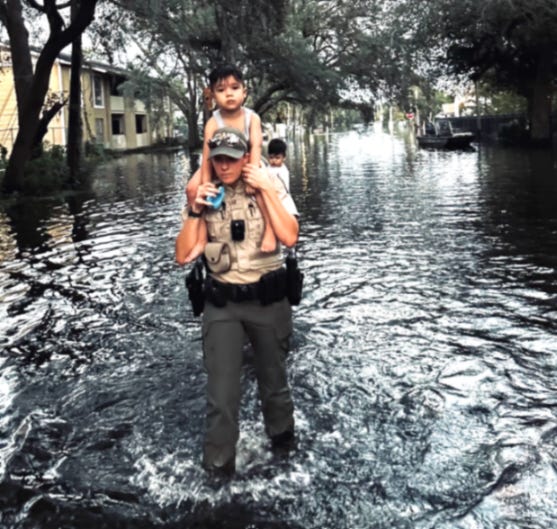
As climate change brings the threat of more destructive flooding to Western Washington, Thurston County continues to allow new homes to be built in places where flooding is already a known danger. By default, the county prohibits such construction. But a review of hearing examiner decisions over the past nine years reveals a striking pattern: exceptions have been granted in virtually every case, putting residents in harm’s way and allowing development that could worsen flooding in the future.
The pattern raises questions about how the county applies a landmark U.S. Supreme Court decision defining the constitutional limits on government regulation of private property.
Thirty-four years ago, South Carolina was confronting a serious problem: erosion was eating away at its beaches, threatening homes and other development along the coast. To protect the shoreline, the state passed a law prohibiting new houses from being built in particularly vulnerable coastal areas. A developer who had purchased two beachfront lots could no longer build houses on them. He sued, claiming that the government had effectively taken his property without compensation. The trial court agreed, concluding that the law had deprived him of “all economically beneficial use” of his land and therefore constituted a “taking” of private property. In Lucas v. South Carolina Coastal Council, the U.S. Supreme Court then ruled that when government regulations have that effect, the government generally must compensate the property owner.
A widespread belief reflected in floodplain regulations throughout the country is that Lucas requires governments to compensate people when regulations prevent them from building a house on their land.
But that is not what the Supreme Court held in Lucas. The Court merely relied on the trial court’s factual finding for purposes of analyzing whether there had been a constitutional taking of private property. In fact, four of the Supreme Court justices were dubious that preventing a house from being built equates to the loss of all economically beneficial use of one’s land. One justice called that finding “curious,” another “highly questionable,” and a third “implausible.” The fourth questioned whether the evidence supported it.
At least one county in the United States has correctly interpreted the case. Carroll County, Maryland, prohibits new houses in floodplains without exception. The county’s floodplain management program is overseen by Patrick Varga, a Certified Floodplain Manager who received a national award in 2023, called the Larry R. Johnston Local Floodplain Manager of the Year Award.
Varga rejects the notion that prohibiting a house necessarily deprives a property owner of all economically beneficial use. “I argue it’s not a taking because you can still do things,” he said. For example, property owners can use floodplain land for parking lots or cell towers, provided they do not raise the existing ground level with fill. “There’s still some use of the property,” he explained.
Closer to home, the Washington Court of Appeals considered a similar question involving a couple who wanted to put a home in a floodway. The Department of Ecology pointed out that the land might instead be used to grow crops, raise livestock, keep horses in a stable, or operate a farmers’ market. The court agreed that prohibiting a house did not equate to a loss of all reasonable beneficial use of the property.
Another Washington court backed up Pacific County when it denied a couple the right to build a house in a protected wetland buffer. The court noted they could park a recreational vehicle on their property, or they could “make some other use of the property.”
The consequences of allowing houses in flood-prone areas are particularly troubling in Thurston County, where flooding is not confined to rivers and streams. Much of the county was shaped by glaciers, which left behind hardpan—a layer of soil that can prevent rainwater from draining into the ground. During prolonged heavy rainfall, groundwater can accumulate above this relatively impermeable layer and rise until it floods the surface. Known as perched groundwater flooding, this phenomenon can threaten homes in high groundwater hazard areas even where there is no nearby river to overflow its banks.
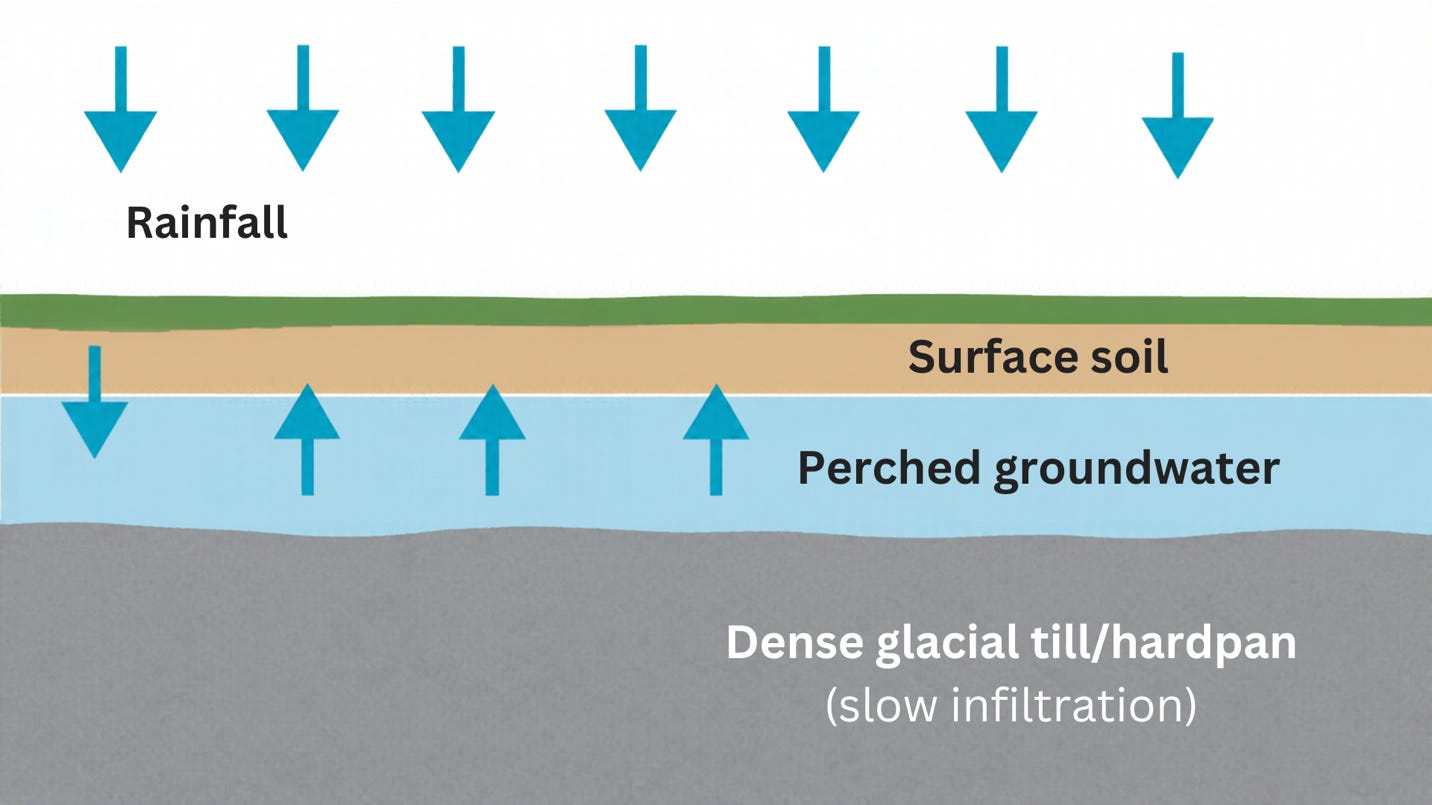
Thurston County’s Critical Areas Ordinance is supposed to protect people and property from flooding by restricting development in frequently flooded areas. See TCC 24.20.135(A). But the ordinance also provides an escape hatch: a property owner can apply for a “reasonable use exception” if complying with environmental regulations would deny them reasonable use of their land.
The distinction between being unable to build a house and being unable to make any reasonable use of property is crucial. Yet in case after case, Thurston County’s hearing examiners have granted exceptions allowing new houses in flood-prone areas.
The question is whether these applicants truly had no other reasonable use for their properties—or whether the county has effectively made residential construction in flood prone areas the rule, rather than the exception.
A 2026 hearing examiner decision illustrates the problem. A property owner (Safeek Ohab) sought permission to build a house on an undeveloped 5.33-acre parcel almost entirely within a frequently flooded area. The property was zoned for rural residential use, which also permitted agriculture and encouraged forestry and other rural land uses. A neighboring property was being used as a turf farm.
Thurston County code requires the hearing examiner to consider alternative uses before granting a reasonable use exception. Yet the examiner’s written decision contains no analysis of whether agriculture or forestry could provide reasonable use of the property. Instead, the examiner concluded that “single-family residential development is the only reasonable use of the property,” citing its size, zoning, surrounding development, and critical-area restrictions. The examiner also reasoned that virtually any use would intrude into the protected area, without explaining why that made residential construction the only reasonable alternative.
Carroll County’s approach stands in contrast. Its floodplain regulations state: “Construction of new residential, industrial, institutional, commercial, or accessory structures within the floodplain is prohibited...A variance cannot be requested for relief from this prohibition.” (See Section 153.007)
Patrick Varga, Carroll County’s floodplain manager, credits the foresight of officials who began restricting floodplain construction decades ago. “We got lucky that someone had the vision to get out in front of this in the 60s,” he said. “We really shouldn’t build in these areas.”