

by Clare Follmann
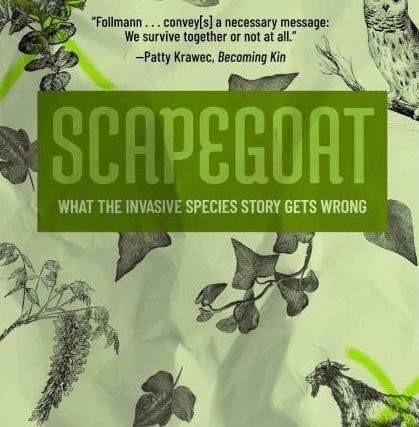
A caste of plants and animals, labeled “invasive species,” are charged with being a key cause of habitat degradation that must be eradicated at any cost — an ethically questionable and often futile approach. While some invasive species cause great environmental damage, recent developments in the study of ecology have found that intervention efforts themselves have frequently proved more harmful than helpful to their local ecosystems. Yet the outdated narrative of “species management” persists in both public belief and conservation policy, distracting from and even justifying a far greater threat to biodiversity: the global capitalist system that is destroying our planet.
(Abridged excerpt, slightly edited)
Although this book isn’t a story, it’s certainly about a story. It is full of many different stories, and it also begins with a story. So, for the sake of tradition (which this book at times will at length disavow), let it begin this way.
Once upon a time, there was a group of fishermen. . .
It was the summer of 1959, and a group of fishermen set sail to Pinta, a small, northern island of the Galápagos. The fishermen planned on using this equatorial island as a home base of sorts while they fished for a few weeks, so they brought plenty of essentials to keep them comfortable and well fed. This included three plump goats, which would serve as a backup food source if the fishermen were unable to catch enough fish to sustain themselves. Whether their fishing expedition was successful or not is unknown, but we can assume that the fishermen’s nets were heavy and full for the duration of their trip because these three lucky goats were spared and left to live out the rest of their days on the beautiful island of Pinta. For the goats, this small island proved to be a paradise — so much so that by the 1970s, they had multiplied to over forty thousand, spreading across the twenty-three-square-mile island. But the native plant life of Pinta suffered thanks to these hungry new inhabitants.
From 1995 to 1997, as the total goat count in the Galápagos topped one hundred thousand, concerned conservationists decided that enough was enough.
To stop the goats and their insatiable hunger, conservationists initiated Project Isabela. Spanning nine years, Project Isabela attempted to restore biodiversity to the Galápagos Islands by “managing” these goats.
“The trickiest part of the whole thing was logistics,” said Dr. Karl Campbell, the field manager who ran Project Isabela’s operations. “We had to bring helicopters, rifles, and munitions to one of the remotest parts of the world.” The conservationists and volunteers of Project Isabela began by hunting the goats from both the sky and the ground. Exterminators wielding rifles leaned out of roaring helicopters or marched across the tropical landscape, shooting down the goats. Despite this methodical massacre, the conservationists still faced a problem.
Project Isabela required the total eradication of the goats, but the goats were getting wise to the pattern of slaughter, and they learned to hide from their executioners.
The masterminds behind Project Isabela came up with a new plan. This involved capturing a selection of the remaining female goats, ominously referred to as the “Judas goats.” These Judas goats would then be sterilized so that they could not reproduce, injected with hormones to produce constant arousal, and accessorized with brightly colored radio-tracking collars. The Judas goats were then let loose on the islands — and surreptitiously pursued. When a Judas goat at last found her kin, the snipers tracking her would swoop down and massacre the herd, leaving only the Judas goat alive. After watching her companions gunned down around her, the frightened Judas goat would flee and look for more goats, and the bloodshed would continue. At long last, every goat was found. “You have to understand,” says Campbell. “We don’t want to put a cute face to an invasive species. We focus on the outcomes, letting people see how good the islands look once the goats are gone.”
Though the goats were killed off, the story does not quite end there. Several years after the completion of Project Isabela, a study emerged that revealed an unexpected consequence of this goat extermination. The native Galápagos hawk, which had fed on carcasses of the invasive goats for decades, experienced a drastic decline in population that coincided perfectly with the timeline of Project Isabela. Luckily, the dwindling Galápagos hawk made a few dietary changes and became more reliant on invasive rats for food. However, in 2012, conservationists initiated Project Pinzón in an effort to eradicate the invasive rats.
Do you see where this story is headed?
The history of invasive species management is littered with stories similarly dripping with irony. Yet the narrative of invasive species is often only told from one side, which describes them as an invading enemy to be eliminated at any cost. Despite being ethically dubious, the popular ways of “managing” invasive species are typically Sisyphean, doomed from the outset. Even if some invasives are killed in management projects, enough are typically able to survive and to reproduce.
Additionally, most common forms of invasive species eradication will also include unforeseen ecological damage. Sometimes, as in the case of the Judas goat and the Galápagos hawk, the invasive species has become so entangled in the intricate web of its new ecosystem that eradication will disrupt that ecosystem.
Particularly in the wake of climate crisis and with the growing flight of climate refugee species, we are facing a strange new world where increasingly undernuanced stories of native habitats, of native species, and of Sisyphean invasive species management nevertheless maintain a firm hold on public belief and conservation policy.
As Greta Thunberg argues, when your tub is overflowing, the first thing to do is turn off the tap. Pursuing invasive species management while largely ignoring the climate crisis and ongoing global capitalism is like bailing out the water before turning off the tap. This isn’t to say we don’t need those sorts of solutions — bailing water out is necessary when you have an overflowing tub. But we also must turn off the tap, or our efforts will be pointless. We need far more diverse solutions, or this story and many other stories will simply end in extinction.
I don’t deny that the goats on the Galápagos Islands caused great ecological damage and that they threatened already endangered species that deserve protection.
Yet, in the story of the Judas goat, I can’t help but feel a deep compassion for those unlucky goats, mercilessly hunted down in their new home. But this is largely the way that scientists in invasive species management have decided to address biodiversity loss. It is just this sort of slaughter that is generally considered necessary for the greater good of the ecosystem. It goes largely unquestioned. But I believe it is important to ask questions especially when something feels wrong but is made to appear unquestionable through language, rhetoric, or tradition. Where do the moral or ethical limitations lie in this philosophy of preservation? What has brought invasive species management to this degree of brutality, and what maintains it? How can we protect biodiversity in a way that feels right?
How can we live with nature better?
Clare Follmann, M.E.S., is an author and environmentalist located in Olympia, Washington. Her writing engages with themes of ecology, language, political theory, and philosophy. She likes to poke holes in dominant or obsolete narratives, and strives to help uplift and listen to the voices and stories that have been too often cast aside — including those from our more-than-human world. Her work focuses on finding and planting the literal and figurative seeds that will help support a post-capitalist society that prioritizes the well-being of people and planet. Scapegoat is her first book.