

by Reed Ingalls
Imagine you, dear reader, are an activist out on the street protesting against the activities of some nefarious corporation, police department, government office or what have you. Or maybe you don’t need to imagine.
So, in this story you and your fellow militants have made all kinds of clever picket signs, banners, maybe even a giant puppet or two, and are now staged outside the headquarters of this organization, trying to convince the people inside the building to stop doing evil, and the other people outside to join you in your righteous crusade. “This is a moral movement,” you say. “Once these wrongdoers see how much harm they are causing they will knock it off!” Well, you keep protesting. Weeks go by, and then months. Years. “Maybe they just need to feel more pressure,” you think. “Maybe we just need more bodies on the line.” But, as is often the case, numbers dwindle, public interest fades, morale deflates. And all the while business continues — impassively, profitably, destructively — as usual.
In our scenario, maybe you, being an intelligent and critical sort of person, have the nagging feeling: “This isn’t working. Why? It would work on me if I were in a position of power. Surely, the people in power are like me, deep down. What gives?” Usually, what gives is you, and, like you, this is where most people give up and go home. But what if, just this once, you didn’t give up? What if you kept asking why?
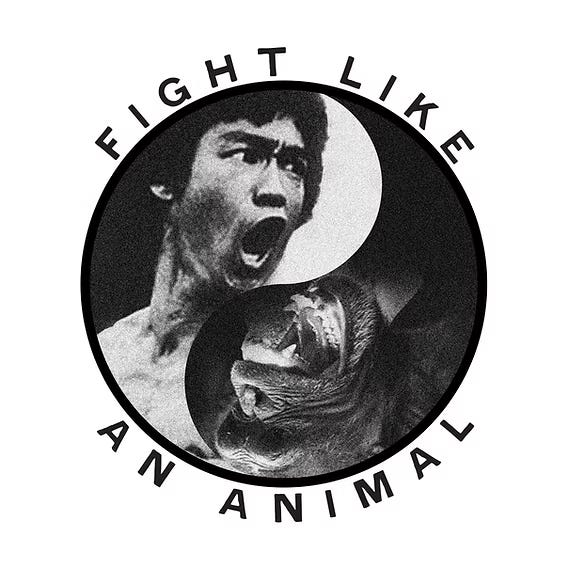
The human drive to avoid cognitive dissonance makes us deny the possibility that maybe everyone doesn’t see the world in the same way as we do; the thought, “Maybe we really are that different, deep down”. If this were true, if people really struggled to understand each other not just because of their ideas, but because of their instincts, what would this do to our politics? In such a world, is there still a place for liberty and equality? This is the hard problem which Arnold Schroder’s recent book, Fight Like an Animal: Revolutionary Biology in Defense of Life (May 2026, Severed Branches Press), takes as its starting point.
A veteran of the radical environmental movement, Schroder has spent most of his life’s energy defending the living world: sitting for weeks up in trees, barricading streets and train tracks, occupying construction sites, filing legal appeals and training countless ordinary people in taking direct action. I first met him in 2014, when he taught my friends and I how to sit on a giant metal tripod, blocking the flow of dozens of notoriously explosive oil trains through the heart of downtown Seattle. For about a decade we (and I expect more than a few Works in Progress readers) were part of a movement in the Pacific Northwest to stop oil and coal exports along the West Coast in the name of fighting climate change. Although we had many small victories, in the wake of the defeat at Standing Rock, Schroder and I both came to the same conclusion: that despite our greatest efforts, we had failed.
The profundity of this failure was underscored to us both by the apocalyptic conditions of the summer of 2017: record breaking heatwaves; a demagogue in the White House; fascist gangs roaming the streets; unprecedented forest fires consuming thousands of acres; smoke blanketing the entire West Coast, confining those who could shelter to the indoors and killing those who couldn’t; the sun a bloody smear, half-visible in the sky at midday. This was the first summer of what we have come to fatalistically call, “fire season”. Global tipping points, we felt, had finally been crossed. There was no going back. As Schroder writes, “it felt like being trapped in heavy-handed screenwriting.” To complete the melodramatic activist arc, Schroder was taken out of the movement — itself in severe decline — by a series of life-threatening illnesses. Rather than giving up completely, Schroder began a podcast (also named, “Fight Like an Animal”). Other radical theorists have their prison diaries; Schroder has his kidney-failure-cancer-COVID podcast.
Now in book form, Fight Like an Animal distills Schroder’s many years of experience, research, writing, and recording into a concise and accessible volume, full of hand-drawn visual aids, real-world examples, and fictional scenarios to help readers digest its core ideas. While the book is worth at least a few readings cover to cover, if I had to describe it to someone in a single sentence it could perhaps be boiled down to the insight that, “we need to understand politics less in terms of the explicit logic of various arguments or worldviews, and begin to pay far more attention to what is happening in people’s bodies when they say what they do.” Understanding ourselves as political animals first allows us, Schroder contends, to step out of denial and fear and into a more bold, curious, and scientific attitude. But in order to do so, we also have to deal with some intellectual skeletons hidden in the closet.
Fight Like an Animal is grounded in a critique of the long-standing “nature/nurture” problem, a false-dichotomy which has impeded science and produced a ghoulish parade of cruel, wrong, and downright disgusting social ideologies. Instead of fighting back, the liberal response has simply been to take biology off the table. But whichever side takes the stand, the dichotomy wins. This is what makes it false. Instead of knowledge, what is produced are self-referential stories about human nature. Such stories often say more about the people telling them than about humans in general. After all, human nature is perhaps best defined by its diversity of behaviors and personalities, not any one person’s narrow idea of what, in their opinion, people should be like. Organisms are not robots controlled by genes, but we are not completely socially-constructed blank slates either. The environment, the society, the individual, and the body are not really separate things at all. What, then, asks Fight Like an Animal, are our bodies really doing when we say the world is like this or like that, and what does this mean for political practice?
Making extensive use of the latest in psychology, anthropology, and animal biology, the book synthesizes ideas for activists and armchair intellectuals alike to experiment with. To take one example, in psychology, one behavioral trait, “openness”, influences our political outlook to the extent that it is a much better predictor of voting behavior than class or race. Openness is itself linked to an even more fundamental biology — a biology defined by a spectrum of fear, friendliness, intelligence, and reactive aggression which appears throughout the animal kingdom. It doesn’t take a biologist to know that authoritarianism is about fear, compensation, and control. But how many people will recognize that the opposite is true as well? Freedom and equality have a biology. They depend on an animal’s innate empathy and openness, from fish, frogs, and chimpanzees to humans. If we want to survive and build a free and sustainable society, it follows that we need others to be open to radical changes even if they are not innately inclined to be. This implies a change in strategy, not just style: organizing needs to help people feel unafraid, together, in our bodies, and in the face of a world which profits by keeping us terrified of everything and everyone. What kinds of movements, what kinds of actions, what kinds of conditions would this take?
While some readers of Fight Like an Animal may be disappointed that it doesn’t have all the answers ready-made and pre-packaged, they are still likely to come away with a more scientifically-informed perspective on social change and some shiny new conceptual tools to experiment with. Some might even come away feeling, like I did, a little bit more hopeful.
It is said that change requires acceptance. And in our case, to change the world we have to accept the painful conclusion that nearly everything that we have tried until now seems to have failed. Any excuse we could come up with — social conditions were against us; the bad guys had more guns and more money; people fell for the same old propaganda again; that one really annoying person derailed all the organizing conversations — is just that, an excuse. This book challenges its readers to stop making excuses and instead do the hard thing: to choose between a “paradigm of action that avoids confronting the unbearable, and one that is born from this very confrontation” To do so we must confront the most frightening foe of them all: our reality, as we find it, not as we want it to be. Only then can we really hope to change it.