

by Carl Eugene Stroud
“The anxiety of not knowing if your landlord will renew your lease, the fear of not making it to the end of the month because of the cost of housing, the violence of homelessness, or the way it’s impossible for young people to get on with building their lives when they lack basic access to housing.” (translated from Spanish to English)
While this will sound familiar to anyone in Washington State, it’s actually describing the current situation in Spain, where a widely covered eviction recently led to protests, occupations, and calls for a general strike by tenant and labor unions alike.
More than two weeks ago, tenants and their supporters across Spain began organizing protests in response to the eviction and hospitalization of María del Carmen Abascal. The 87-year-old woman, known as Maricarmen, was physically forced out of her home of more than 70 years in a violent scene that’s become emblematic of the housing struggle in Spain and the cruelty that’s inflicted on tenants.
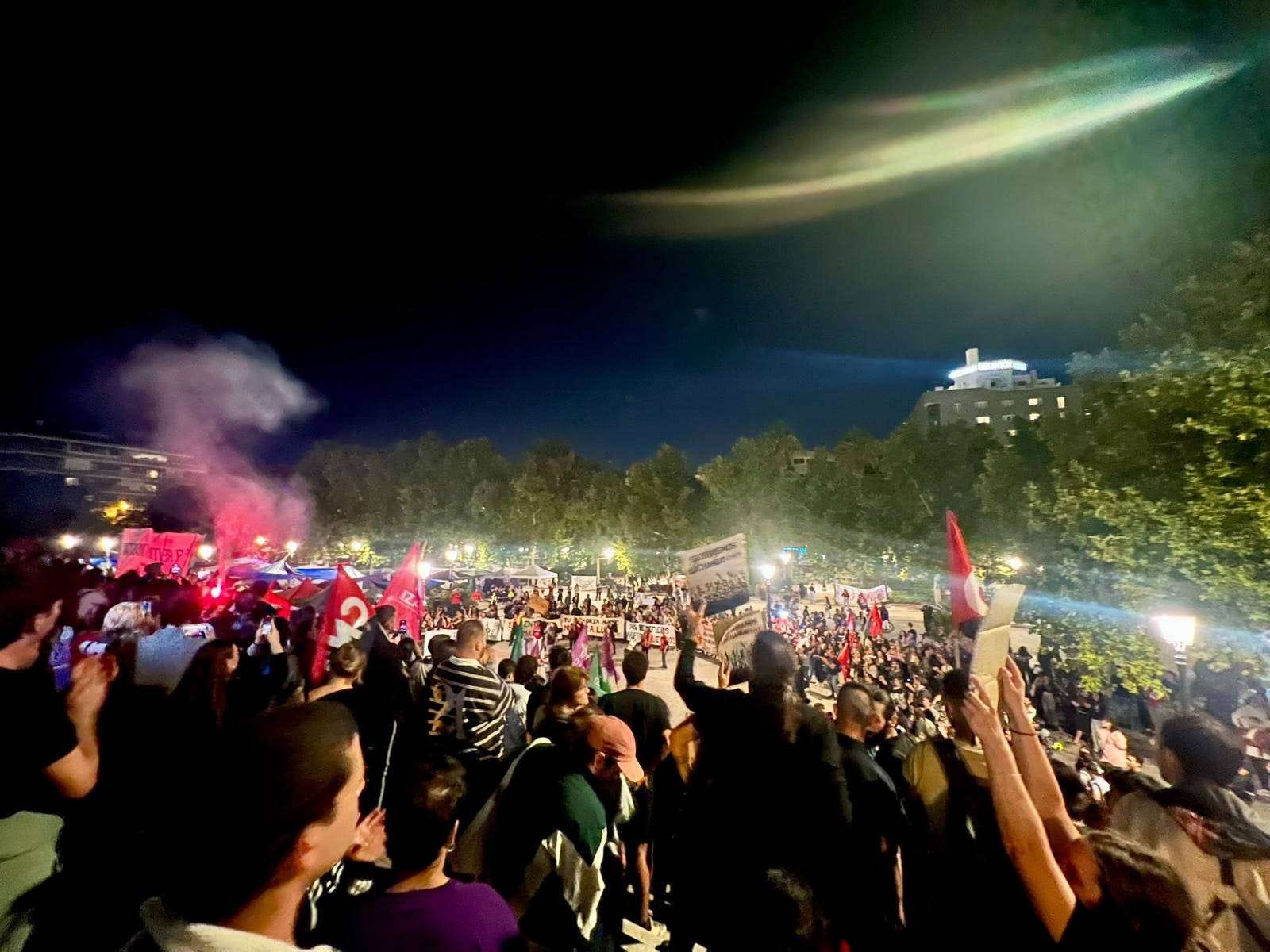
The resulting tenant marches in Madrid, which continued after her eviction, grew from 10,000 to 25,000 in the first few days. Later, the tenants were joined by teachers’ orgs and then by labor unions. The protests, which led to a vote for reforms that failed to pass in parliament, have since turned into occupations in the town squares of multiple Spanish cities. These occupied zones are familiar to Washington activists, and just like here, they produce a variety of different opinions in Spain, both strategic and tactical.
In Madrid, there’s a social democratic current that wants the camps to end before the police intervene and a young communist current that sees this as an opportunity to gain publicity and insert class into the discussion. There’s also an autonomist anarchist current made up of social centers and independent tenant unions without legally recognized status. Their priorities are split between wanting to continue the camp for as long as possible and trying to use the momentum from it to organize a general strike.
Despite the fact that they’re relatively new and represent less than half of the organized tenants, the Sindicato de Inquilinas is the largest tenant union in Madrid. It’s a legally recognized entity that mostly fights evictions in court, and until recently, they had been able to dictate a lot of what happened regarding mobilizations. They knew the eventual outcome of the Maricarmen eviction for months before and had been looking for a way to turn it into some kind of victory. They were the first to set up camp during one of the marches. A few days later, after the reforms had failed, Inquilinas wanted to disband the encampment, leading to escalating confrontations with the coalition of less “official” tenant unions, which have a longer history of organizing tenants and practicing direct action.
“We have intervened in the organization of the camp itself to make sure it works as democratically and transparent as possible […] Our political line is that the camp does not become an end unto itself but that further organization and action can be achieved from it,” a militant from the anarchist political organization Liza told me. The org, which was already integrated into several of the housing and labor unions present in the mobilizations, has since set up their own tent alongside free food, first aid, and meeting places for various assemblies related to organizing the camp. “There’s even an urban planning committee for managing tent placement.”
In the U.S., the right wing’s influence on tenants’ rights is limited mostly to propaganda promoting the rhetoric of squatters and the plight of “small” landlords. This seems similar to the situation in Spain where, after several failed attempts to raid the tenant camp, the right wing has resorted to using footage from the camp as red meat for social media, since they have nothing relevant to add to the tenant debate.
Elderly evictions are also common in Washington. According to a tenant rights attorney that I spoke with, as many as 20% of the eviction cases that they see involve people over 70, usually living on a fixed income. This is related to the fact that most eviction filings in Thurston County are brought by landlords from the nonprofit sector that receive state and federal incentives for offering low-income housing.
“The court cases communicate to everyone that tenants’ rights are enforceable and that landlords can be held accountable for violating them. Long term tenants have the right to not be evicted without just cause,” the attorney told me. However, they also made clear that the law lays out 16 pretty broad reasons why someone can still be evicted in Washington State. Even after the 2025 law that restricted how much a landlord is allowed to raise the rent in a certain period of time, most people are still being evicted for nonpayment because they just don’t have enough money.
Given all these similarities, it’s worth considering the differences. Without an array of organized tenant unions, without the participation of the labor unions and the interest of young people, the struggle around renting in Washington will remain in the courts.
We could learn a lot from Spain, where they have legal protections but don’t rely on them. They’ve built a massive tenant movement capable of going beyond legal defenses and legislation, turning elected officials into spectators who have to try and follow where the movement is going. They’re showing the world how the working class should be preparing for the struggles to come.
The participant from Liza said that all the housing unions are benefiting from this moment to grow their numbers, adding that, in terms of the next steps, “neighborhood committees have been organized for each Madrid district to start working on the general strike.”
We last spoke, for this article, after the tragic news was confirmed that Maricarmen had died in the hospital.
The night of her death people marched to the Congress and the next day to the home where she was never able to return, the crowd screaming “Murderers!”
Her death has hardened people’s resolve to keep fighting, and there’s now a date set for the strike. Organizations like Liza are working to ensure that this isn’t just a high water mark and that the working class coordination developed in preparation for the upcoming general strike on November 11 will survive and continue to build popular power.
Carl Eugene Stroud is a member of the Center for Especifismo Studies