

by Coco N. Spirator
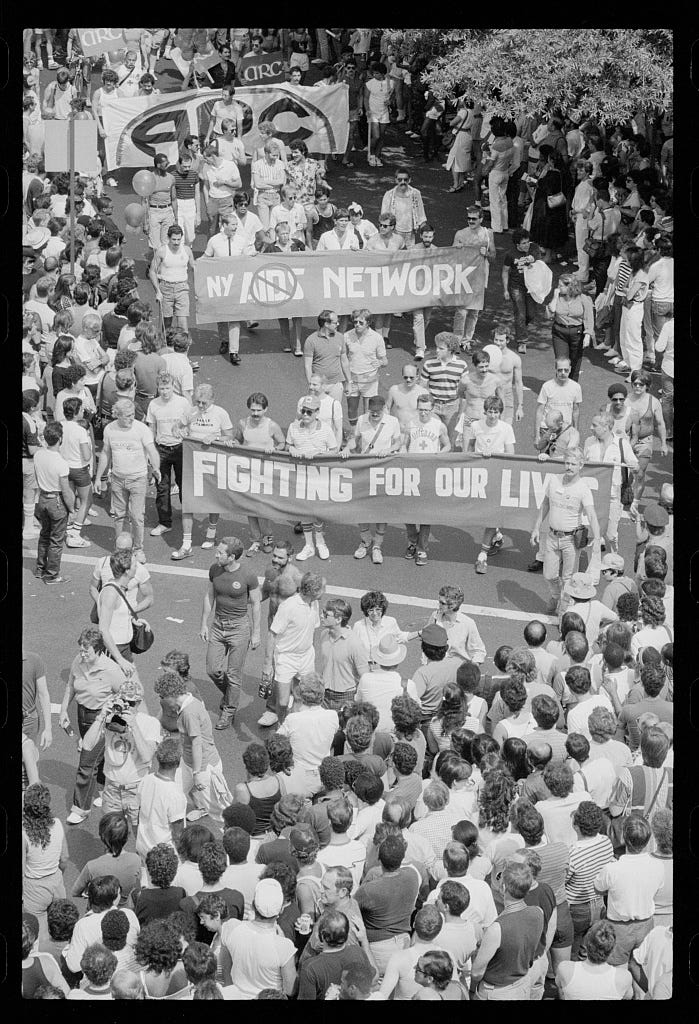
Historically, the fights for queer liberation and for working-class power are seen as completely separate struggles, with completely independent demands. Yet, most queers in the United States are, and always have been, working class. Additionally, queer people also make up some of the most economically marginalized members of the working class. In reality, the history of queer struggle is often about tangible day-to-day concerns: work, living, housing, policing and access to healthcare. In other words, working-class issues. This oversight is particularly dangerous right now, as attacks on trans existence have become a central pillar of the right-wing movement.
What follows is a small collection of scenes from the history of queer struggle that demonstrate how the material realities of class and race informed those struggles. Although these movements rarely utilized many working class slogans, it was these day-to-day realities that brought people together into larger fights for queer liberation, and affected the kinds of movements they built. Unfortunately, these concerns were just as often also the basis of class divisions that would tear those movements apart again and again. There are important lessons to be learned here.
Queer Work in the Early 1900s
At the turn of the 20th century, there was a mass migration of people into urban centers. That migration of people cultivated a social and economic landscape centered around industrial and service work. Queer people tended to congregate around certain jobs: retail sales, marketing, fashion, and performance, such as the popular female-impersonators in vaudeville shows. Historian Allan Bérubé refers to many of these jobs as “Queer Work”: work that was associated, often negatively, with gay and gender nonconforming people. It is usually work that crosses gender expectations, and is often sex-segregated. It is also usually some of the lowest paid work.
An example of work that crossed gender expectations was hospitality work on luxury ocean liners. Typically seen as women’s work, hospitality work on certain cruise ships were staffed entirely by men. According to a former employee, stewards often referred to themselves as Queens, and “when there [weren’t] any passengers around, all the stewards called each other by girls’ names.” The Marine Cooks and Stewards Union, which represented these workers, was initially whites-only. In a matter of just a few years, it would become a proud beacon of mixed-race, queer militant unionism. It would integrate during the historic 1934 Longshore workers’ strike – the result of agitation by Black workers, many of them communists. The new Black union members then immediately pushed for desegregation of the industry through the union. The membership’s new shared sense of solidarity and militancy also brought about more rank-and-file democracy within the union, and a number of gay men were quickly voted into leadership. When attacked by more conservative unions, they proudly proclaimed their solidarity: “It’s anti-union to red-bait, race-bait or queer-bait.”
Queer Living in the Post-War City
Queer neighborhoods, as typically conceived, began in major urban centers after World War II. Many queers, due to race, poverty, or gender non-conformity, increasingly found themselves only able to live in small, neglected corners of the city, usually the vice districts. This was particularly true for those who did not or could not stay closeted. These were neglected areas with some of the lowest rents and least discriminatory landlords. These areas became centers of illegal work that many queers had to partake in to survive. These neighborhoods were rigidly policed, the boundaries were strictly enforced, and police pay-offs were an expectation
There was a neighborhood politics that developed around this. In the queer Central City of San Francisco, gay organizations fought to attract federal grants into the neighborhood, sometimes in alliance and sometimes in competition with neighboring minority neighborhoods. Later, some gay organizations would begin to take on the issue of police violence, through watchdog and know-your-rights campaigns. One of the most interesting organizations to come out of this time was Vanguard, which sought its membership in street youth, including young street queens, and was an active force in what became the Compton’s Cafeteria Riots in 1966. These neighborhood politics of safety can have a dark side as well. By the late 90s,, some gay and lesbian communities would support gentrification and increased policing efforts in historical gay neighborhoods, directly harming the younger, poorer, and less white queers who also lived there.
Gay Liberation & Division
When Leslie Feinberg asked Sylvia Rivera why she fought back in the Stonewall riots, Rivera simply answered, “We were fighting for our lives.” The 1969 Stonewall riots, like the Compton’s Cafeteria riot years before, sprung from the margins: street queens, hustlers, trans men, homeless youth and others. They were among the most deeply criminalized, policed and kept out of the formal labor market. It even spread to the women’s prison in the same neighborhood, where generations of gay women and gender nonconforming people were housed. In contrast to the largely respectability focused Homophile movement that proceeded it, the Gay Liberation Movement which emerged from Stonewall was revolutionary, solidaristic, and anti-assimilationist.
Still, as the movement grew, the class and racial divides within the queer community would soon split it. In 1973, homosexuality was depathologized and abortion was legalized. The particular demands of the poorer, more criminalized parts of the movement would come to be seen as a threat. That same year, trans people were pushed out of the Gay Liberation and the Women’s movement. The most famous incident happened during the Christopher Street Liberation Day Rally, when a number of activists tried keep Rivera from speaking. In response, she famously stole the microphone, ran out on stage, and gave them a piece of her mind.
The Beginnings of Queer Labor
At about the same time, queer organizations were beginning to form direct alliances with labor unions. This would develop over the years into unions taking on queer issues, such as anti-discrimination policies in the workplace, and helping to halt the wave of anti-gay legislation spearheaded by purity warrior Anita Bryant’s moral panic over gay teachers.
One of the most spectacular examples of gay/labor solidarity was The Coors Beer boycott, which ran from 1966 through the late 90s. It was started by Latino organizations in Colorado and then taken up by the Teamsters around 1974. The San Francisco gay community soon joined. Coors Beer was known for firing gay workers, as well as conducting lie detector tests during hiring. The Coors family themselves were arch-conservatives on a campaign to change American politics and it was this political fight that would carry the boycott long after the unions dropped out. Gay organizations would directly flier gay bars to convince owners and patrons to join the boycott. The San Francisco gay community would stay as the backbone of the boycott until the 90s, when the company finally made a number of concessions to gay and other minority causes.
ACT UP and Access to Healthcare
Access to healthcare has been another critical part of queer struggle. In 1987, when the direct action group ACT UP launched, it immediately set its focus on getting access to AIDS treatments. ACT UP’s first actions targeted Wall Street over price gouging on the only available treatment at the time: AZT. The actions worked and the price came down. Later ACT UP targeted the FDA to speed up its drug trial process and to open up trials to more people. They campaigned against the use of placebos in AIDS trials, as well as the sexist and racist scope of current AIDS diagnostic criteria. The group also began needle exchange programs to stop the spread among drug users. In the early 2000s, ACT UP expanded their fight and campaigned for universal healthcare.
Working-Class Queer Struggle Today
The queer movement of the last two decades relied primarily on a strategy of visibility and social acceptance, putting the material realities of the majority working-class queer people to the side. This has left trans people completely unguarded when the right-wing began attacking the trans population at those most basic levels of survival (i.e., access to restrooms, healthcare, and government documents).
But, there seems to be rumblings of a renewed, working-class queer movement. Trans participation in the labor movement has exploded in recent years. Two stand-out examples includet he Starbucks Workers United campaign, and Real You Electrolysis Workers United. There have been continued protests over hospitals ending gender-affirming care for youth. Queer support organizations in Seattle are currently pushing the city to declare a state of emergency, in order to unlock funds and support the wave of trans people migrating to the city from hostile states, to say nothing of the countless, mutual aid efforts already helping new arrivals.
New working-class queer fights are encouraging. But if there is anything to take from the longer history of queer struggle, it is that any movement that wants to last and make real, liberatory gains will have to take seriously the material needs of those it is fighting for, not just visibility. That means standing in solidarity with and fighting for the demands of the least privileged parts of that movement. Without that deep solidarity, the movement risks becoming a way to build new oppressions.