

by Morgan Atwater
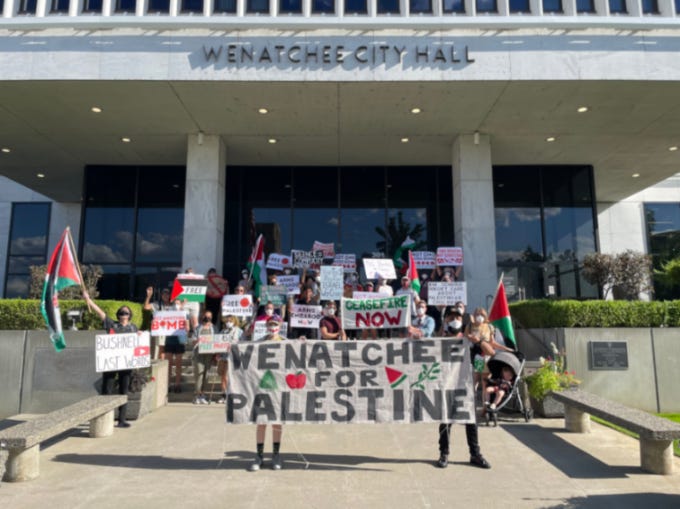
While we were tabling at a No Kings protest, a Palestinian man from out of town stopped by and said to us, “I can’t believe a group like this exists in Wenatchee. You expect to see this kind of thing in Seattle, not out here.”
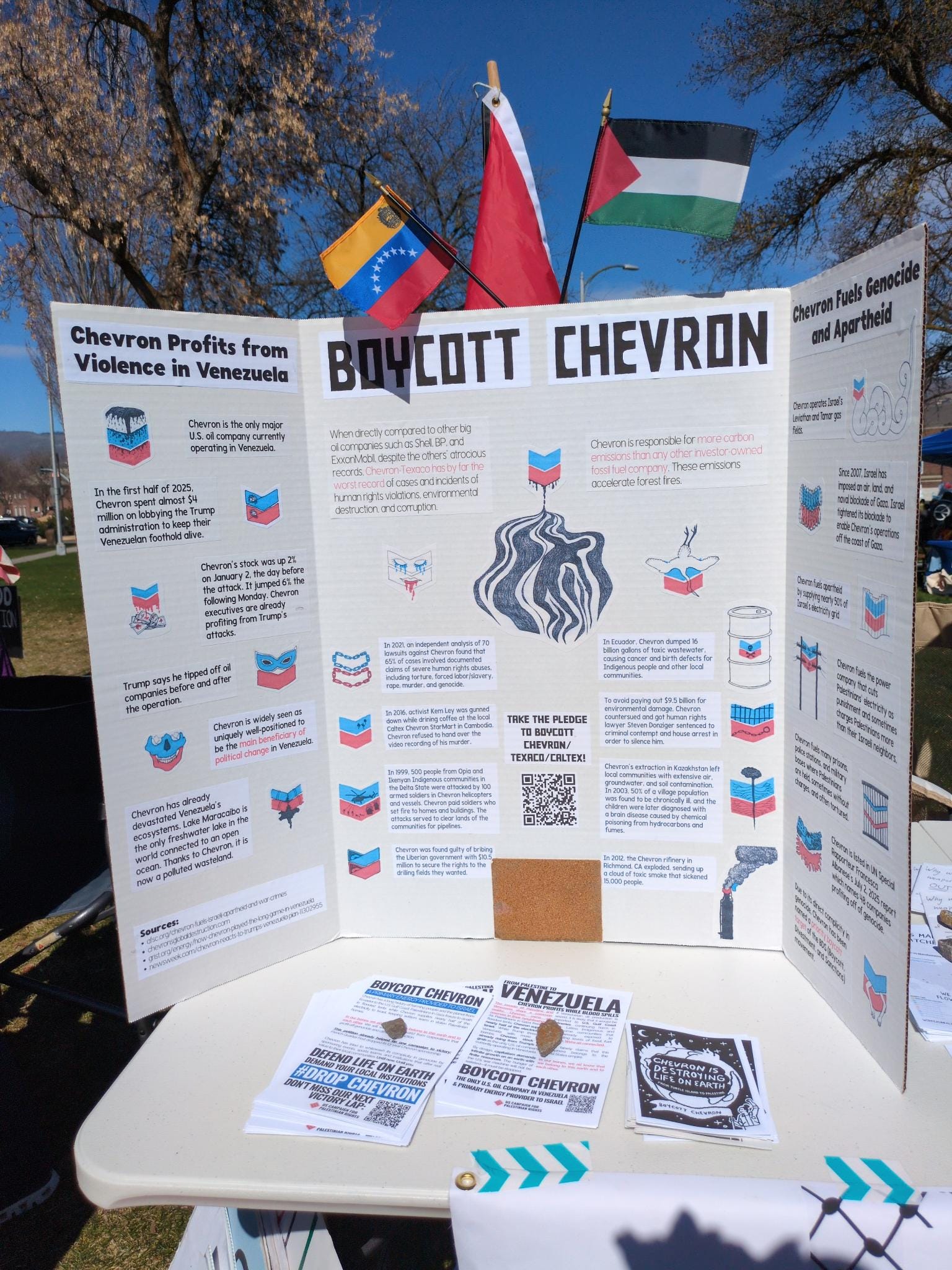
We were handing out zines and flyers promoting our Apartheid Free Wenatchee campaign and collecting email addresses for the Wenatchee for Palestine mailing list. Beside us, a Boycott Chevron trifold poster teetered in the breeze.
If you put a pin in the center of Washington state, you’ll probably land on Wenatchee.
As you cross over the mountains from the west side, the rain dries up, the lush forest becomes sagebrush, and the liberal political climate turns conservative and deeply bigoted.
“Wenatchee is a hotbed for Christian nationalism. Josh McPherson, an ultra conservative pastor who prayed for Trump inside the Oval Office during an official White House visit, leads the local Grace City Church. Grace City Church has successfully installed local Republican elected officials who are friendly to them, has a very close relationship with local police, and recently pulled off a coup to replace the City of Wenatchee’s Pride banners in June with Turning Point USA banners.
Wenatchee also has some of the cheapest electricity rates in the country thanks to our hydroelectric dams, and we are what people in the data center fight refer to as a “frontline community.” Cryptocurrency and AI companies have their greedy eyes all over the region, so we’re having to fight off Microsoft and Sabey Corporation, who are attempting to steal our hydropower to power data centers. This is in addition to the problems that every other city is facing: ICE abductions terrorizing community members, housing and food insecurity, worsening wildfires, and summers that are just getting hotter and hotter.
Somehow, in the midst of all of this, Wenatchee for Palestine was born.
Wenatchee for Palestine’s roots are actually somewhere in Olympia. Or rather, The Evergreen State College was where I first learned to talk about Palestine in terms of occupation and liberation. Years ago, I took a class on representations of martyrdom, not knowing that the course of my own life would be radically altered by the ongoing genocide that would follow in the wake of October 7, 2023.
When Wenatchee for Palestine started, it was December 2023, and we were just three people holding signs on the side of the street. For those initial months, we often stood out there in the snow.
At the time, my hard lines for participating in protests were the following: I won’t give any speeches, I won’t lead a march, and I won’t lead chants. I would go on to do two of those three things within the next year. I still haven’t led a chant though.
Wenatchee for Palestine’s membership steadily grew over the course of 2024. As national and international organizing around the genocide shifted, so too did our tactics. Our protests grew more focused. Rather than protesting the genocide in general, we zeroed in on priority boycott targets of the Boycott, Divestment, and Sanctions (BDS) movement, like Chevron, which supplies nearly 50% of Israel’s electricity grid.
In early 2025, Wenatchee for Palestine decided that it would be beneficial to join the brand new local coalition that was just starting to coalesce around anti-Trump sentiment. Our primary motivation at the time was to counteract the erasure of Palestine taking place within the Democratic Party and Democratic-Party-adjacent national groups like Indivisible. We wanted to make “progressive except Palestine” untenable in the Wenatchee Valley.
We thought that if we could just get Wenatchee for Palestine into the coalition, then they would print our name on all of the No Kings rally flyers alongside groups like the NCW Democrats and Confluence Indivisible. This would make it clear that progressives on a grassroots level support Palestine and that the national organizations were ignoring the genocide at their own peril.
We strong-armed our way into that coalition with a lot of persistence.
At the same time, we expanded our BDS work. We joined the nascent West Coast Boycott Chevron coalition and participated in their first action, a coordinated highway banner drop, on August 29, 2025, as well as several more coordinated actions on November 22, 2025 and March 22, 2026.
In May 2025, we found out that the Chelan County Public Utility District planned to authorize a contract with Microsoft that would grant the software giant access to our hydropower for their data centers. We collaborated with Weapons Out of Wenatchee on a letter-writing campaign to block the contract. If nothing else, we figured our efforts would at least put additional pressure on Microsoft during a pivotal time for the worker-led No Azure for Apartheid movement.
We criticized Microsoft’s complicity in genocide at both the PUD public comments meeting and at the No Kings protest in June 2025. Days later, the PUD board of commissioners voted unanimously to authorize a large load service agreement and contract with Microsoft. It would be nice if we could win all our campaigns with just a few well-worded statements at a public comments meeting, but it’s never that easy.
But sure enough, that September, Microsoft caved under pressure and stopped the sale of a subset of its cloud and AI services to Unit 8200, the spy agency of the Israeli military. Even though we lost our local battle, we played a small part in a broader BDS victory by demonstrating to Microsoft that their support for genocide will not go unchallenged. We did have better luck with another local campaign, though.
On May 18, 2025, we helped arrange a film screening of the Oscar-winning documentary No Other Land at the First United Methodist Church. After the screening, we spoke to members of the church and informed them about the Apartheid-Free Pledge, which invites communities of faith, congregations, and other organizations to take a stand against apartheid. The members of the church were moved by the film and receptive to the pledge. They wanted to act in solidarity with Palestinians.
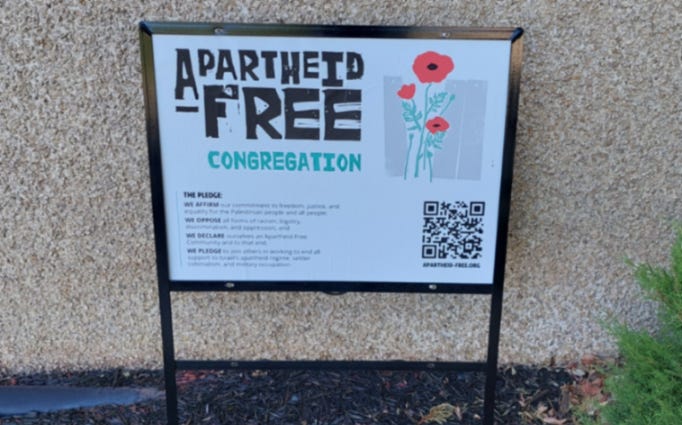
And on October 12, 2025, after months of dedicated work from church members, the First United Methodist Church voted to take the Apartheid-Free Pledge. In doing so, it became the first Apartheid-Free Community in Wenatchee, and the first in Central Washington as a whole. Then, less than two months later, on December 2, 2025, the Sunnyslope Church voted in favor of taking the Apartheid-Free Pledge, making them the second Apartheid-Free Community in Wenatchee.
Both churches would go on to do significant work on their own in solidarity with the people of Palestine. That December, the First United Methodist Church hosted a Boycott Chevron caroling event which was the first BDS action in Wenatchee arranged by an organization besides Wenatchee for Palestine. Then in March, the church hosted a book club for Faith in the Face of Empire: The Bible Through Palestinian Eyes by Palestinian Christian theologian Mitri Raheb.
The Sunnyslope Church has a big sign out front promoting the Apartheid-Free Pledge. Individual members of the church are working diligently to spread the word and encourage other organizations and congregations to take the pledge.
Slowly but surely, we’re growing our Apartheid Free Wenatchee map.
Organizing in a rural area has its challenges, but it has some advantages, too. There is less institutional power, but less institutional obstruction as well. Some advice I was once told is: “Organize where you’re at.” We are most powerful in the communities we are already embedded in, where we have preexisting connections and are participants in a society that can’t function without us.
All over the country, there is important work happening in rural areas that never makes it into the news but is nonetheless helping shift narratives and broaden the window of what is possible. What people should take away from this is that you can just do things. You can just start a group called “[Your City] for Palestine.” What that group looks like will depend on your specific location and what opportunities are available to you.
Here in Wenatchee, the local struggle against data centers has been reenergized by support from Washington AI Resistance, a statewide organization, and a brand new local data center opposition group called No Data Centers NCW. Unlike with other BDS targets, we have actual leverage over Microsoft because we have something they want: our land, our water, and our hydropower. And we are bound and determined to keep those resources out of Microsoft’s hands as long as their technology is used to surveil and kill Palestinians.