

By Jacqueline Garrison
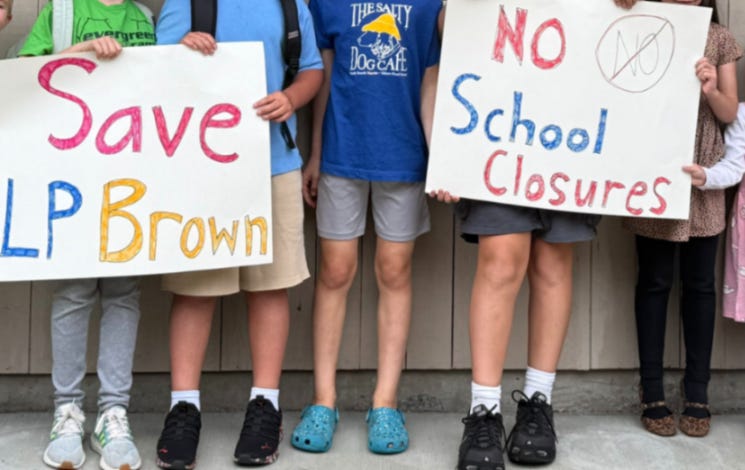
On September 17th, the Olympia School Board was presented with a plan slating Madison, McKenny, and LP Brown Elementary Schools for closure. The written analysis justifying these closures coincides with a 90-day period for public hearings before a final vote on November 12th. If the board votes in favor of closing and consolidation, this school year will be the final operating year for these schools.
While this news may shock some, closures were never truly off the table after being introduced in 2023. Our district reached a crossroads where a clear path forward was never chosen. Now, we must finally decide: do we accept the promised efficiency of a larger school model, or do we fight for the values represented by our small neighborhood schools? This tension between community values and corporate-style consolidation isn’t unique to Olympia — it reflects the broader crisis facing public education and the growing trend toward divestment and privatization.
How Did We End Up Here Again?
In 2020, the COVID-19 pandemic reshaped public education. Districts scrambled to resolve remote learning challenges and navigate public health emergencies, all while families lost loved ones. Many students left the district and never returned. When in-person instruction resumed, seats remained empty, academic benchmarks were scattered, and financial planners for the district joined everyone in a frantic game of catch-up. No one foresaw this, and it drastically altered future enrollment and budget projections.
Back in 2016 when enrollment was trending upwards, Olympia voters passed a bond (a long-term loan that authorizes the district to do capital projects) presented as a way to lower class sizes in compliance with new state guidelines. Anticipating population growth, the bond funded infrastructure improvements, necessary repairs, and five mini-buildings at schools with the highest projected capacity needs. New construction delivered the improvements to facilities without the projected students to fill them.
Architects of the 2016 bond — and the voters who approved it — assumed expansion costs would be easily sustained by increased state funding as enrollment grew. Instead, over the next 10 years, enrollment gradually fell to roughly 1,000 students short of the 2016 projections, prompting administrators to panic over an impending budget “shortfall.” Superintendent Patrick Murphy convinced the board that closing small, under-enrolled elementary schools was the best way to cut costs. At a late-night meeting in December 2023, the board voted to initiate the timeline to close Madison and McKenny Elementary schools.
The public mobilized rapidly, leading to emotionally charged hearings. Ultimately, the closure process was halted not by public outcry, but by a Thurston County Superior Court judge. The district had failed to provide all legally required written analyses prior to the 90-day public comment window. Grassroots organizing hadn’t saved the schools, administrative incompetence simply pushed closures to the back burner.
Since that March 2024 court ruling, Superintendent Murphy has sought his pound of flesh elsewhere. A Reduction in Force (RIF) eliminated elementary art instruction, family liaisons, and other vital support positions. Yet these cuts still fell short of the district’s financial targets. Now, schools and the jobs attached to them are back on the chopping block.
The district’s current financial standing has been grossly miscommunicated. Many assume incorrectly that OSD is in debt. In reality, the district’s Ending Fund Balance (EFB) — the money remaining after all annual operating expenses are paid — is projected to be roughly $8.4 million. That is over $8 million sitting in reserves designed to serve as an emergency buffer. The Office of the Superintended of Public Instruction (OSPI) recommends an EFB be anywhere between 4% and 7% of a district’s annual operating budget, depending on multiple factors.
Olympia School District (OSD) currently maintains an EFB ratio of roughly 4.4%. To boost the district’s OSPI financial health score, Superintendent Murphy aims to push the EFB to 7.14% or higher by the 2028–2029 school year. This detail is critical: achieving a 7.14% EFB without new enrollment revenue requires cutting over $3 million in annual expenditures. The Superintendent insists closing schools is the best path forward. Many in the community strongly disagree. In order to understand this conflict more clearly, let’s examine some of the broader context.
What are some of the Structural Causes for OSD's Budget Problems?
Declining birth rates, dwindling federal funds, complex tax structures, inflation, private school competition, administrative bloat, teacher salaries — blame has been cast in virtually every direction. It is easy, and perhaps accurate, to attribute our financial strain to a combination of these factors. But responsibility is not shared equally among all actors, and it’s worth investigating where things don’t add up.
Consider the federal and state backdrop. In 2007, education advocates filed a lawsuit arguing Washington State was violating its own constitution, which mandates:
“It is the paramount duty of the state to make ample provision for the education of all children residing within its borders, without distinction or preference on account of race, color, caste, or sex.”
The lawsuit demonstrated that relying on local property tax levies disproportionately benefited wealthy districts at the expense of poor ones, depriving students of an equitable, fully state-funded education.
While McCleary v. State of Washington moved through the courts, the Washington Legislature passed ESHB 2216 in 2009, redefining “basic education” to include full-day kindergarten and a 17:1 student-to-staff ratio in grades K–3. This policy change directly motivated OSD’s 2016 bond proposal.
While advocates celebrated these structural wins, state implementation faltered. A critical funding gap emerged as local levy capacity dried up faster than state dollars arrived, and some districts realized just how much they were benefiting from the levy structure. Districts like OSD continued passing local levies, but districts that lost levy funding before state allocations materialized to the same degree rapidly fell into deficits.
Faced with state-level mandates, local administrators must decide where to cut. At the top of the chain sits the Superintendent, who drafts the operational vision, and the School Board, which approves or rejects it. The Board consists of elected officials meant to advocate for the communities within their district.
At the base level there’s us, the constituency. Public comment is given at every Board Meeting that allows it, with many asking for budget considerations that align with the district’s own stated goals of “equity.” For frequent commenters, the process feels like an unwelcome formality. Any ideas or information presented are entertained primarily under legal obligation over a genuine interest from all board members in what the public has to say (OSD Board Meeting Schedules).
Our public school advocacy group, OSD4ALL, has researched and presented that as enrollment has declined, spending on administrative salaries and added positions have trended the opposite direction. When elementary art specialists were cut, the district added a new position in central administration to guide art programming for teachers to incorporate in their classrooms. This is just one example of many where funding is funneled away from student-facing positions and into administrative roles that rarely, if ever, set foot inside a classroom.
One alternative approach to revive the district’s financial health comes from the corporate world the administration often emulates: a comprehensive job audit. Evaluating job descriptions, actual daily tasks, and compensation across positions is a core tool of organizational efficiency. If budget cuts are necessary, why haven’t we audited high-salaried administrative positions first? Demanding an audit at the district level is a logical first step, yet leadership has neither conducted nor proposed one.
Beyond structural funding issues lies a frequently cited budget strain: declining birth rates and shifting family choices. Across the country, birth counts are falling, and parents of those fewer children are increasingly opting for private schools, charter programs, or homeschooling. In Olympia, the trend follows. Kindergarten enrollment in OSD is dropping at 2.5 times the rate of local birth count decline.
Getting Smart, an outside consultant firm hired by OSD, estimates that there are currently about 1,000 children within OSD boundaries who would be in k-8 but are not enrolled in public school. Where are these students going, and why aren’t they choosing OSD? The district lacks the survey data and targeted research to explain why families are opting out. If you were a School Board member, wouldn’t that be the very first question you’d want answered?
Who does a Closed School Serve?
A study recently released by Stanford University analyzed California school closures between 2011-2019 to evaluate whether closing under-enrolled campuses actually balances district budgets. The findings were clear: districts do not save money by closing schools. Minimal operational savings were consistently offset by revenue lost from families leaving the district, ongoing maintenance costs for vacant facilities, and a failure to reduce high-salaried administrative staff.
Despite being repeatedly presented to the OSD Board and Superintendent, this research has been largely dismissed under the logic that “we are not California.”
So consider the Bellevue School District, nestled in an affluent suburb of Seattle. Following the McCleary Decision, Bellevue faced a $20 million budget shortfall when caps were placed on its generous local levies.
In 2023, after heated debate, Bellevue closed and consolidated elementary schools. By 2025, those closures had failed to bridge the budget gap. Bellevue voluntarily entered binding conditions, allowing them to sell a vacant $30 million property to fund operations under newly created state emergency guidelines (SB 5412). Beyond that one-time real estate windfall, their recovery plan focused on trimming administrative overhead and restructuring transportation.
The Bellevue example reinforces what the Stanford study proved: closing neighborhood schools does not solve structural budget problems. Financial challenges are framed as emergencies that only consolidation can solve. Future bonds and levies are then funneled into building larger, centralized campuses, resulting not just in financial stagnation but the social erosion of established neighborhoods.
In Olympia, staff cuts have already occurred, and further reductions are being used as a threat if closures are rejected. One could assume that closing campuses would protect remaining jobs, but the opposite is true. As the Superintendent has explicitly noted in meetings, the primary savings from closures come from eliminating “redundant” positions: newer teachers, office staff, custodians, bus drivers, and food service workers. The district is effectively trying to cut the backbone of schools by eliminating some of the most essential yet lowest-paid jobs in the district. High paying admin positions, on the other hand, face less severe cuts.
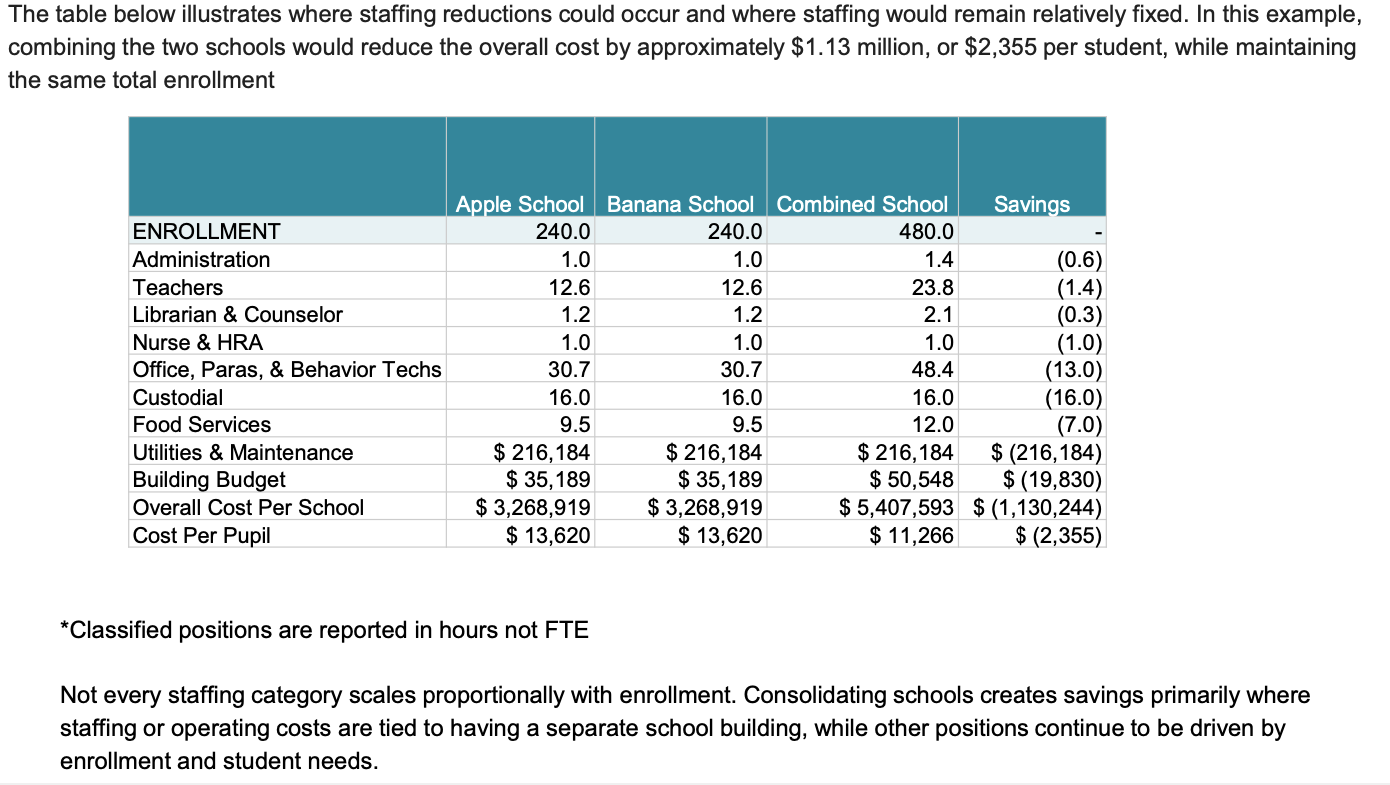
Even in the unlikely event that student enrollment remains steady after closures, fewer drivers will haul children farther distances, fewer food service workers will prepare meals, fewer custodial staff will manage facilities, and more students will be packed into limited classrooms and shared spaces.
No promises have been made by the Superintendent to reduce class sizes, bring back staff or programs that have been cut, or to even provide more resources to schools that receive the students from closed schools.
Perhaps they know these promises would mean a complete financial negation of the meager savings a closure would provide.
On a human level, what’s lost goes beyond buildings, payroll, or line items. We lose the heart of our neighborhood, communities uprooted for what amounts to administrative preference.
Can we honestly argue this serves the public good?
Relying on school closures as a frontline solution reveals a profound lack of imagination, a reliance on weak conventions, and an extreme deficit in leadership. We should expect the same from our leaders that we demand from our children: to stay grounded in our values and to use creative problem-solving to fight for what matters.
Nationwide, we are facing the dismantling of the Department of Education and the erosion of funds for underserved populations. As federal resources shrink, state budgets struggle to fill the void. The expansion of school vouchers and unmonitored charter options worsens a split system where rich families retain advantages while poor and oppressed students bear the brunt of systemic divestment.
When you ask anything of the School Board, administrators, or legislators, they point to the finances. They explicitly tell us that current decisions are driven by capital rather than community needs or educational outcomes. The U.S. spends more per student than nearly any other country, yet academic outcomes remain average or worse. If students are not benefiting from these investments, who is?
Subscribe to Works in Progress to get part-two delivered straight to your inbox when it comes out on October 16.
Jacqueline Garrison is a full-time parent, part-time volunteer, and a dedicated advocate for public education and transit.