

by Ronda Larson Kramer
A first-of-its-kind lawsuit by growth management watchdog Futurewise against Thurston County is set to become one of the initial tests of Washington’s pioneering climate planning law.
The 2023 law builds on decades of planning research showing that development patterns influence how far people drive and how much money local governments spend extending water, sewer, and other infrastructure. The climate planning law requires many local governments to reduce greenhouse gas emissions and vehicle miles traveled through land-use planning.
Under Washington’s pre-existing Growth Management Act, most future urban growth must occur within designated Urban Growth Areas, or UGAs. UGAs include existing cities as well as adjacent unincorporated land intended to accommodate future urban growth. One of the main aims of a UGA, according to the Thurston GeoData Center, “is to provide a limit for the extension of urban utilities, especially sewer service.”
Where urban utilities are extended strongly influences where growth occurs. Research has found that extending water infrastructure leads to residential growth. Where growth occurs, in turn, influences vehicle miles traveled. That connection is one of the main causes for the climate planning law’s emphasis on reducing transportation related greenhouse gas emissions and vehicle miles traveled.
When the Thurston County Board of County Commissioners declared a Climate Emergency in 2021, the Board acknowledged that mitigating climate change would require immediate action and a long-term commitment. Five years later, Futurewise’s appeal alleges that the County has failed to adopt measurable actions to reduce greenhouse gas emissions and vehicle miles traveled.
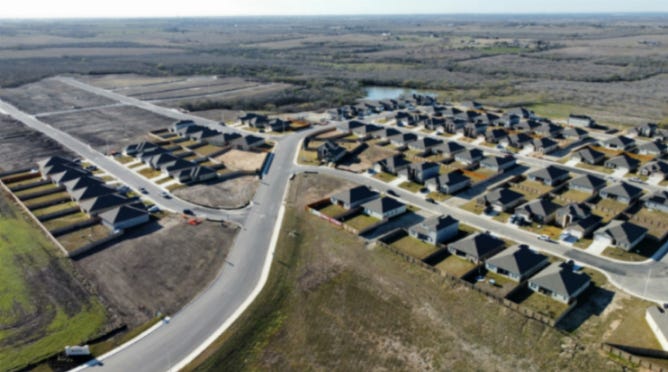
The appeal comes as county officials continue debating how unincorporated land within UGAs should develop. At the Thurston County Planning Commission’s June 17 meeting, the discussion turned to leapfrog development, a pattern of growth in which developers bypass vacant land closer to existing urban areas in favor of less expensive land farther away.. Economist Carol Heim describes leapfrogging as “one form of urban sprawl” driven in part by developers seeking lower land costs in outlying areas.
Thurston County Community Planning Manager Derek Day stated that leapfrog development can sometimes be used strategically to extend sewer and other urban services to “places that are unserved” in the more rural areas of UGAs. “That can be a strategy,” he said. “In an area where you don’t have the services, large enough development might be enough to trigger the services to go all the way out.”
But extending sewer in this way can have significant consequences for existing homeowners. Connection costs can be substantial, often placing sewer service beyond the reach of lower-income homeowners. The City of Olympia Septic to Sewer website indicates a cost between $8,000 and $103,500 for a single homeowner. In some situations where connection is required, those costs can mean the difference between remaining in one’s home and having to move.
The consequences may extend beyond individual homeowners. Manufactured home parks are an important source of affordable housing, particularly for many seniors living on fixed incomes. Extending urban infrastructure can increase land values and redevelopment pressure, creating economic incentives to replace those communities with higher-priced housing. For residents who own their homes but rent the land beneath them, redevelopment can mean displacement and loss of housing.
Leapfrog development also generally costs local governments more because roads, sewer, water, and other infrastructure must be extended farther outward. Building on vacant or underused land within existing urban areas — or redeveloping existing neighborhoods — uses infrastructure that is already in place. This is known as infill. It involves replacing older single-family homes with higher-density housing such as duplexes, townhomes, or apartments. Compared with leapfrog development, infill generally requires fewer infrastructure extensions and generates fewer vehicle miles traveled.
The Growth Management Act encourages local governments to ensure development occurs “in a contiguous and orderly manner.” Leapfrog development, by definition, is neither contiguous nor orderly. As Thurston County seeks to comply with Washington’s new climate planning law, that distinction may become increasingly important for jurisdictions that view leapfrog development as a strategy for extending urban infrastructure.