

By V Lane Hoy
Towards the end of my last article I touched on the unexpected deflation that some residents experienced after securing housing and moving out The People’s House, a low barrier homeless shelter originally sited in the basement of First Christian Church on the corner of 7th and Franklin. I find my mind will often circle back to some variation of this topic, which in the broadest sense, I would describe as the tension between the human need for connection and refuge. Environmental psychologist Irwin Altman has called this “dialectical process of privacy.” I’m picking up that contemplation of the porousness between self and other, as well as the ways that tension extends into and emerges out of the built environment.
A friend of mine once detailed a two-day vow-making workshop at her Buddhist temple. During the closing ceremony, attendees spoke of their reflections and takeaways from the experience. While most noted how impactful it had been to feel witnessed and connected to others, the man sitting next to her, also expressed profound dread at the prospect over leaving to return to his family and “the crushing isolation of the nuclear home.”
Hearing this, I experienced an immediate flush of emotion. I felt defensive on behalf of his presumed wife, drawing in my mind an association with the misogynistic “ball-and-chain” marriage trope, through which many men have flipped the script to paint themselves as the true victims of entrapment through marriage. Allowing myself a more generous interpretation, I sensed the genuine pain and alienation his daily life presented, which his spouse likely shared. I felt a resonance with his sentiment even without having a nuclear family myself, aside from the one I was raised within.
The resonance I felt also spoke to a deep desire I maintain, along with many friends, to build an alternative kinship domain network, more spacious than a nuclear unit, queer or otherwise. And by build, I have at times really meant build, as in construct a home together, or if not a single home, a network of homes within a short walking distance. This stems from an understanding that even if one seeks to displace the couple form from the center of one’s life, the fact of a home with its particular borders and distance from whomever else one might call family reproduces the solitary unit, despite the intention and effort to challenge it.
And because, I’m wagering, this action takes place whether or not the relationship within the walls is a heterosexual one, the possibility of challenging this insularity is a profoundly queer challenge regardless of the identity of whomever participates. It’s my sense that the People’s House was, in some strange unexpected way, queering the concept of home and opening up some other mode of togetherness. It was also deeply imperfect and occasionally created its own distinct forms of violence, largely due to the pressures created by its failure to meet privacy needs. But the shelter’s mode nevertheless spoke to a deep human need that an individual taking residence in an apartment building where they otherwise don’t have a connection, and many residing in single-family homes alike do not adequately speak to. The question then becomes how can the home be a less insulated social sphere without sacrificing privacy and boundary needs.
In An Introduction to Environmental Psychology, published in 1974, William Ittelson writes, “...the house itself is undergoing a change of function to accommodate the nuclear family, as compared with the extended family of earlier generations.” Ittelson was of course writing at a time when post-war suburbanization was still a strong cultural trend. Today we’re on the brink of a very different phenomenon, informed by widespread economic precarity, record housing costs and subsequent inaccessibility of home ownership, and continued dissatisfaction with suburban culture that young people began articulating as early as the 1960s, even if many of them went on to build their lives in the suburbs as their parents had. Today with more millennials and zoomers living in group housing, it seems the typology of the home is once again under reconsideration and perhaps doubling back toward an extended family configuration, where “family” includes the possibility of one which is chosen.
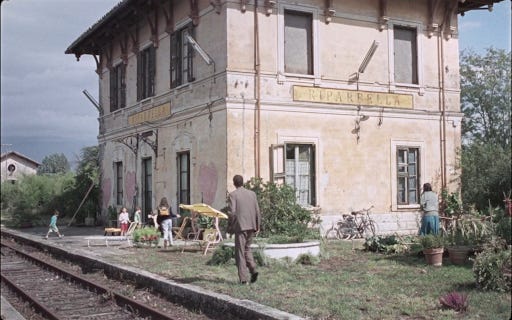
When thinking of queering the housing arrangement I’m brought back to scenes from the film La chimera, released in 2023, in which a wonderfully quirky and indiscernible woman, Italia, begins squatting in an abandoned public train station in the Tuscan countryside.
We are introduced to Italia in another ramshackle situation, in which she is working as an “apprentice” of an aging but acclaimed vocalist, though mostly it seems she is merely the domestic servant of the vocalist’s increasingly dilapidated estate. It isn’t entirely clear whether singing is even a passion of Italia’s, or whether she simply stumbled into the arrangement and thought, why not? She has an air of someone utterly indomitable interpersonally, yet even still, the circumstances of her life seem to be living her, rather than the other way around.
In this first scene she is dismantling an old chair to use as firewood. It looks to be a frustrating affair. Toward the end of the film we get something of a bookend: we enter the train station infused with new life and see Italia, crouched once again by a chair, this time with hammer in hand, making repairs. There is an atmosphere of joyful effort.
Other women and children are there with her, without explanation. The station, it seems, becomes a kind of catchment system for those without other accommodations, or perhaps those who have defected from whatever they had; it seems that mostly women and children have opted out or fallen out of these arrangements. Sheets are hung to create partitions and an informal kitchen is erected from repurposed basins. The children’s drawings are clothespin-fastened to a line strung above the dining room table. Everyone sleeps in a dogpile in the main room, after a day of communal delousing along the train platform-turned-patio adorned with bikes, toys, and terracotta pots growing herbs or perhaps cherry tomatoes.
As I write this, I’ve gone back to review this scene, which I’d initially described from memory after a single viewing in the theater. It’s almost better the second time. My partner enters the room and hovers over my shoulder to get a second view too. “Reparbella, something to do with repair?” he speculates about the faded name I hadn’t noticed etched on the outside of the train station. Bella, something beautiful; repar, something repaired. A quick etymology search disproves this false cognate translation (it is rather to do with the tufaceous rock the town sits atop) but I like it nonetheless as it captures the rugged aliveness of this make-do aesthetic.
Earlier in the film, we notice Fabriana and Italia have some kind of undefined tension. Italia is disgusted by the happenstance grave robbing the group undertakes after a night of dancing. Grave robbing is the backbone of the film’s narrative, which traces a ragtag crew through their exploits, though somehow Italia has remained unaware of their grave robbing ways until this late stage. All the larcenists are men, with the exception of Fabriana. Fabriana is more or less one of them in the way that sometimes tomboys are allowed to hang out with teenage boys up until things get hairy, at which point she is sent away or given the marginal role in whatever clandestine activity the boys are directing. Fabriana’s masculinity, it seems, allows her the degree of access she is permitted. When Italia expresses her shock at their disrespect for the dead, Fabriana scoffs, as if to say, this is why we women aren’t allowed to play.
This makes her unaccounted for appearance in the squat later on all the more unexpected, as is her smile, which transforms her typically steeled face. The women exude a quiet solidarity towards one another that had seemed impossible in the earlier circumstances. Is it the absence of men that allows such peace and ease of cooperation? Yet the ease at which Italia’s love interest, Arthur, is assumed into the squat formation — what’s one more dog on the pile, after all — interrupts such simple conclusions. He does the dishes after dinner; he is tender to Italia; the children have created their own world around the adults, as children do. Everything has a position here, even if the overall tone is the pastel hue of dislodging outmoded roles based on gender and sexuality.
This dislodging doesn’t seem to come by way of explicitly politicized effort, as so many communal endeavors are motivated, one gets the sense, from an ideology being willed into the material (who’s to know though, everything in the film is delightfully unexplained). I’m aware I’ve let the faint virtuousness I feel in whatever is motivating the horizontality in this scene seep into my description of it, though I’m not exactly meaning to, or I’m not exactly committed to this position. It’s just that one longs for a possibility model for whatever this other way could look like and especially a model that seems to emerge and unfold and adapt rather than require the plan, the crane, the permit, and a lot of dough.
V Lane Hoy is an interdisciplinary writer drawing on observation, cultural criticism, architecture, and psychogeography.
Citations
William Ittelson et al., “An Introduction to Environmental Psychology,” accessed March 23, 2024, https://www.amazon.com/Introduction-environmental-psychology-William-Ittelson/dp/0030013461,10.
Richard Sennett, The Uses of Disorder: Personal Identity and City Life (New York London: W. W. Norton & Company, 1992).
Blake Bakkila, “The State of the Housing Market Has Forced Millennials to Get Creative,” Sunset, August 5, 2025, https://sunset.com/home-garden/millennials-sharing-homes-non-relatives.
“(21) Alessandro (@snarmph) / X,” X (formerly Twitter), accessed May 7, 2024, https://twitter.com/snarmph.
(17) “Riparbella,” Locali d’Autore, published January 5, 2011, https://www.localidautore.com/paesi/riparbella-1916.