

by Ronda Larson Kramer
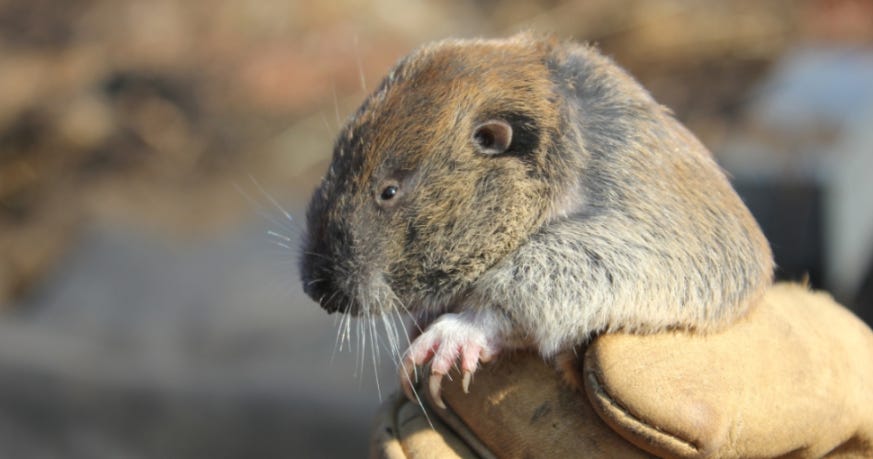
In December 2025, federally threatened Mazama pocket gophers played a key role in halting a plan to significantly expand the Olympia Regional Airport. Seven months later, the species and its Bush Prairie habitat at the airport have become part of a nationwide effort to stop a sweeping rollback of the Endangered Species Act.
The U.S. Fish and Wildlife and National Marine Fisheries Services — federal agencies that say their mission is to conserve species and “their habitats” and “the ecosystems they depend on”— have finalized a rule that redefines “harm” under the Endangered Species Act to exclude habitat destruction.
At issue is whether governments, companies, and landowners may destroy habitat occupied by protected species. Tribes and conservation groups insist that protecting endangered species necessarily includes protecting the habitat they require to survive and recover.
The Department of the Interior and the Department of Commerce stated in a July 2026 press release that they disagree with the previous interpretation of “harm,” which they claim interfered with private property rights and imposed unnecessary permitting costs on landowners, businesses, and local governments. According to the press release, the system created by federal agencies under the Endangered Species Act improperly “punished people for indirect or speculative impacts never contemplated by Congress.”
Congress enacted the Endangered Species Act in 1973 to conserve endangered species and the ecosystems they depend on. Under the Act, it is unlawful to “harass, harm, pursue, hunt, shoot, wound, kill, trap, capture, or collect” an endangered species. For more than four decades, federal regulations have defined “harm” to include significant habitat destruction that injures protected wildlife. This interpretation has shaped permitting decisions and endangered species protection nationwide.
The U.S. Supreme Court upheld that interpretation in 1995. Justice John Paul Stevens wrote for the majority that the definition of harm “naturally encompasses habitat modification that results in actual injury or death.” He also explained that if Congress had intended “harm” to only refer to direct injuries, it would have been unnecessary to include in the Act, because it would have been redundant alongside words such as “kill” and “harass.”
Fourteen conservation organizations, the Squaxin Island Tribe, and the Swinomish Indian Tribal Community said in three separate complaints filed with federal courts that the federal agencies should not have rescinded the longstanding regulatory definition of “harm.”
“If you’re destroying habitat and, as a result, you’re injuring or killing wildlife, that is harmful,” said Brett Hartl, government affairs director at the Center for Biological Diversity, in an interview with New Hampshire Public Radio. The Center for Biological Diversity, the Sierra Club, and Conservation Northwest are among nine conservation organizations represented by Earthjustice in the lawsuit involving Bush Prairie.
The nine conservation organizations argue in their complaint that changing the definition of harm “will upend the finalization of the draft Bush Prairie Habitat Conservation Plan,” which is being developed by the City of Tumwater and the Port of Olympia under the Endangered Species Act. The complaint states that the rule change would undermine habitat conservation measures in the plan, including those intended to protect the Olympia pocket gopher and streaked horned lark.
Olympia resident Betsy Norton is a member of the Center for Biological Diversity and is identified in the complaint as someone who would be personally harmed by the rule change because the species protected by the Habitat Conservation Plan bring her “great enjoyment as she regularly hikes and birds in the area.”
Norton helped South Sound Bird Alliance (formerly known as Black Hills Audubon Society) with its successful 2025 appeal of the Port of Olympia’s Airport Master Plan Update. That appeal resulted in the Port withdrawing its environmental determination and putting airport expansion plans on hold. Mazama pocket gophers featured prominently in the airport appeal. The hearing examiner devoted substantially more analysis to the gopher and other protected species than to issues such as aircraft noise or air quality.
According to the U.S. Fish and Wildlife Service, the Olympia Mazama pocket gopher is one of four federally listed subspecies of Mazama pocket gopher in Washington. Thousands of Olympia Mazama pocket gophers may occupy the Olympia Airport prairie, which is the subspecies’ core habitat. Elsewhere, populations number only in the hundreds or tens.
The primary threats facing the subspecies are habitat “fragmentation, degradation, and loss” due to development. Both the survival and growth of the subspecies depend on efforts to preserve and restore the prairie habitat.
That dependence on habitat is why conservation groups have enlisted the Olympia pocket gopher in the nationwide legal challenge over whether the Endangered Species Act should apply to habitat. In this lawsuit, as in the airport appeal, the gopher may be rescuing humans as much as humans are rescuing it.
Disclosure: Ronda Larson Kramer was an appellant in the appeal of the Port of Olympia’s Airport Master Plan Update.