

Five Fingers on the Total Plan
by: V Lane Hoy
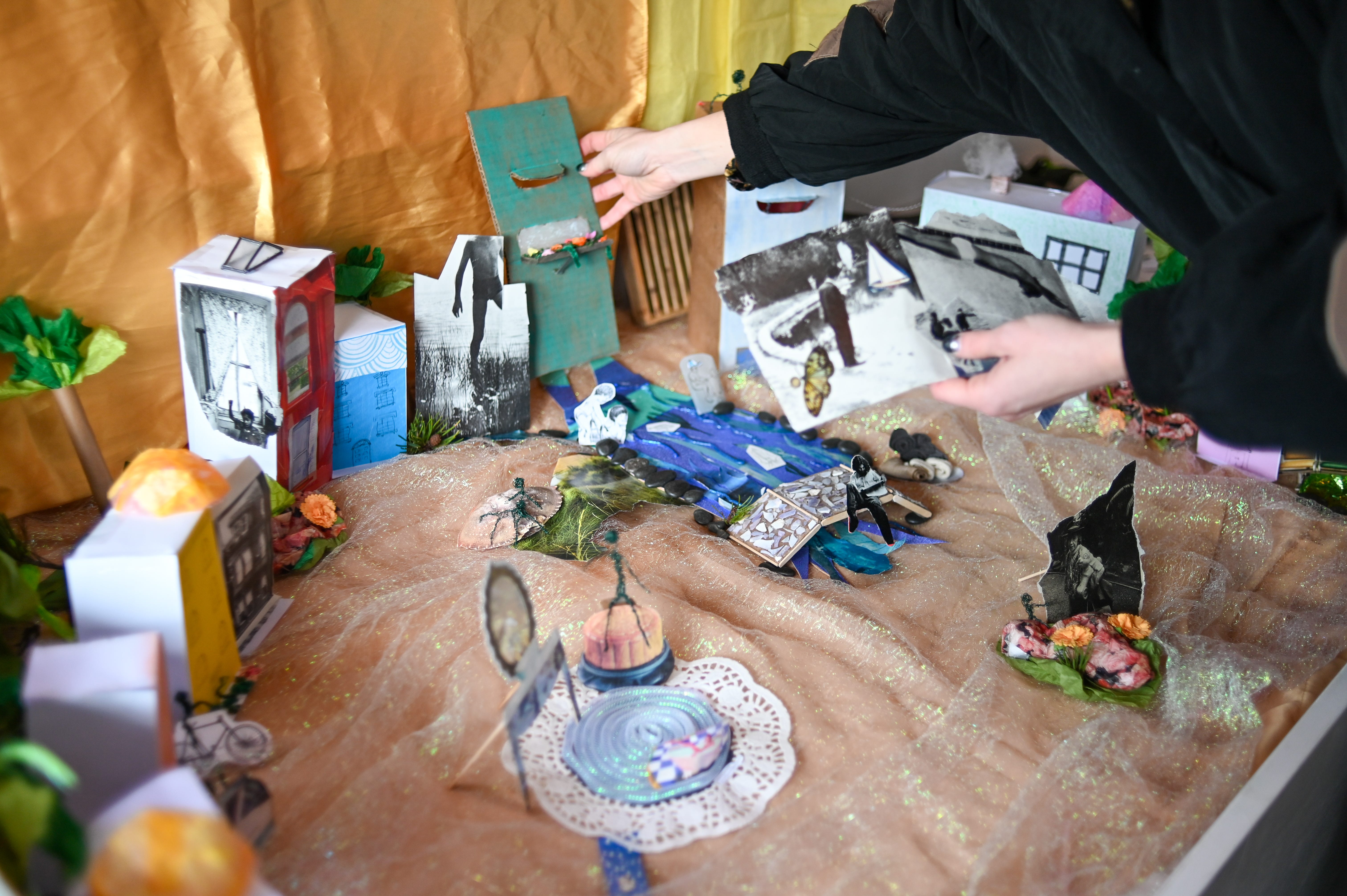
A few weeks ago, I built a diorama in response to a call for artistic proposals ruminating on the theme of “the space between.” I took a somewhat literal interpretation and focused on the space between buildings, drawing inspiration from the title of Danish urbanist Jan Gehl’s 1971 book, Life Between Buildings, and let my hands be guided by whimsy and vagary. Halfway through the process, I was struck by doubt: Am I doing anything more than child’s play: building a fairy theme park using a variety of adhesives, popsicle sticks, and fake mosses? Is that art? The issue — I felt in the moment — had partly to do with the popular appeal of the cuteness of miniature scenes and objects. I wondered: Is cuteness a shortcut, and proof that the project lacked conceptual rigor?
Eventually, I got over this, both because I was running out of time to be delayed by doubt, and also because I was ostensibly taking a vacation to pull this off and wanted to have a little fun. I was finding that working with my hands allowed me to slip effortlessly into the unparalleled pleasure of “flow state.” Compared to that feeling, who cares about conceptual rigor? Not me!
Plus, beneath the doubt, I was curious about cuteness as potentially fruitful intellectual terrain. I wanted to create an opportunity for my imagined viewer to experience the feeling of opening the plastic oyster shell of the mermaid Polly Pocket, which, as a kid in the 90s, I recall evoked both kinds of wonder: the awe and the aww kind.
This makes me wonder if part of why these kinds of toys are so effective at captivating the attention of children, in particular, might have to do with the already out-of-scale-ness of their experience, in which most everything, materially speaking, is just out of their reach. For a kid with a Polly Pocket in palm, suddenly, mercifully, they have one thing in their control. Their little kid fingers, typically offering insufficient grip on the average door handle, become powerful and imposing in that small palm-sized world. And might that serve as a way to attenuate the frustration of the otherwise reignless period of young life when one is blown around by the whims of adults like a reed in the wind?
Along with age, I sense sex and disability are at play — the world is also made just a little out of scale for the small body, the slow body, the body on wheels or crutches. Feminist architects and urbanists have been sounding this alarm for ages, though the message is still largely tuned out. We can’t seem to get out from under the influence of the man most identified with the Modernist movement in architecture, Le Corbusier, who envisioned the “Modulor” as a tool to incorporate the human scale into design. A worthwhile aspiration, I’d say, except that he based this human scale on “the good-looking men, such as policemen” in detective novels, who, he claimed, were “always 6 feet tall!” Unfortunately for the rest of us, his Modulor standard was taken up across Europe, the United States, and other places where Modernist influences are articulated in the built environment.
So perhaps alienation is relative to the extent of the out-of-scale-ness one feels with the surrounding structures. Even so, the wonder of the miniature seems to work on just about anyone. For me, cityscape miniatures hold a particular fascination. My working theory has to do with the perceived irreproachability of the built world. The average person is rarely afforded the kind of agentic rush of leaning over to pick up a building and move it here and there or experimenting with being the decider of what gets affixed where with the power of the hot glue gun.
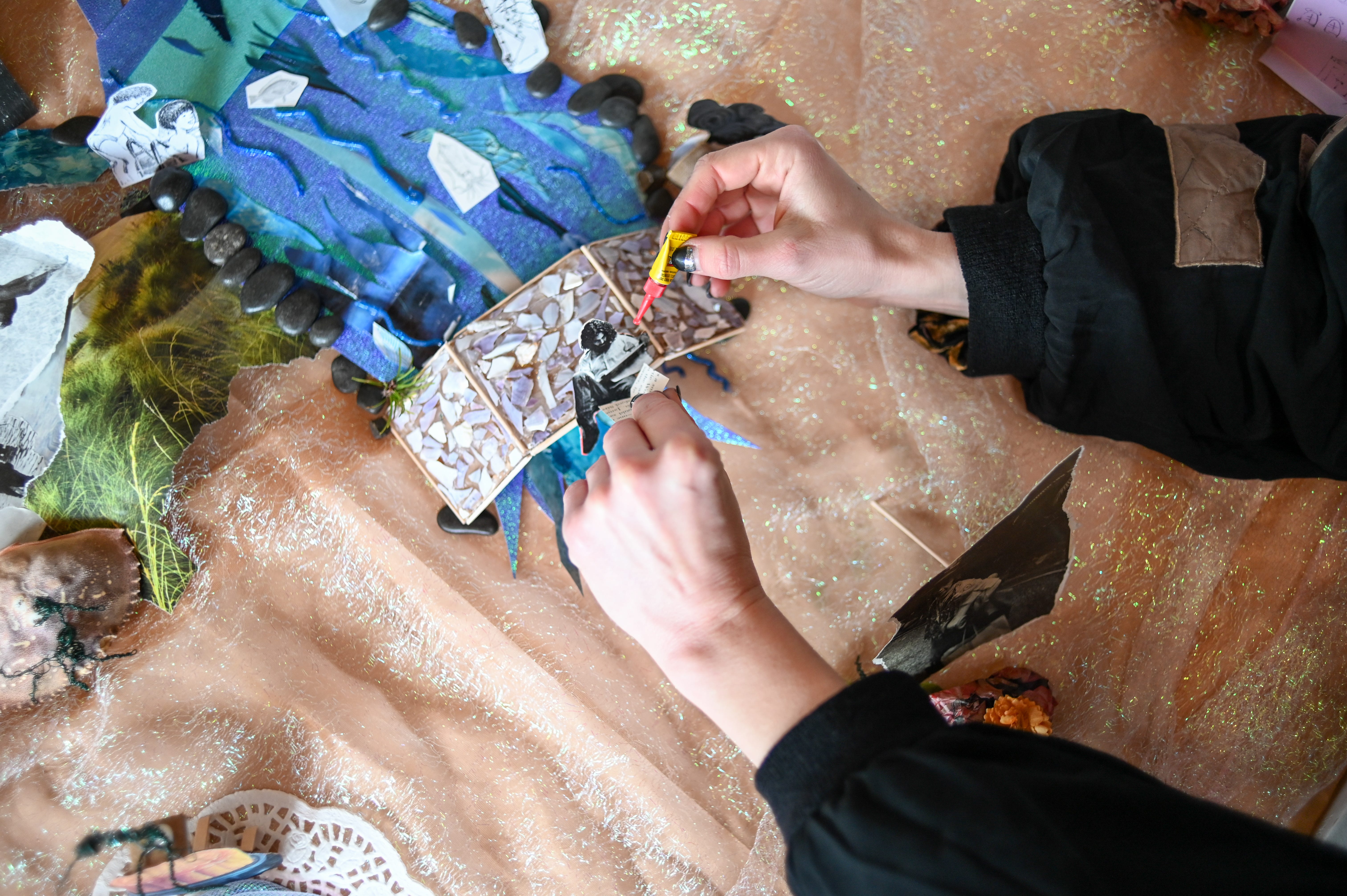
Part of the intrigue of the urban diorama stems from a general sense that the built world is something that happens to you rather than something you have a relationship with. You might walk downtown and suddenly find that a building you’ve come to have some relationship with was leveled and the grade beams have been laid for the foundation of a new development, and it’s not clear why and it’s not clear who decided and it’s not clear if anyone — any regular person — was consulted. All of this can lend itself to a sense of alienation from the urban process and the built environment. Making a diorama creates a fantastical opportunity to step into the role of decider, but it also creates the space to re-enchant the process and expand the realm of possibility.
While reflecting on the catharsis afforded by my week of diorama-ing, I developed a fantasy of renting a small warehouse downtown, perhaps in the building along the west side of Capitol Way between Olympia and Thurston Avenues that housed the Procession of the Species studio circa 2011. I recall admiring its vaulted skylights and taking refuge in the lofted area that had a secret-crawl-space feel while I built a stegosaurus costume in anticipation of that year’s parade, with somewhat unfortunate results, the back portion looking more like a giant weed leaf than the regal spines I was trying for.
In this imagined warehouse, people could stop by to drop off unusual household items and interesting garbage, anything that could possibly come in handy for model-making. To picture this grand diorama, look at The Panorama of the City of New York on display at the Queens Museum, a 1:1200-scale replica of the city first created for the World’s Fair in 1964, which continues to aspire to keep pace with the city’s developments and serve as an honest representation of every one of its evolving structures.
Yet rather than a representation of what already is, this collaborative model-making scheme would be a fantastical manifestation of the dream city, of what could be. Perhaps a child wants to make a playground for their paper dolls. The neighbors living along the north block of Legion Street who, while taking my evening sit in Sylvester Park, I see lugging their groceries from the bus stop on route 14, might enjoy a zip line installed along the park’s perimeter to ferry their bags along their route. For my part, I wouldn’t mind a public soft serve ice cream machine installed by the Artesian Well, whose contested perimeter gate, in this telling of the tale, has been removed once and for all. Any of these ideas and more could go into the dream city model.
The word diorama comes from two roots: dia, the Greek word for “through,” and orama, from “panorama,” a compound which means “a complete view.” This Works in Progress column is an iterative space to elaborate this diorama-esque work on the page, in service of seeing as clearly as possible what is, in order to courageously and playfully envision what isn’t yet. The wager: Making sense of the built forms around us is the first step in articulating what we’d like them to be and what we’d like to preserve, what we might want to demand and what we might need to make for ourselves.
Note: “Five fingers on the total plan” is a lyric from the song “Ode to Hanky” written by Lucien Spect with the band Scrivener.
V Lane Hoy is an interdisciplinary writer drawing on observation, cultural criticism, architecture, and psychogeography.