

by: Rob Ott
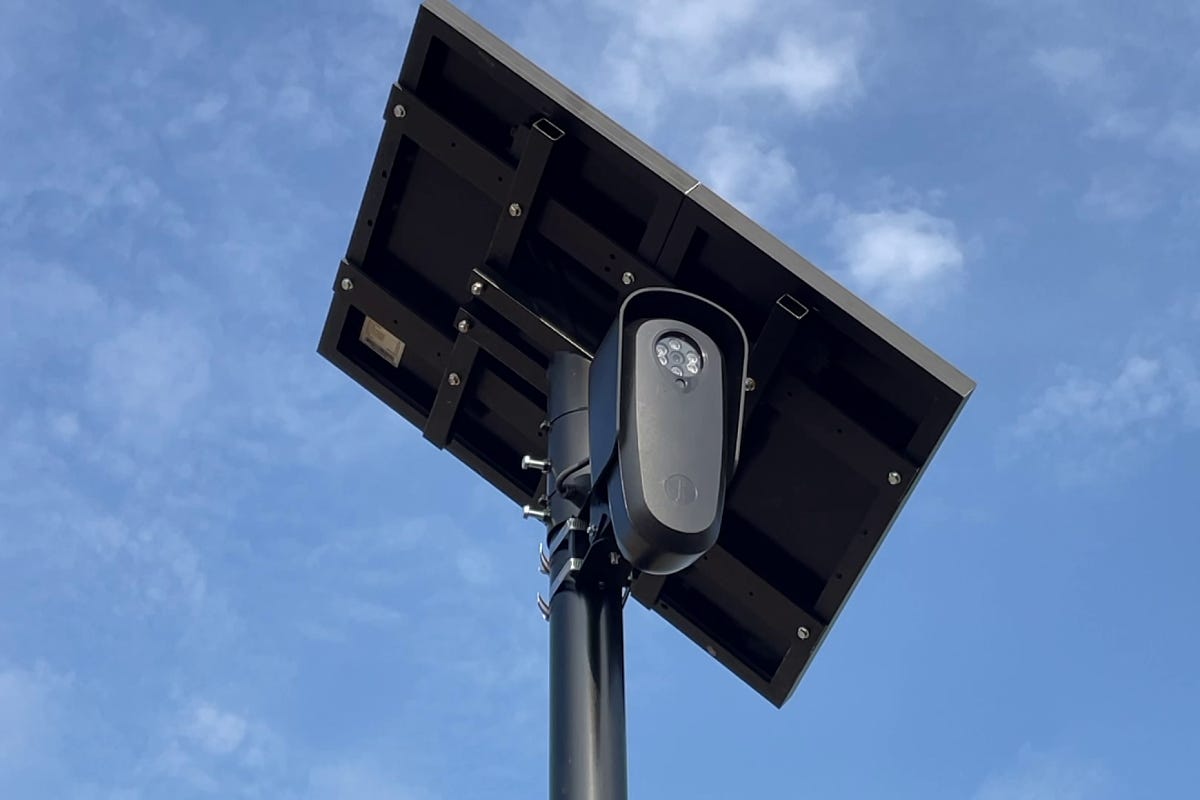
Perhaps you’ve recently noticed a few sleek black cameras, paired with black solar panels, popping up on traffic light poles around your city. These cameras and panels seemed to appear out of nowhere, their lenses pointing down busy streets, toward freeway on-ramps, and at major intersections. The police department website called them “automated license plate readers” (ALPRs) and alluded to them being for crime prevention, so it was easy to assume they were another traffic enforcement measure aimed at catching speeders, red-light runners, and other dangerous drivers. You may have told yourself that this would probably be a good thing, and soon the cameras became another piece of visual clutter to filter out automatically as you drove around.
However, these cameras don’t catch speeders. Or red-light runners. They don’t report crimes in progress. What they do is track every vehicle that passes them by using artificial intelligence to capture the license plate number, color, model, and even your “Coexist” or “Support Your Local Co-op!” bumper sticker. These data points, along with the location, the time, and your travel direction, get filed away on privately owned servers administered by tech companies such as Flock Safety to be searched by police departments and other public agencies. This system flagrantly goes against the Fourth Amendment of the U.S. Constitution as well as court decisions against warrantless surveillance. Big Brother is indeed watching you, and he knows exactly where you’ve been.
And this information is not only searchable by local agencies. In the October 2025, a study by the University of Washington (UW)’s Center for Human Rights showed that federal agencies have repeatedly accessed Flock data, including revealing evidence that:
Flock data from Washington has been searched thousands of times by federal immigration enforcement agencies.
At least eight Washington law enforcement agencies have settings that allow full data sharing with federal immigration enforcement agencies.
At least 10 Washington law enforcement agencies have had their data accessed by federal immigration enforcement agencies without permission.
Proponents of ALPRs claim that data can only be shared with explicit permission from the recording agency. Flock Safety supplies “accountability portals” for each local agency who contracts with them that list prohibited uses. In Washington, the prohibited uses nearly always include “immigration enforcement” in order to comply with state laws such as the Keep Washington Working Act, which restricts state and local agencies from assisting federal agencies with immigration enforcement by sharing data. We also have legislation (SB 6002 and HB 2332) making its way to the governor’s desk that claims to make privately contracted ALPRs “safe” to use by putting a 21-day retention limit on data storage, reiterating that they cannot be explicitly used for immigration enforcement or suppression of free speech, and requiring records of system use to be kept and audited.
However, will these bills actually increase the safety of ALPRs? According to the UW study, much of the data that was accessed by Immigration and Customs Enforcement (ICE) and other federal agencies was provided as a favor by a local agency with permission to search the database (referred to as “side door” access”). Other evidence shows that ICE used “back door” access through the vendor to search camera data. This all occurred while the Keep Washington Working Act was in place, which does not inspire confidence that additional future regulatory legislation on ALPRs will prevent it from occurring again.
The legislation also says very little about regulating the security of vendors like Flock Safety, aside from vague language about requiring “security measures” from them. For all practical purposes, we have no way to stop ALPR vendors like Flock from handing this data to whomever they choose, whether that is ICE, the FBI, or some advertising company trying to figure out when you are most likely to drive by a fast food restaurant during your week.
Members of law enforcement in other states have abused access to ALPR databases, with multiple cases of officers using data to stalk former or current romantic partners. Agencies in states where abortion is illegal have also used database access to try to prosecute people seeking reproductive care in other states that allow it. We have no idea how many abductions of undocumented immigrants ALPR data has made possible so far; there are over 500 cameras are in the Minneapolis/St. Paul area, for example.
We must ask ourselves:
Are these abuses enough to disincline us from trusting further use of these systems?
What would happen if these systems were in the hands of an even worse government that had outlawed free speech, assembly, or made certain currently protected classes of people “illegal”?
With federal cases such as those related to Prairieland or Stop Cop City in Atlanta setting precedent for anti-fascist organizing to be charged as terrorism, and with the continued efforts to link Palestine solidarity movements to terror charges, how could blanket, warrantless surveillance of activists be misused?
Are the supposed benefits to law enforcement worth these risks?
Last fall in Olympia, a group of residents concerned about the city’s contract with Flock Safety held an information night to tell the community about ALPRs and discuss what to do. The group, called DeFlock Olympia, advertised via poster and social media and had meeting space donated by a local cafe after hours. The event was heavily attended, with community members lining up outside the door, unable to get in. Meeting attendees decided to coordinate a Signal messaging group, set a date to submit public comment to Olympia City Council, and demonstrate outside an upcoming “closed study session” between the Olympia Police Department (OPD) and City Council. Community members also met with City Council members one-on-one and circulated an open letter that was signed by nearly a dozen local organizations and over 100 individuals.
This pressure had an effect. At the end of the study session, which had to be moved further into City Hall chambers to get away from the noise of the demonstrations outside, OPD recommended that the city suspend use of its ALPRs due to public outcry. The cameras were covered and then later taken down.
Multiple other cities in Washington and across the United States have suspended their use of ALPRs or canceled contracts after similar activity. The American Civil Liberties Union is filing multiple lawsuits against other municipalities over their contracts with Flock.
However, even with these successes, there are still ALPRs in use all over Western Washington. The cities of Tacoma, Shelton, and Yelm have active cameras up, and Tenino, Bucoda, and Rainier are working to get contracts.
Derek Sanders, the Thurston County sheriff, is campaigning to try to build goodwill for his effort to pursue a Flock contract, and the Thurston County Auditor’s Office is planning to install federally funded AI-powered facial recognition cameras in election and voting facilities. This last development is especially concerning given the federal government repeatedly telegraphing their intent to “watch for fraud” in the next election, combined with their willingness to outright lie about facts or fabricate images, such as the AI-generated footage of the murder of Renee Good that was posted on social media.
What can we do to fight this, you may ask?
To start, research if there are any ALPRs are near you, and determine who owns the contract for them. You can use the DeFlock website, which provides a map of ALPRs using open-source tools and community reporting. The map and reporting tool are also available in a smartphone app. The organizers of DeFlock have created tangible resources, such as zines, flyers, and stickers you can print out to raise awareness among your neighbors and community.
In the end, do you feel safer with Big Brother watching? Or are you ready to do something about it?