

by Antonio F
[ON RADIO]:… continued disturbances in Jakarta, but are advising U.S. citizens…
JOEL: Jakarta. Where is that, Middle East?
TOMMY: Doesn’t ring a bell. It’s definitely a country. Or maybe part of Asia?
SARAH: Being a part of Asia isn’t mutually exclusive with being a country, and in fact, [Jakarta] is the capital of Indonesia.
- HBO’s The Last of US
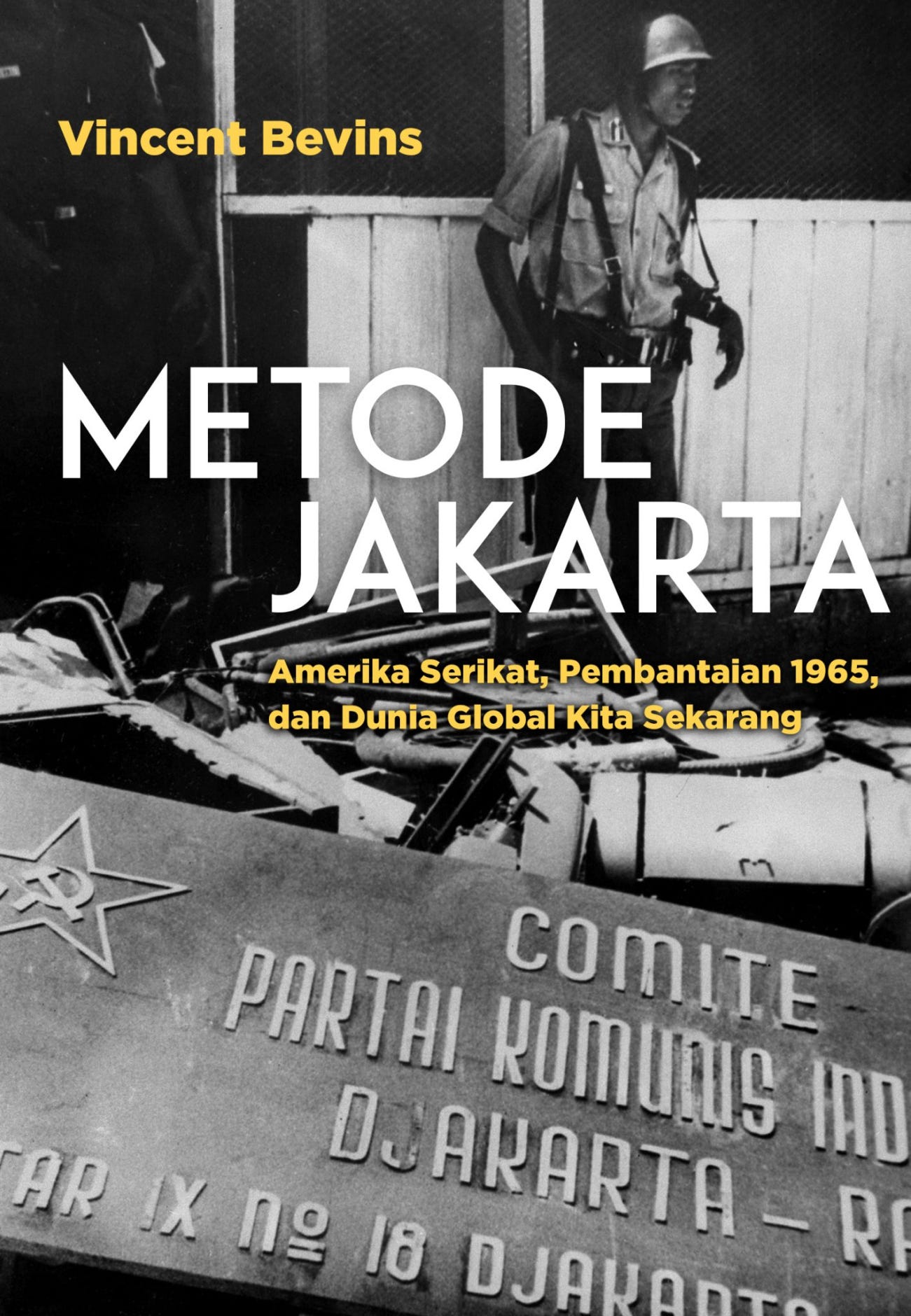
The prevailing tendency in the English speaking world is to reduce the Cold War into a boxing match between capitalism and communism (the plot of Rocky 4) or a story of two superpowers playing spy games in the shadows (the plot of Stranger Things season 3). The Jakarta Method by Vincent Bevins rectifies this misreading and shines light on the overlooked history of anticommunist bloodshed. In his 2020 debut, Bevins argues that the United States’ most significant Cold War victory took place in Indonesia roughly 60 years ago.
Regardless of postal address or education level, few North Americans could tell you anything substantial about Indonesia. Most do not know that Indonesia’s population exceeds 270 million. Or that it is home to more Muslims than any other country in the world. Due to its reputation as a desirable vacation spot, Bali has more name-recognition than the rest of Indonesia’s 17,000 islands combined. Why does the Southeast Asian archipelago cast such a small imprint? If Indonesia’s present does little to pique our interest, then Indonesia’s past does less. Our lack of awareness is by design.
Only a handful of First Worlders, even those who proclaim a general moral opposition to US imperialism, are familiar with former Indonesian Prime Minister Sukarno or the bloody coup d’etat that removed him from power. In 1965, high-ranking Indonesian military officials, supported by Washington, started a genocide that ended with over five percent of the Indonesian population being killed. But The Jakarta Method is much more than just a summary of a single mass-killing campaign. According to Bevins, Jakarta was once synonymous with “brutal elimination of people organizing for a better world” (pp. 205). This book is about the legacy of imperial violence that extends beyond the shorelines of Bali and Java and still reverberates today.
Sukarno was not a communist in theory or practice, domestically or internationally. In fact, shortly after vanquishing the colonial Dutch government, Sukarno pleased Washington by putting down a communist rebellion. So what did the father of Indonesian independence do to provoke the US? For one, he hosted the intercontinental Bandung Conference in 1955. “Third World,” is often a euphemism for abject poverty. Bevins interprets it as “a movement…that came into its own in Indonesia.” (pp. 55). The Third World internationalist movement, or “Bandung spirit,” was rooted in a principled commitment to post-colonial sovereignty and self-determination. Most attendees were leaders of former colonies who strove for Cold War neutrality. They did not want to be US banana republics or be beholden to Moscow — a stance the newly-formed Central Intelligence Agency (CIA) found unacceptable. To them, anything short of a total disavowal of Moscow was an affront to Washington.
Sukarno’s other sins included passing “very moderate land reform[s]” and proposals to appropriate oilfields from foreign capital. What Western intelligence agencies found more distressing, however, was the rising stardom of the Communist Party of Indonesia — The PKI. “Since the 1950s” the US was determined “to destroy the [PKI], not because it was seizing power undemocratically but because it was popular,” writes Bevins (pp.155). By 1965 the PKI’s “three million card-carrying members,” made them the third largest communist party in the world. The PKI simultaneously supported Sukarno’s reforms while criticizing them for not going further.
Most CIA plots to destabilize Indonesia failed. However, they successfully infiltrated and divided the loyalties of Indonesian military leadership. The State Department won over many soldiers through exchange programs and bribery. This included a corrupt general named Suharto. Shortly after kick-starting the coup d’etat in the fall of 1965, CIA analysts handed Suharto’s army a kill-list containing “the names of thousands of communists and suspected communists” (pp.156). Within six months, the new anticommunist regime had toppled Sukarno’s government and placed a million Indonesians into concentration camps.
Suharto’s military dictatorship shut down Indonesian media outlets except the ones paid by the CIA to manufacture consent. An alternative history was pushed to the world: Suharto’s men had saved Indonesia from a nefarious commie takeover. The massacre of Asian civilians generated little to no outrage from most international publications. The New York Times praised Indonesia’s “savage transformation” (pp.158). Estimates vary but historians conclude that the military dictatorship butchered between half a million (a conservatively low estimate) to one million Indonesian men, women, and children; including “several hundred thousand” PKI members (pp.151). Due to a sustained effort to silence the truth, it is impossible to calculate exactly how many Indonesians were killed, maimed, or tortured.
Every dollar the State Department invested into engineering and justifying the anticommunist crusade paid off immediately and in multiple hemispheres. Essentially, “the Indonesian government went from being a fierce voice for cold war neutrality and anti-imperialism to a quiet, compliant partner of…US world order” (pp.158). When nearby East Timor gained independence from Portugal in 1975, Washington feared it could become the Cuba of Asia. Suharto received a “big wink” from Nixon and savagely transformed East Timor through an invasion which “annihilated a third of the population.” (pp.213) Over in Latin America, “[T]he scale of victory...and ruthless efficiency…inspired extermination programs named after the Indonesian capital,” including Operação Jacarta in Brazil and Plan Djakarta in Chile (pp.159).
The anticommunist dictatorships in both Brazil (which took power in 1964) and Indonesia could not have emerged if the US had not indoctrinated their troops. Some of that indoctrination took place in the 1950s across the state of Kansas where Indonesian and Brazilian soldiers roomed, trained, and studied counterinsurgency together. Just like in Indonesia, Brazil’s “most important media” outlets churned out fanatical anticommunist propaganda (pp.105) Just like many Indonesians, many Brazilians accepted the fabricated story that their military had valiantly saved civil society from an evil communist plot. One anticommunist revolutionary was a young soldier by the name of Jair Bolsonaro.
Brazil would play the same role in Latin America that Indonesia played in Southeast Asia. When Salvador Allende won Chile’s 1970 presidential election, Washington saw him as a bigger threat than Fidel Castro due to his popular non-authoritarian brand of socialism. Just like in Indonesia and Brazil, the CIA successfully bought off high-ranking members of the Chilean military and press. A spray-painted message started appearing on the walls of Santiago: “Yakarta viene” (Jakarta is coming). And so it did. On September 11, 1973, corrupt General Agusto Pinochet overthrew Allende and established a decades-long dictatorship. Unsurprisingly, Pinochet’s execution squads featured Brazilian soldiers.
That alliance formed the basis of a Latin American anticommunist network called Operation Condor. The condors dispensed Jakarta-esque terror across the Americas. In the entire hemisphere, journalists, labor organizers, immigrants, indigenous peasants, and members of persecuted religious groups risked being deemed subversives. Therein lies the key to anticommunist violence: anyone who challenges an unjust status quo can become a threat that needs to be neutralized. Instead of delivering democracy to the Third World, the so-called free world delivered the freedom to exploit and dominate. Any country, socialist or not, whose modus operandi was not perfectly aligned with US hegemony could meet the fate of Indonesia.
The Jakarta Method is a harrowing read. It contains graphic violence. More importantly, it forces readers to ponder “what-could-have-been.” What would global inequality look like today without these genocides? The Bandung Spirit did not expire, it was extinguished. The trauma caused by anticommunist bloodshed never left us. Capitalist exploitation remains the nucleus of our global economy in large part because of what went down in Indonesia.
The Jakarta Method undermines a status quo that reinforces itself by sweeping atrocities under the rug. The most stirring passages in The Jakarta Method are the testimonies from survivors whose lives were shattered by anticommunist violence. In Indonesia, monuments that commemorate the victims of anticommunism are prohibited by law. Honor them by reading their story.