

by Carl Eugene Stroud
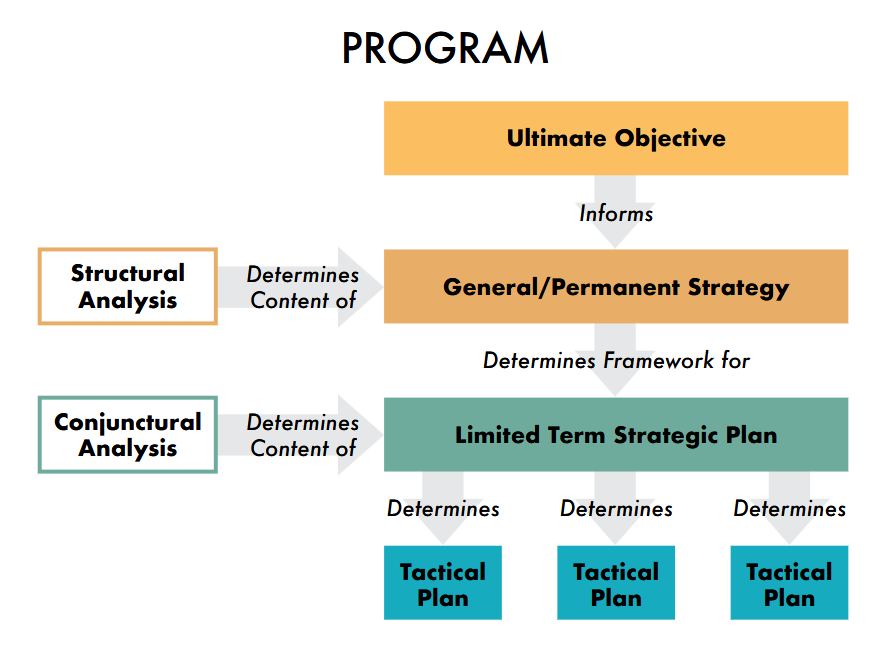
It doesn’t matter what the goal is, there’s not much point in only anticipating ideal scenarios. This is why the concept of “conjuncture” is helpful, for strategizing and getting a lay of the land. Analyzing the conjuncture is about starting from the here and now because it’s important to look at things in context, paying attention to the situation at hand, accounting for the when and the where. But it’s also true that, as a term, conjuncture needs to be demystified to make it a tool that more people feel comfortable picking up and using.
To begin with, a conjuncture is singular, like a moment. It usually refers to now, what’s sometimes called current events. This brings us to the first potential confusion: not all moments are created equal. They’re not even all the same size.
Does a conjuncture last a year, a month, a decade? Are we talking about historical periods or more like different administrations?
Even obvious examples of current or recent time periods, like the Trump era and COVID, are still blurry around the edges. The details around the beginning and end need to be as clear as possible to make the concept sharp enough to be useful.
In addition to the temporal meaning, conjunctures are also intersections. Like with the Spanish “coyuntura,” which can mean joint as well as circumstance, the concept of conjuncture refers to the interaction of different forces. It’s the node where the joining takes place, a pivot point around which things move, an instance of connection.
Dialogue and relationship building are examples of the positive, constructive side of conjunctures, but not all interactions are positive. Conjunctures are also characterized by the divisions between different camps and the limited positions that are available at a given time.
For example, the labor organizing and community response to the budget cuts at Timberland Regional Library point to a conjunctural conflict that’s still unfolding, and nationally, the battle line between the MAGA coalition and the anti-Trump movement has effects around the world.
These lines are never completely static; they’re constantly being blurred, erased, and redrawn. This means a conjuncture is also like a choke point, a narrowing of the road where not everything will fit. Having an approaching point of no return makes it clear what to do first and what can wait for another time.
Elections tend to produce this funneling effect, as do union votes, contract negotiations, and strikes. This is also true of natural disasters, economic crises, and mass protests. Any of these could be key moments when important questions are asked, and the way you answer depends entirely on where you find yourself in the squeeze.
Decision-making itself is related to the conjuncture, meaning conjunctures aren’t always mountains to climb or walls to scale; they’re also doors to walk through. But this requires a lot of commitment and determination not to get distracted and disillusioned along the way. So, a conjuncture is also something to resist and remain unchanged by.
This is exactly why organizing around a shared program is so important. Continuity across conjunctures is the basis for solidarity as a force for change. Like with the tenants organizing in Tacoma, conjunctures are full of possibilities that give meaning to the slogan “together we can change things.”
Of course, doomerism is also conjunctural. The idea that everything is futile, and there’s nothing we can do; the short-sightedness that tells us to only look out for ourselves; the narrow-mindedness that makes us think that only local changes are possible. Frustrating limitations, dead-ends, and burn-out cycles are experienced in a distinct way at every conjuncture, and there are a lot of different possible reactions someone might have.
So finally, we have to consider the individual agency and free association involved in accumulating force at the current conjuncture because it’s this same force that will be used to shape future conjunctures.
Who are the key players, the trusted leaders, the active parties, the relevant voices? Which forces are gaining strength, which proposals are convincing, which ideas are influential?
The answers to these questions have a shelf life because conjunctures are momentary and conditional, not structural or ideal. Our sense of the conjuncture needs regular sharpening to cut through the noise and get down to what’s most important. Nevertheless, like the community breakfast that’s been defending the Olympia Planned Parenthood for years, it’s always possible to create continuity. That’s the only way to ensure the values, practices, and organizations that we support will survive this conjuncture and have an influence on the future.