

By Morgan Atwater
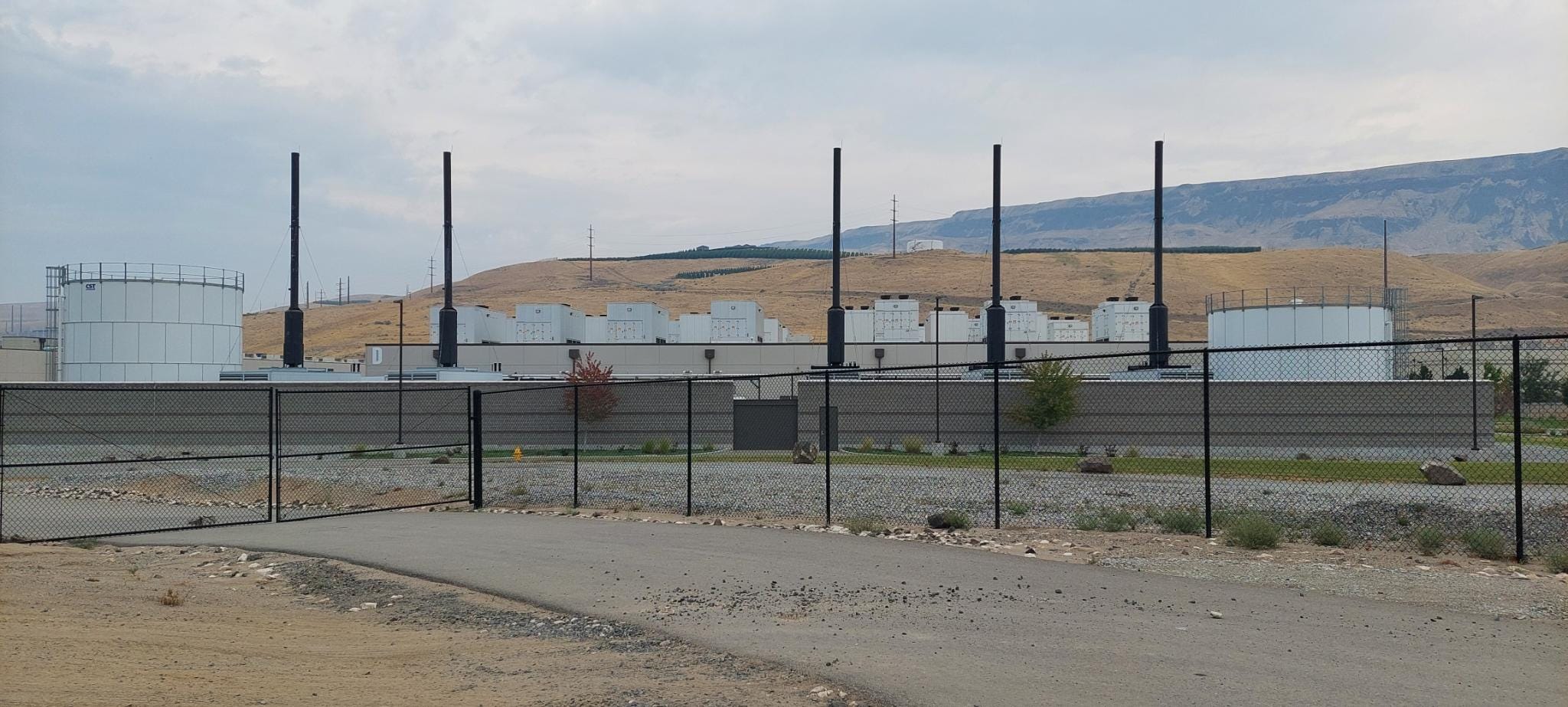
When we arrived to protest the Wenatchee 2026 AI Expo on August 11, someone was dumping water on the ground, trying to scrub away chalk messages that said things like “Sabey pollutes our air with diesel,” “Microsoft cloud + AI kills kids,” and “AI steals from YOU.”
The chalk had been there since that morning. In bone-dry Wenatchee, often the weather works in a protester’s favor. That day, we stood beneath sunny skies with a thin haze of smoke on the horizon. At least the air quality index wasn’t 285 like it was the week prior.
We could almost be grateful for it. The universe had granted us the perfect window to demonstrate how it all comes together: climate change, Big Oil, genocide, and data centers.
Sabey’s Dirty Diesel
People on the west side of the state might know Sabey Corporation as the company that leases space to Immigrations and Customs Enforcement (ICE) and the Department of Homeland Security (DHS) in Tukwila. This includes a facility that was slated for use as a detention center before the Tukwila community mobilized to pass a moratorium blocking the expansion of ICE detention centers in the city. King County community members have been giving Mayor Joe Sabey trouble at Hunts Point town hall meetings ever since.
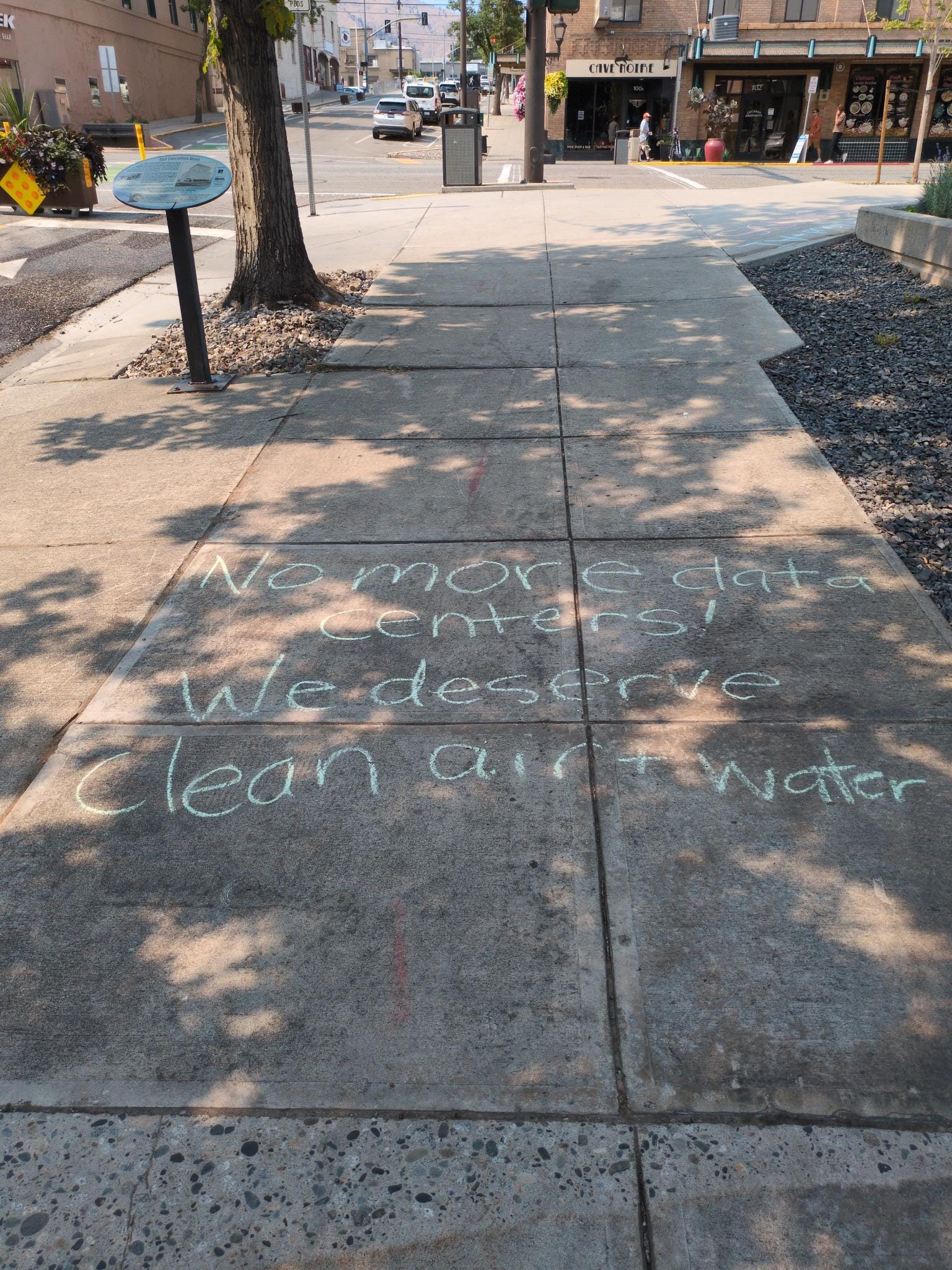
Sabey Corporation also owns a data center in East Wenatchee. It has 170-megawatt capacity. In big letters, Sabey Data Centers’ promotional flyer proudly advertises: “Harnessing Hydro for Low-Cost Power.”
Chelan and Douglas County Public Utility Districts (PUDs) bristle when you try to say that the data centers are after our hydropower. The data center FAQ article on the Chelan Douglas Regional Port Authority (CDRPA) page on North Central Washington data centers emphasizes that “the majority of electricity serving local data centers is supplied through market-based power purchases from outside the region rather than relying solely on Chelan PUD’s local hydropower resources.”
It seems that the companies and the public utility districts don’t agree on this point. Or rather, the access to hydro is a selling point for Big Tech, and a dirty secret for the utilities. They know how it comes across to the public.
Douglas County — where East Wenatchee is located — doesn’t have an official statement on the CDRPA page, but they definitely are supplying at least a portion of Sabey’s power. Supposedly, Sabey will transition to getting their power through a third party in 2033.
But if the data centers’ power isn’t coming from hydro, then where is it coming from?
That is just one of the many questions we don’t have answers for because these companies are so resistant to transparency. We do know one thing: The power needs of these data centers are supplemented by fossil fuels.
Sabey recently made the news in Wenatchee after word got out that they had applied for a Notice of Construction Air Quality Permit for 15 new diesel generators in East Wenatchee, adding to 11 existing ones. The community mobilized, and after an Action Network petition campaign and a flurry of comments on the Department of Ecology website, the agency was forced to offer an online public hearing on August 18.
We were, at that point, several weeks into a particularly bad wildfire season, and the Wenatchee Valley had been filled with smoke almost the entire time.
None of the public comments at the hearing had anything positive to say about Sabey Data Centers effectively getting a license to pollute more. The Ecology representatives explained to us that cleaner alternatives were “cost-prohibitive.” When we asked why our community should be expected to sacrifice our health just to give Sabey more money, they could not give us a good answer. The Ecology representatives also acknowledged that their assessments for safe pollution levels for our area were done based on older research that did not factor in additional sources of air pollution like wildfire smoke.
As many people pointed out in their comments, an Ecology report identifies the Wenatchee and East Wenatchee community as overburdened and highly impacted by air pollution. Ecology’s own website says that diesel exhaust is the most harmful air pollutant in Washington.
The whole process demonstrated how the agencies that are supposed to protect us are signing away our future little by little. Sabey argues that these are just backup generators, but what gives them the unalienable right to expand their facility when our region is already beyond capacity? How much is too much? If climate change is a death by a thousand cuts, Sabey is one of the thousand hands holding the knife.
Ryan Vicente, from Ecology’s central region air quality program, spoke in defense of Sabey’s proposal. “What we’ve seen in the past, they purposely site these facilities close to power. It’s hydropower, it doesn’t go out very often,” he said. “It’s in their best interest, cost saving wise, to not be running the engines. Diesel, if you’ve seen the gas pump price.”
Hydropower "doesn't go out very often", but studies are predicting rolling blackouts within a few years. As one protester's sign read: "Who gets power when it's -15°F? You or Sabey?"
And what about when Sabey transitions off of hydropower and gets their power through a third party? What will be more cost-effective then? If they want to power their whole facility on fossil fuels, will anyone stop them?
Microsoft’s Gas Paid in Blood
Microsoft is the other major player in the data center industry in the Wenatchee area. They operate a 288 megawatt data center in Malaga and a large data center in East Wenatchee with a capacity that has not been made public. Columbia Riverkeeper’s estimate notes “213 MW existing / 203.5 MW planned.”
Douglas County PUD is currently providing transmission and distribution lines for Microsoft’s East Wenatchee data center, though unlike their agreement with Sabey, they require Microsoft to buy the actual electrical power it uses from a third party. Where exactly that third party power is sourced, we don’t know. Chelan County PUD’s contract does allow Microsoft access to hydropower for their Malaga data center, though most of the data center’s power will be from a “to-be-determined power source.”
Microsoft claims that they will supply their own power with Helion, a fusion power start-up that has yet to generate more electricity than it consumes. Experts are doubtful that Helion will be able to fulfill its promises. Seeing Helion’s track record, it appears to me to be essentially snake oil used to sell communities like ours on data centers.
In Washington state, Microsoft is constrained by pesky mandates like the Clean Energy Transformation Act (CETA), but other parts of the country are lawless territory. For all of Microsoft’s attempts at putting on a climate-conscious act in Washington, the mask is fully off in Texas.
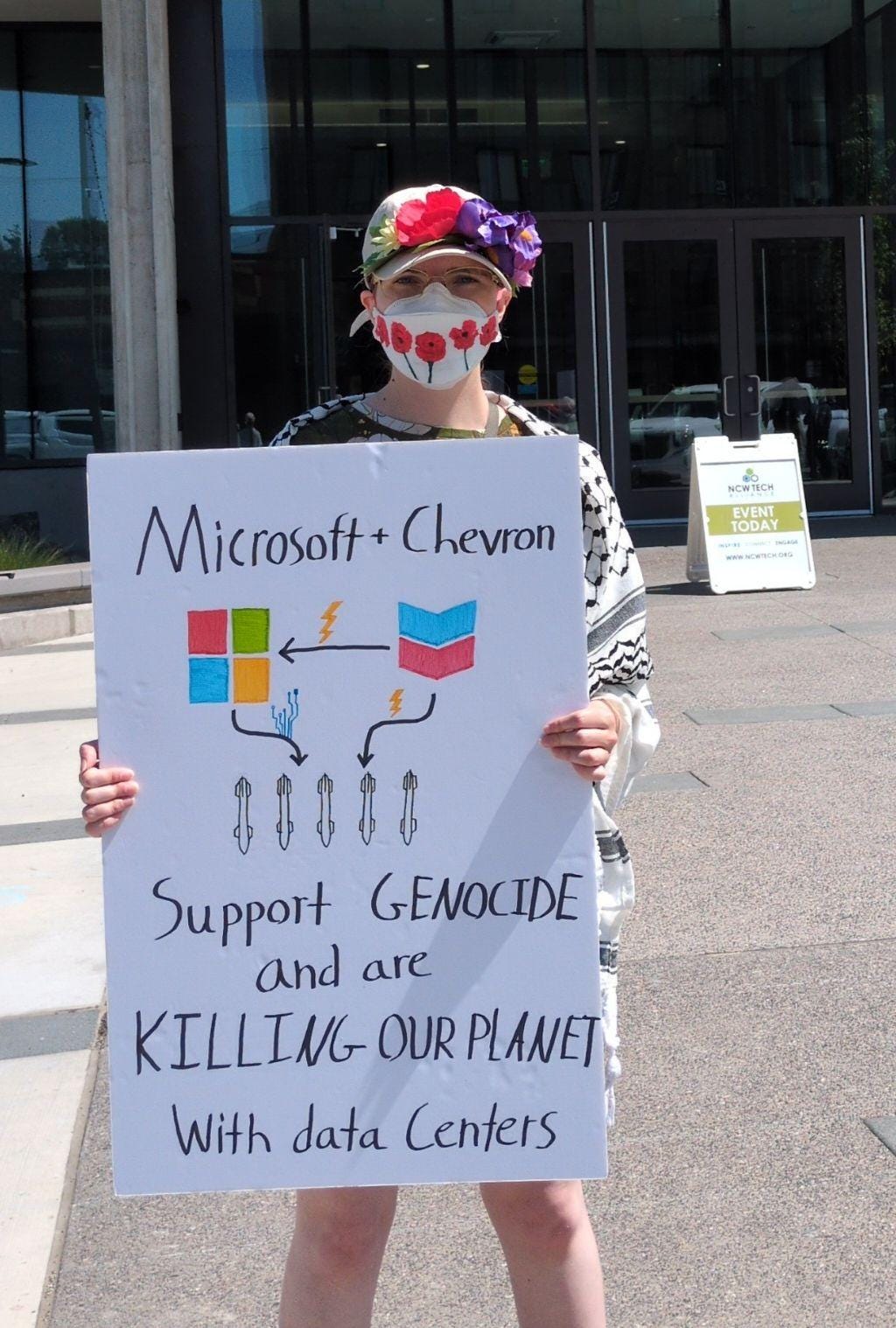
Microsoft just signed a gigantic 20-year deal with Chevron to power a data center in Texas. It is number 7 on the Environmental Integrity Project’s list of planned data center gas plants with largest potential greenhouse gas emissions. In early 2026, Stand.earth put out an open letter demanding answers from Microsoft on its climate and community impacts, calling out the company for abandoning their climate commitments. Over 150 organizations signed this letter. Wenatchee for Palestine was one of them.
For Palestinians and pro-Palestine activists, the Microsoft–Chevron alliance is a particular slap to the face because both companies are boycott targets of the Boycott, Divestment, and Sanctions (BDS) movement for their complicity in genocide. Chevron operates Israeli gas fields and pipelines in Palestine, including off the coast of the Gaza Strip, and supplies almost 50% of Israel’s electricity grid. Microsoft provides the Israeli military with Azure cloud, AI, and storage services.
This is the reality of gas-powered data centers. It’s a very ugly industry.
And even if the data centers are powered by renewable energy like hydro, that has a knock-on effect of causing rate increases in Western Washington. Utilities like Puget Sound Energy have to compete with data centers eating up all the power in Chelan and Douglas Counties. It also sets us back on our energy transition goals because there is no “transition” happening, only energy addition.
All the while, climate-induced wildfire smoke chokes our skies, and, for once, we get a taste of the direct harms of extractive industries right here in the imperial core rather than exporting them elsewhere.
But by giving voice to the problem, we can begin to wake up our communities and inspire people to fight back. We can prove that none of this has to be inevitable.
Morgan Atwater can be reached at morganatwaterwrites@proton.me.