

by West Bay Development Action
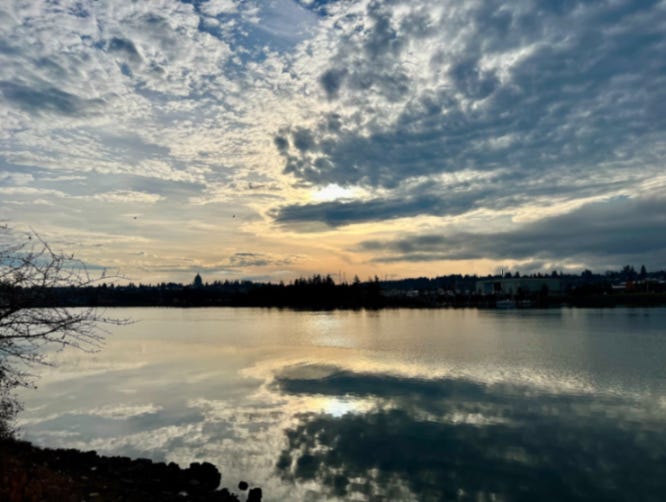
When I need to clear my head and reconnect with the plants and animals who share this land, I wander down Garfield Nature Trail or through West Bay Woods toward the waterfront. Herons call from the shallows, seals bark in the inlet, waterfowl murmur among the reeds, and willow leaves rustle overhead as the smell of saltwater and seaweed rises from the shore. I watch the sun rise over the inlet and set beyond the hills, with Mount Tahoma and the Olympic Mountains visible in the distance.
This space is part of a larger living system where freshwater and saltwater meet and reflects an ecosystem that is beginning to heal from decades of extractive industries and colonial degradation. As nearby old-growth forests in the Black Hills and Willapa Hills watersheds were clear-cut for profit and shipped away, the inlet was reshaped to serve the timber industry. Land was artificially filled with soil dredged from the water, and the shoreline was used for timber mills, log storage, towing, and railways. This industrial history continued as Hardel Mutual Plywood leached petroleum products, sodium hydroxide, formaldehyde-containing resin, glue, pitch, and other chemicals into the soil and the surrounding watershed. Today, the property still contains roughly 200 creosote pilings along with metal, concrete, dumped debris, and rocks that do not belong to the natural shoreline. The contamination left behind is not an isolated problem; it is part of the lasting environmental cost of colonial development and an extractive economy that has treated forests, wetlands, and waterways as resources to be exploited.
Now, despite all efforts to restore the inlet to a natural estuary, real estate developers are moving forward with a plan to generate corporate revenue under the guise of environmental remediation. West Bay Development Group is planning to build five three-story apartment buildings known as West Bay Yards along the shoreline. This project advertises a fragile ecosystem as a “luxury waterfront community.” Despite the fact that hundreds of residents voiced opposition to this project and local conservation groups such as OlyEcosystems appealed the decision, the City approved the project’s permits. This real-estate land grab is being presented as a shoreline restoration project when in reality it’s merely another way for developers to privatize already-limited public waterfront access, permanently destroying the possibility of interconnected ecosystem restoration.
This project will have devastating impacts on surrounding plant and animal communities, because the shoreline is part of the food web that supports salmon. Budd Inlet, including the proposed development site, provides shallow, sheltered nursery habitat where young salmon from watersheds as far away as the Green and Puyallup Rivers can grow before moving into larger waters. Its tidelands also support forage fish and shellfish that salmon and marine birds depend on for food. Filling those tidelands and covering the shoreline with gravel would replace aquatic habitat with land that can no longer serve those functions, and construction could disturb fish and nearby heron rookeries.
The development would further separate the shoreline from West Bay Woods, disrupting the movement of birds, nutrients, and plant material between the forest and the water. The original environmental surveys were conducted before the restoration of West Bay Woods was complete, and the preserve is now a healthy wildlife corridor directly beside the proposed project. Luxury housing, traffic, lighting, and commercial activity could permanently fracture this interconnected habitat.
The project would also change daily life for people who live nearby. Brand new luxury housing tends to inflate property values, which could intensify gentrification on the West Side.
This proposal reflects a larger question about who gets to decide what happens to Olympia’s waterfront and what “restoration” is supposed to mean. While communities are investing in salmon recovery, wetland protection, shellfish restoration, and the repair of damaged estuaries, private developers are increasingly being invited to combine cleanup, restoration, and commercial construction into one project, allowing environmental work to be shaped around what is profitable. In this case, the City determined that the proposal did not require a full Environmental Impact Statement, despite its size and location on a contaminated, flood-prone shoreline beside important habitat. That raises serious questions about whether the project has received the level of environmental review it deserves. It also raises a more basic question about public land and public access: Should a fragile waterfront be treated primarily as an opportunity for private development, or as part of a shared ecosystem and community resource?
The green scare, housing scarcity, burnout, trauma, and federal repression have taken their toll on the region’s direct action environmental movement. But as habitat loss, mass extinction, and climate change loom larger than ever, we must join together to resist extractive industries. The West Bay Yards proposal ties all of these issues together – the ways extractive industries have damaged our communities and watersheds, political regimes have removed decision-making power from impacted communities, and commercial development continues to make housing unaffordable and inaccessible to those who need it most. This project preys on our desire to restore ecosystems damaged by industry, but instead of directing that energy in a positive direction, it uses caring for the environment as a trendy footnote to justify the profit-gobbling, attempt to privatize public land. Affordable housing isn’t created by building more luxury apartments. And the last thing we should be doing in a climate crisis is bringing thousands of people to live directly on top of an unstable shoreline that’s in the flood zone and earthquake liquefaction zone.
Email wbdact@proton.me to get involved in efforts to organize around this project and other community-led environmental resistance efforts.