

by Whitney Bowerman
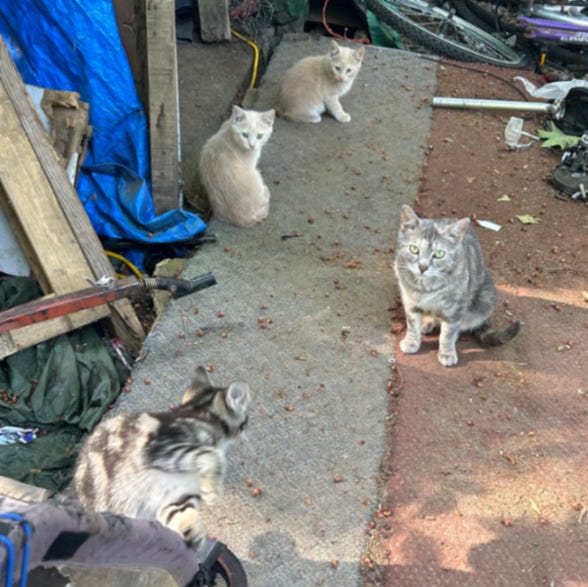
In May, the City of Olympia announced the beginning of a multi-year process to close The Jungle. It is the right thing to do. The site is unsafe and lacks the infrastructure to support human life with dignity.
However, conversations about encampment closures almost never cover the fact that the residents have animals, and lots of them! Almost all housing has strict rules about animals.
Most housing options permit a maximum of two animals. Encampment residents frequently have more. Additionally, animals must be spayed, neutered, and vaccinated to be accepted by most housing options — services that are genuinely difficult to access without transportation, funds, or the ability to keep appointments. So residents face an impossible calculus: which animals do I give up to get into housing? For many, the honest answer is none. They will not leave their cats behind. What looks from the outside like resistance to housing, is often something much simpler and more human. It is loyalty. It is love.
Pet Life in The Jungle
“Hello, hello! This is Whitney with Oly Camp Kitties! We have some cat food for you!”
This is how we announce ourselves at every campsite we visit in The Jungle. The responses we get vary — sometimes people wave, sometimes they shout, sometimes they just rustle their tent flap — but we almost always encounter a cat.
One resident we visit regularly has two of them. They are particular fans of Churu treats — the squeeze-tube variety that I affectionately call “kitty crack.” This resident is meticulous about ensuring each cat receives an equal number of treats in each flavor. They are genuinely concerned their cats would be upset if they received different things, that there might be conflict over it. This is a person paying close attention to the emotional lives of their animals. This is a person who loves their cats deeply and has, for many years, made a life with them in The Jungle.
When I describe scenes like this to people outside the encampment world, I am often met with surprise. “But I never see homeless people with cats,” is a common response. It is true! You don’t see them from the road or the sidewalk. But The Jungle is absolutely full of cats, hundreds of them when you count both the friendly/socialized ones and the feral ones who watch suspiciously from a distance. Residents know them — their names, their personalities, their histories, their relationships with each other. The cats of The Jungle are not strays wandering through. The cats are family.
Why People Experiencing Homelessness Have Pets
A common public reaction to learning this is: “Why do homeless people have pets if they can’t even take care of themselves?” This is a question that reveals more about the public’s assumptions than about the reality of unsheltered life.
People experiencing homelessness have pets for exactly the same reasons the rest of us do.
The science is clear. Interacting with animals boosts oxytocin and endorphins, reducing anxiety, lowering blood pressure, and improving overall mood and outlook. Caring for a pet creates routine and structure, things many of us take for granted, but which can be profoundly stabilizing for someone whose daily life is defined by uncertainty and instability.
And there is something even more fundamental at work. People experiencing homelessness are among the most invisible members of our society. Passersby avoid eye contact. People cross the street to avoid them. The daily experience of being unseen and unacknowledged is dehumanizing in ways that compound over time. A cat does not do this. A cat makes eye contact, it purrs, headbutts, demands attention, curls up in a lap. A cat says: you are here, I see you, you matter to me. For someone accustomed to being looked through, that is no small thing. It can be exactly the thing that gives a person hope.
The Hard Work Ahead
When encampments are cleared, the animals are never part of the government’s planning conversation. The burden falls on municipal animal shelters and animal rescue organizations who are suddenly absorbing animals with no warning and no resources allocated for their care. If the animals at The Jungle are not addressed systematically there will inevitably be a large number of animals left at the end. The honest and uncomfortable truth is that many of them will be euthanized. No one wants to say this out loud. But the shelter system cannot absorb a sudden, massive influx of animals. And the government actors planning this closure do not, as of now, have a plan to deal with The Jungle’s cats.
The resident with the two Churu cats has lived in The Jungle for many years. They are skeptical of the housing options available to them and resistant to how most housing projects are run. They are what service providers call “hard to house,” and they represent the population that will define the greatest challenge of The Jungle closure. This is not because they don’t deserve housing, but rather because the housing available has not yet been designed around people like them.
As the City and its partners work through what is expected to be an 18-month to two-year closure process, the cats will be there. Hundreds of them. Bonded to residents who will not easily be separated from them, and who should not have to be.
The measure of how well we close The Jungle will not only be how many people we house. It will be whether we were honest enough to plan for their extended family — the animals.