

by Arlo Dolven

History is not only what happened, but also how things are remembered. Since 1990, Works in Progress (WIP) has been a platform for the public and independent thinking of a community assuming control of its own history. A summary of WIP headlines from when it was first published up to now illustrates both the global and local nature of Olympia’s political sensibilities.
Fifty years of neoliberalism have demolished social and political institutions across the country. “Capitalism is eating democracy alive,” says cultural critic Catherine Liu. Organizations like WIP are the frontline of defense against the Far Right. With massive corporations devouring newsrooms everywhere, WIP lets Olympia tell its own story.
The Birth of Works in Progress
Works in Progress published its first newspaper in May of 1990, but its story starts two years earlier during Jesse Jackson’s remarkable 1988 presidential run. Influenced by the Black Panther Party, Jackson formed a national organization called The Rainbow Coalition to build mass support for his campaigns. During his 1988 candidacy, unofficial local chapters started to pop up all over, including one in Olympia that attracted a recent Evergreen graduate by the name of Sylvia Smith. Smith and the Thurston County Rainbow Coalition (TCRC) would go on to launch WIP, but not before a dramatic split occurred with the statewide organization, The Washington State Rainbow Coalition (WSRC).
When George H. W. Bush won the presidency in 1988, Coalition locals turned their focus to internal development. The WSRC began working on obtaining official status as a chapter of the National Rainbow Coalition (NRC). At their founding convention in early 1989, the WSRC elected a seven person executive committee. One elected member was Dave Jette of Thurston County, an idiosyncratic, popular figure among coalition members.
Jette described the founding convention as “wildly successful. Some 270 Rainbow members from all across the state attended it, and worked out a detailed political platform … to organize the most powerful, democratic, and progressive political organization in the history of Washington State.” Notably, the founding convention identified creating a statewide newspaper, called Rainbow News, as an important objective.
After the convention, Jette and two others travelled to Chicago to attend the National Rainbow Coalition meeting. There, the Washington delegation found themselves at odds with Jesse Jackson’s newly proposed organizational blueprint. Cindy Domingo, a leader of the King County Rainbow Coalition wrote, “Jackson … came down with an iron fist and stated … that all … Rainbow chapters will be transformed into his personal presidential campaign structure.” The WSRC defied Jackson’s proposal. As a result, they were rejected from officially joining the NRC, but continued under the Rainbow name.
Throughout 1989, divisions opened up at the state level along three significant lines. Some saw the Rainbow Coalition as a means of turning the Democratic Party into a truly democratic organization; others saw the Democratic Party as a means toward building an independent party; and a third tendency did not engage in electoral politics. The WSRC stagnated and membership declined from almost 1000 to 300. Jette was tasked with planning a retreat for March 1990 to address the situation, but for many in Olympia it was already too late. Sylvia Smith of TCRC wrote a scathing letter to the WSRC in advance of the retreat stating, “Our annual meeting … was a great success … Thurston County has not ‘dropped out.’ We just stopped paying attention to you.”
To compound the frustration in Olympia, the statewide coalition had flopped on one of its major objectives coming out of the founding convention a year prior. The statewide newspaper, Rainbow News, had barely gotten off the ground. There was no editorial board and the entire publication’s committee was composed of just one person. Feeling frustrated with the WSRC and increasingly distant politically, Sylvia Smith and a few others in TCRC decided to launch a newspaper of their own. In May 1990, Works in Progress hit doorsteps for the very first time.
Works in Progress once presented itself as a project of the Thurston County Rainbow Coalition, but it was clear early on that Olympia felt the gap between them and Jackson was widening. In July 1990, WIP published an article by Alexander Cockburn titled “Don’t Run, Organize,” that criticized Jackson for being uninterested in “building a political movement capable of acting in any way independent of his own personal political ambitions.” Shortly thereafter, much to the chagrin of the TCRC membership, Jackson defended Operation Desert Shield, saying that the United States must be ready to “use military force, multilaterally or unilaterally” to defend its diplomatic partners (Saudi Arabia and Kuwait) from Saddam Hussein’s Iraq.
Jackson endorsing military escalation in the Middle East inflamed statewide tensions and caused things to boil over. In September 1990, Dave Jette — who still maintained his position within TCRC and on the state executive committee — took the mailing labels from WSRC and helped WIP send its September issue to the entire state. Inside, he had penned an article titled “The Rise and Fall of the Washington State Rainbow Coalition,” where he criticized the WSRC for being overly bureaucratic. At the following executive committee meeting Jette sardonically asked permission to use the statewide mailing labels for WIP again in October. The committee rejected his request and suspended him for stealing the mailing labels.
In advance of WIP’s October issue, Jette once again stole the statewide mailing labels so that WIP could send that issue directly to every Rainbower in the state. On the centerfold he wrote, “The National Rainbow Coalition is now nothing more than an extended campaign committee for Jesse Jackson. The problem lies not with Jesse Jackson … The problem is with progressives who attach themselves to the Jackson campaign instead of tackling the far more difficult task of building a democratic, grassroots-based progressive political movement.”
Rainbowers in Olympia saw Jette’s antics as heroic and brave, but many elsewhere thought they were contrarian and irresponsible. In a recent interview, Cindy Domingo reflected that Jette’s defiance demonstrated a short-sightedness that did not take seriously the long-term project of building political power. As TCRC drifted away from the statewide organization, the Rainbow Coalition legacy manifested differently across the state. King County found electoral success in the 1990s and many of its members held office well into the 21st century. Thurston County continued publishing Works in Progress, which would go on to become one of the longest lived independent newspapers still circulating in Washington.
Critical Reporting by Works in Progress
For the next 36 years Works in Progress has published articles covering local land use, police brutality and surveillance, social movements, and international issues, just to name a few. In 2012, WIP published an open letter to Olympia City Council titled “Stand Up For The Plan: Reject the 7-Eleven at Harrison and Division.” It received a massive amount of signatures and led to the creation of West Central Park. WIP’s ongoing coverage of American imperialism, from Nicaragua, to Iraq, to Palestine bolstered the anti-war politics that is a hallmark of Olympia today.
In the early 2000s, the Iraq War came home, when it was uncovered that the Port of Olympia would be used to ship Stryker combat units (large military vehicles) to Iraq. In 2006, Olympia Port Militarization Resistance (OlyPMR) coalesced to educate the public about the war and organize direct actions to raise the social cost of using the Port of Olympia. OlyPMR’s goal was primarily to delegitimize the Iraq War, which had been propped up by years of manufactured consent by a hawkish, Islamophobic corporate media landscape. OlyPMR needed a news outlet that was willing to publish their anti-war message. WIP was the only game in town.
The high water mark for OlyPMR came in late 2007. Mass mobilizations on November 9 and November 13 completely blocked the Port for over 30 hours in total. In a WIP article titled “Two Weeks that Shook Olympia,” Evergreen Professor Peter Bohmer wrote, “Olympia resembled an occupied city with police spread out in riot gear and military convoys on the streets.” In later years it would be uncovered that an FBI informant had infiltrated the protests.
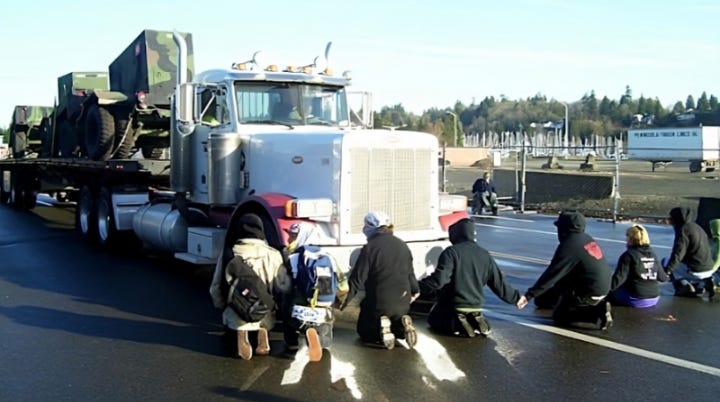
The Olympian sent reporters to the scene, but utterly failed to report on the excessive police violence, even against their own reporters. In a November 15 editorial titled “At the port: What happened and what did not happen,” then Executive Editor Vickie Kilgore smeared protestors as “whiners” and called for them to be prosecuted for property damage and disruption of traffic. Bohmer, in his WIP article, reported that just two days earlier the Olympia Police Department shot a bystander with multiple pepper balls and struck him in the face with a baton.
In her editorial, Kilgore also brushed off accusations that the police attacked one of her own journalists, Matt McVay, on the job. Brendan Funtek, a staff member at The Olympian took to WIP to publish his perspective. He wrote, “I’ll always remember the feeling of numbness and nausea that coursed through my body the day I read Vicky Kilgore’s editorial.” She “directed public ire at unaccountable protesters and dismissed McVay being shot [in the face with a pepper ball] by an accountable police department.” As Funtek wrote, Kilgore’s representation was completely contrary to how events played out in real life. The police brutalized protestors and bystanders. WIP’s coverage provided a counter narrative and legitimized OlyPMR’s direct actions against the Iraq War in an otherwise hostile media landscape.
In a recent interview, Sylvia Smith reflected that The Olympian’s poor coverage of OlyPMR was not the fault of individual reporters, but rather their for-profit structure. The Olympian has been tossed around by some of the largest corporate news outfits in the country for the last 50 years. It was most recently acquired in 2006 by McClatchy Media Company — owned by the hedge fund Chatham Asset Management. Chatham’s founder, Anthony Melchiorre, was invited to dine with Trump at the White House in July 2017 after wielding his hedge fund to help “Catch and Kill” negative coverage of Trump in the run up to the 2016 election.
Community and Legacy
Works in Progress is not only independent from hedge funds; it was forged in the hearth of community organizing and remains entwined in the social movements pushing Olympia forward. WIP itself represents the fight for local news, a resource that is becoming more endangered each year. Community institutions are capable of producing knowledge that can push back on hegemonic narratives and create a counter balance of power. Since the 1990s, the people of the South Sound have seen their story told in Works in Progress.
100 years ago, Benito Mussolini and the Italian fascist party took power. They killed and imprisoned the socialist, communist, and anarchist leaders of the time. Antonio Gramsci, a leader of the Communist Party, contemplated the ascendance of Italian fascism from his jail cell. What had allowed such violent and corrupt politics to take hold? Among his richest conclusions was that the Italian working class was organized by forces antagonistic to its own actualization. The Catholic Church, the press, Italian literature, and other social institutions that shaped the thinking of everyday Italians had become deeply entrenched in capitalist politics. When fascists pushed for power, they found it easier to tap into a political ethos that was already latent in the Italian public. Future movements for socialism, Gramsci concluded, would need to find ways to create their own history where they are the protagonists.
From his jail cell, Gramsci wrote, “To tell the truth, to arrive together at the truth, is a communist and revolutionary act.” That is, to tell it, to have an active role in creating it. The creation of history relies on protagonists. Works in Progress knows who the protagonists are. That is what makes us news for the movement.