

by Carl Eugene Stroud
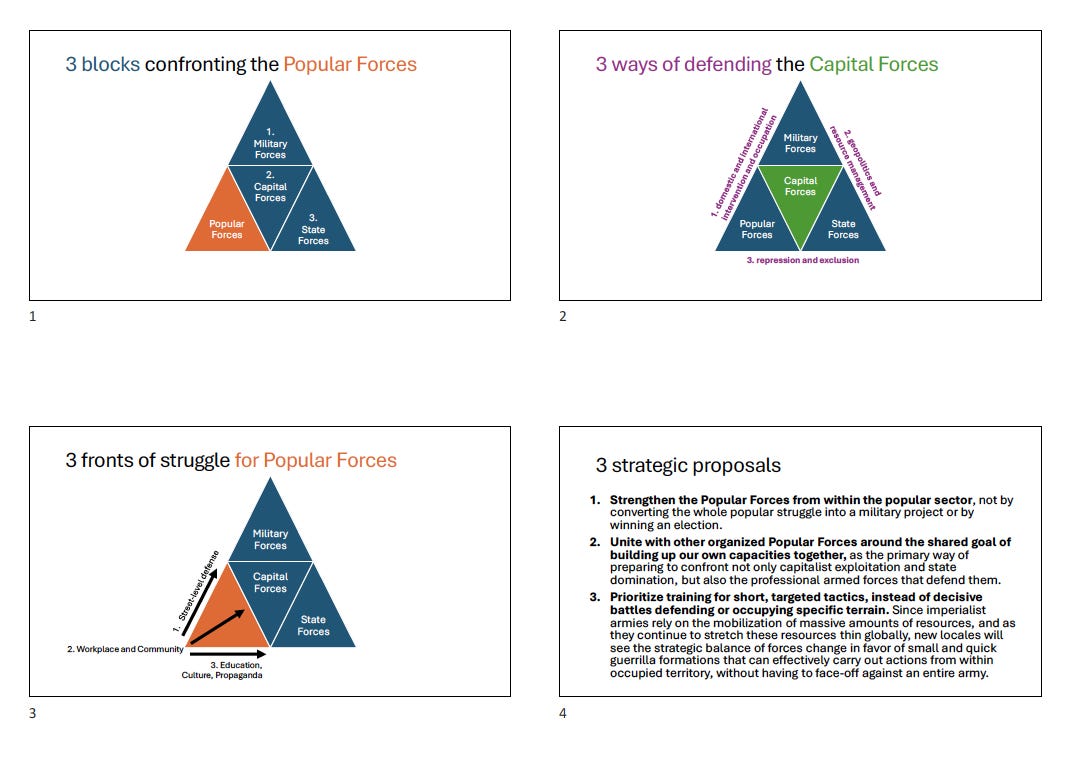
If you follow the news at all, you’ve definitely encountered their extra easy-to-understand theory of war, a theory that presents armed conflict like a soccer match. The pervasiveness of this theory has created a situation where the dominant narrative about American-Iranian relations might be true, but it’s not the whole truth. Billing it as two sides facing off against each other increases the number of spectators watching from home, but it doesn’t help us see where, how, or why various forces are behaving the way they are.
The intrigue of a potentially declining world leader going head to head against a re-emerging regional powerhouse is useful propaganda, and that sells. So, pretty much all the media outlets around the world pose the same rhetorical questions. In any number of different languages, they repeatedly ask if this is the end of US hegemony and whether or not Iran controls the Strait of Hormuz. They want to know definitively if Trump made a mistake in starting the war and where the negotiations are headed. And of course, they have to ask: does the most recent attack fall outside of the current ceasefire agreement?
In political analysis, it isn’t useful to consider nation-states as bastions of solidarity. The premise that both sides are solid masses without internal contradictions is way too convenient. It shouldn’t be taken for granted that the state forces are the most capable of rallying everyone else behind their cause. This means the harmonious coordination of military, capital, and state forces should never be assumed since their relationship is always in flux.
For example, there are politics involved in the exercise of military power. Any theory that conflates state apparatuses with military might incorrectly expects the chain of command (or some other structural assurance) to prevent the need for analyzing the relations between different sectors.
However, since power is a social force, social dynamics can’t be subtracted from the equation. That explains why all the capitalists of the world don’t just come together and form a single block of power to control all the others. We shouldn’t expect them to team up and defend one side because they play for both teams and change sides when there’s more money to be made.
Some capitalists are against the war in Iran because high oil prices generally increase the cost of doing business. But others, like weapons manufacturers and the makers of electric vehicles, are fine with the current situation because it increases the overall demand for their products as well as their customer base.
Still, generally speaking, war between nation-states is good for the capitalist system because it distracts from the class struggle, domestically and internationally, and leads us to underestimate the role that people play in the formation, maintenance, and reproduction of power.
Capitalists will position themselves to profit regardless of which side wins, but military leaders, have a different task. The allegiances of the US Armed Forces and the IRGC are obviously to their own respective states, but just like how the capitalist forces must accurately consider the material reality of doing business, the military forces must consider strategic planning and logistics using their own theories and methodologies.
This is why the popular forces should be seen as something distinct from the military, state, and capitalist forces. They’re different because they’re unmediated. Even within the current paradigm, the popular forces have a unique kind of flexibility since they’re not bound by military strategy, profit margins, or statecraft. They don’t have to use the dominant modes of power to organize communities, workplaces, and industries.
The international working class has the potential to reproduce it’s own power, through its own labor. But popular forces can only be strengthened from within the popular sector. They aren’t helped by the oil industry’s critiques of the war or the military industry’s embrace of it. The same is true for the actions of the US or Iranian militaries and the executive orders of government leaders.
Most theories of geopolitics are only concerned with the interactions between the (mostly synonymous) state and military forces. This usually gets boiled down to a narrative with a “home team” taking on an “away team,” just like in sports. But while there are undeniably state and military forces at play, there are also capitalist ones as well. And most significantly, there are popular forces that encounter the others in the form of repression and exclusion, exploitation and poverty, occupation and violence.
Superficial theory limits our actions. With a theory that considers states the only relevant forces, the international working class won’t notice the other potential forces at play, including its own. When the only methods we see are geopolitical, we’re left with nothing to do but watch the news and wait for peace to be brokered by the same political class that started the war in the first place.
While this article can’t be a substitute for specific strategic proposals, this theoretical framework can help us recognize opportunities for people to have an influence on international conflicts. A salient, working class theory of global power relations is a necessary foundation for revolutionary politics. The popular forces of the world don’t need states to declare war and peace on their behalf; what they need is a sense of their own agency and collective will. This means staying focused on the class struggle and leaving the overly simplistic theoretical tools to the football commentators.