

by Morgan Atwater
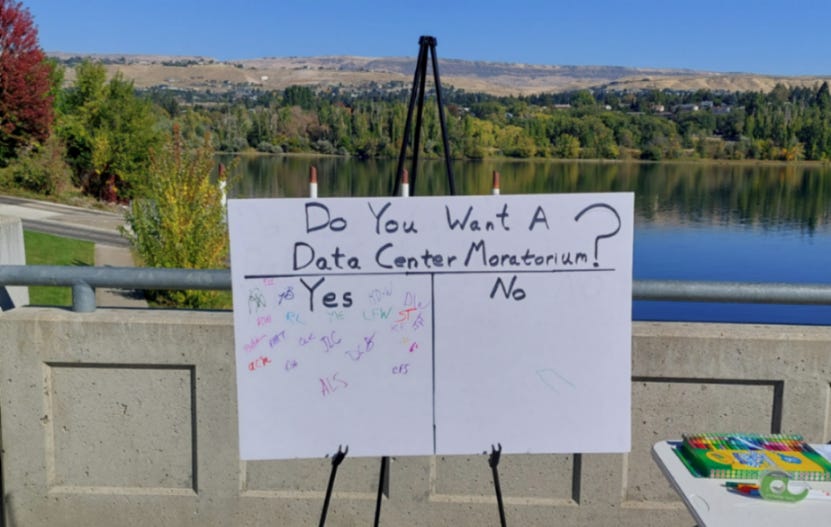
On October 4, we stood beside the beautiful Columbia River in Wenatchee and asked people passing by on the Loop Trail if they wanted to see a data center moratorium. We had them sign their initials on a tally board under “YES” or “NO.” During the time that we were there, we collected 24 “YES”s and 0 “NO”s.
Our action was one of at least 19 events that were part of a statewide day of action demanding a data center moratorium in Washington, organized by Washington AI Resistance. 15 cities participated, including Olympia, Seattle, Tacoma, Tukwila, Moses Lake, Cle Elum, Ellesnburg, and Spokane. We planned to take our tally board to the last of three community meetings hosted by our Chelan County commissioners to show demand for a countywide data center moratorium.
Without a statewide data center moratorium, as a Puget Sound Energy (PSE) customer, your electric rates hinge on enough rural Eastern Washingtonians getting mad at data centers to stop them from coming into our communities and gobbling up our power. Your fate lies in our hands.
Obligation to Serve
At the county commissioner community meetings, we brandished a new zine which highlights an April 2026 report by Energy and Environmental Economics (E3). You can view the zine in English or Spanish on the No Data Centers NCW Linktree.
Chelan PUD did not like us talking about this report, even though they were one of the utilities that had sponsored the study.
The report paints a dire picture of the Pacific Northwest’s ability to provide enough power for our region in the coming years. They predict an almost nine gigawatt power supply shortfall by 2030. This comes with a risk of rolling blackouts (“reliability events”) and unavoidable rate increases. The largest driver of load growth is “anticipated data center interconnection.”
Despite this, the report never suggests reducing the size or number of data centers as a solution.
Alarmingly, the E3 report reads almost like an ad for natural gas. It says that “Achieving 100% carbon reductions is not feasible without at least one ‘clean firm’ technology available at scale,” and “If new natural [gas] generation is not allowed, costs and build requirements increase significantly.”
When I read this, I had an awful premonition of this report being leveraged to strike down the Clean Energy Transformation Act rather than being used to reign in data centers.
PSE just proposed a new three-year plan that would increase electric rates by nearly 30%. And Chelan PUD, after adamantly insisting that their rate policy would insulate residents from rate hikes, just unveiled a five-year plan that would increase our rates by nearly 28%. Chelan PUD actually supplies a large portion of PSE’s power: PSE gets 25% of our hydropower output.
There is less and less energy to go around — especially renewable energy. Every new data center competes for power with existing customers, including utilities like PSE.
During a Chelan County candidate forum hosted by independent reporter Dominick Bonny, an interesting question came up in the Zoom chat, which one candidate chose to answer. His response didn’t make it into Bonny’s recap, but I took note of it. Aaron Young is simply a candidate running for PUD Commissioner, not a current commissioner, but his viewpoint is very typical for the position.
The question asked: “What will you do to ensure that not only local Chelan County residents but also Washington state residents on the west side will be protected from rate increases due to increased demand on our local renewable energy from data centers? Also, what will you do to ensure that data centers are not taking away power that could be used to help us transition off of fossil fuels?”
Young responded: “As a Chelan County PUD Commissioner, I would place the needs of Chelan County first. It would not be my practice to consider the costs of power in other areas as part of the decision making process. I would place importance on the reliability, sustainability and responsible approach to all power generation, and all rate decisions. It is the responsibility of the PUD to provide service to Chelan county customers and not to decide which customers to provide power to.”
For anyone in Western Washington hoping that our Chelan County elected officials will have your best interests at heart, know that you don’t factor into their decisions at all. They will sell you out in an instant to supply power to data centers instead.
This is the so-called “obligation to serve.”
The Community Speaks
At the September 30 community meeting in Leavenworth, we asked Chelan County Commissioner Shon Smith point-blank if he would support a data center moratorium. He said at this time, no.
Most of the Leavenworth residents were angry about a cell tower that was slated to be installed in the area. But as we expressed concerns over data centers, other folks started asking questions about them, too.
At the very end, a constituent took an informal poll. He asked who in the room wanted to see six new hyperscale data centers in Chelan County. Zero hands went up. Then he asked who wanted to see a pause in data center construction in Chelan County. Every single hand in the room went up — including Commissioner Smith’s. He didn’t want to be the only one not raising his hand.
In the space of two hours, we successfully peer-pressured one county commissioner into reversing his position, albeit in a very informal, non-binding vote.
If this was the response at Leavenworth, what were we going to see at Chelan County Commissioner Kevin Overbay’s community meeting a few days later? That one would be happening in Malaga, ground zero for hyperscale data centers in our county.
Not long after, I noticed a sign up in Wenatchee that said “No data centers next to homes.” It directed people to attend the same meeting we were planning on bringing our tally board to.
I felt a surge of excitement in my chest as soon as I saw that sign, because it was not ours. Someone else in town was trying to organize people to fight data centers. Commissioner Overbay had a storm coming his way.
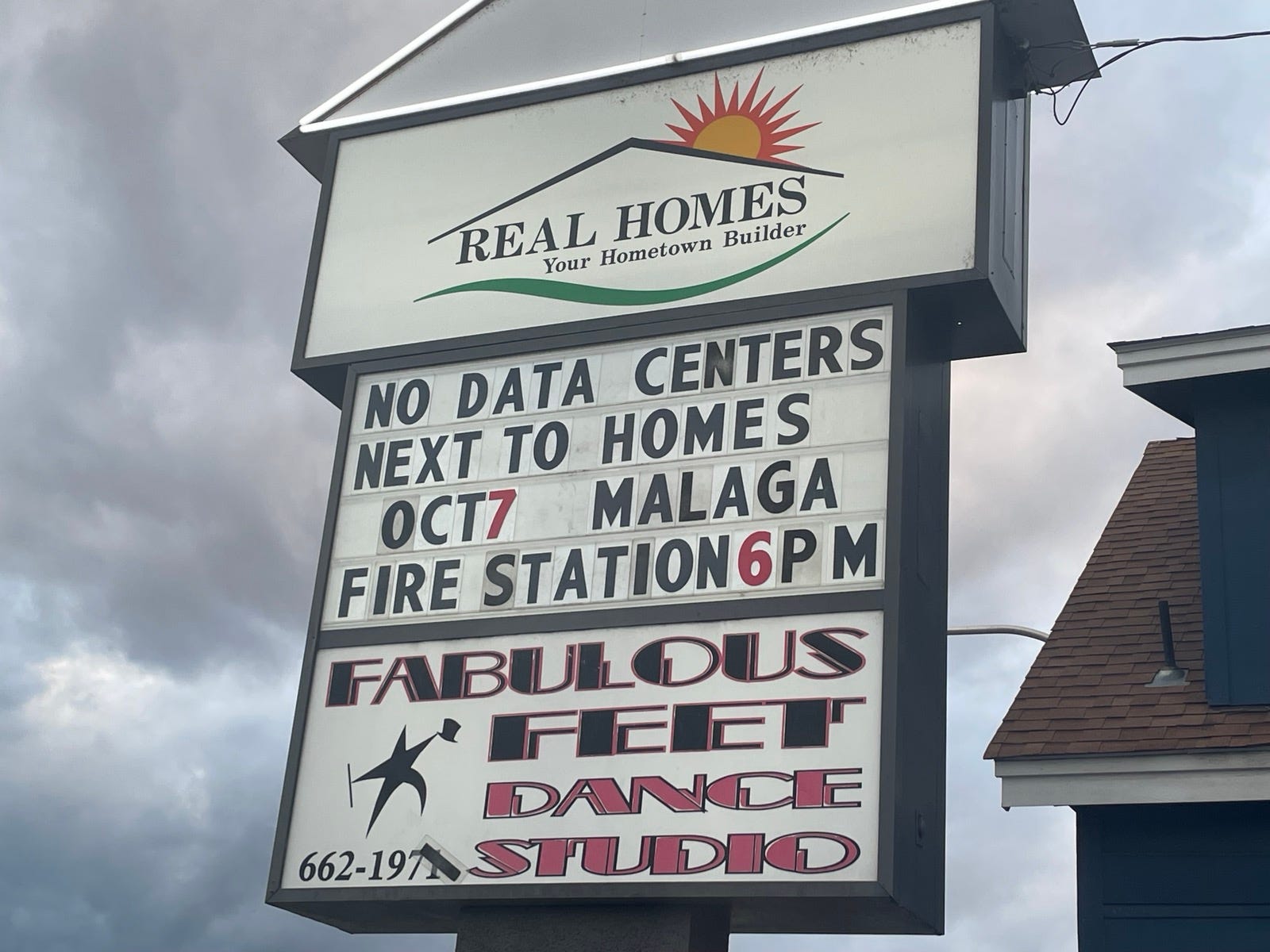
So many people came to Malaga Fire Hall on October 7, the crowd spilled to the sidewalk outside of the building.
To my surprise, data centers weren’t the only topic on the minds of Malaga residents at that community meeting. After the combined organizing efforts of No Data Centers NCW and the community member who put up that sign and paid for mailers to be sent out, I assumed most of the attendees were there because of data centers. But people had other questions and concerns. They easily filled the hour and 40 minutes that Commissioner Overbay blocked off before allowing the data center topic to finally be opened. Later, someone explained to me that Malaga is undergoing a lot of change right now. The high level of public engagement at this community meeting reflected people’s anxiety over the future.
They were watching the rural community where they had spent their lives develop into something else right before their eyes.
Many of their concerns were indirectly data center concerns. For instance, Microsoft is funding an infrastructure upgrade to Malaga’s water system. This invites questions about the aquifer and related issues. Microsoft is of course benefiting directly from these infrastructure improvements, which are necessary to support the development of their data center campus in the area.
Examples like this are cited when our elected officials tout the benefits of data centers. Personally, I don’t think we should rely on corporations to fund essential infrastructure. Microsoft will only help us as long as it benefits them. This is the devil’s bargain they offer us. Let us in, and we will pay for all of the things you can’t or won’t fund with taxes.
It’s easy to see how community after community falls for this trick. Everyone is desperate for easy money, and no one wants to look at all the problems that come with it.
In public comments, and in the “Neighbor Brief” that was distributed among the attendees, Malaga residents cited concerns with light pollution, noise pollution, and air pollution. One person’s voice shook with emotion as she expressed worries about how the light from the data center might be affecting the local bat population.
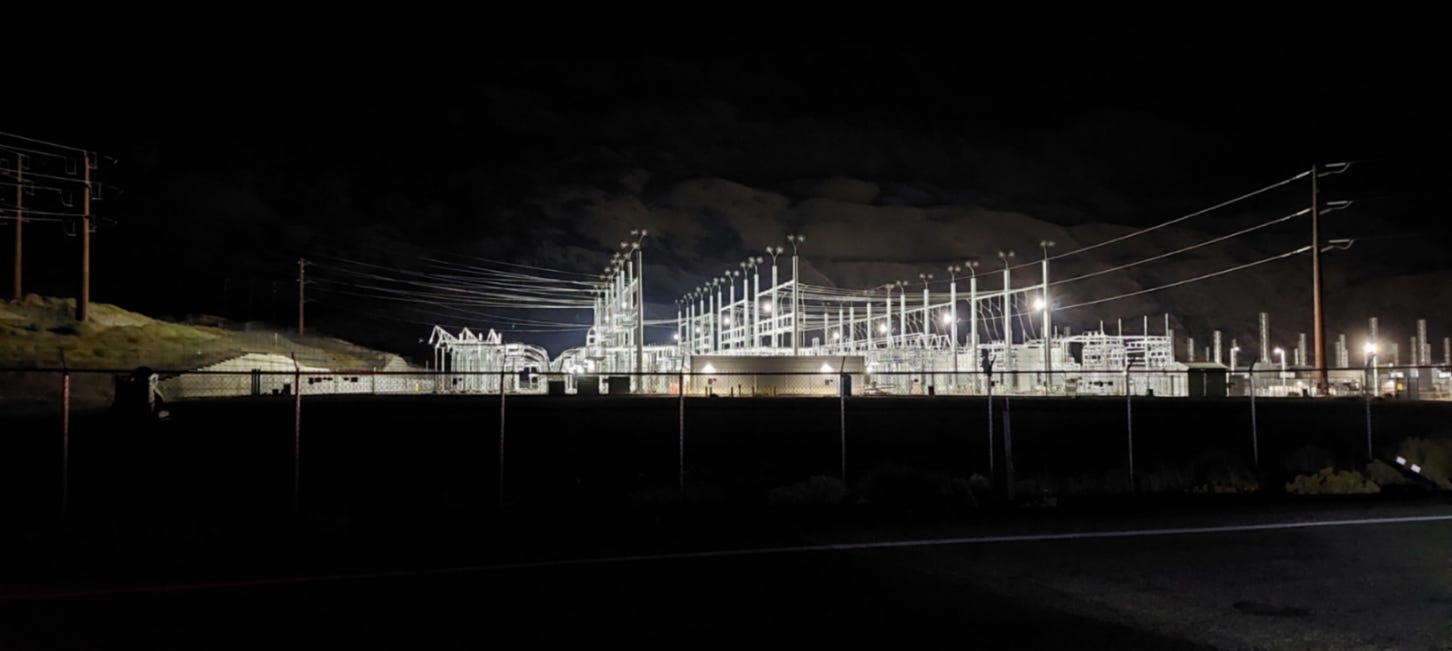
That night, after the community meeting wrapped up a full hour after its scheduled time, we drove by the Microsoft data center before heading home. The data center campus is impossible to miss. Bright lights flood the sky, illuminating the nearby hills with a ghastly glow.
As I stared out at it, I thought about the hunger and excess of these tech companies. What incredible greed to take not only our power and water and land, but the stars, too.
Morgan Atwater can be reached at morganatwaterwrites@proton.me.