

by: Peter Bohmer
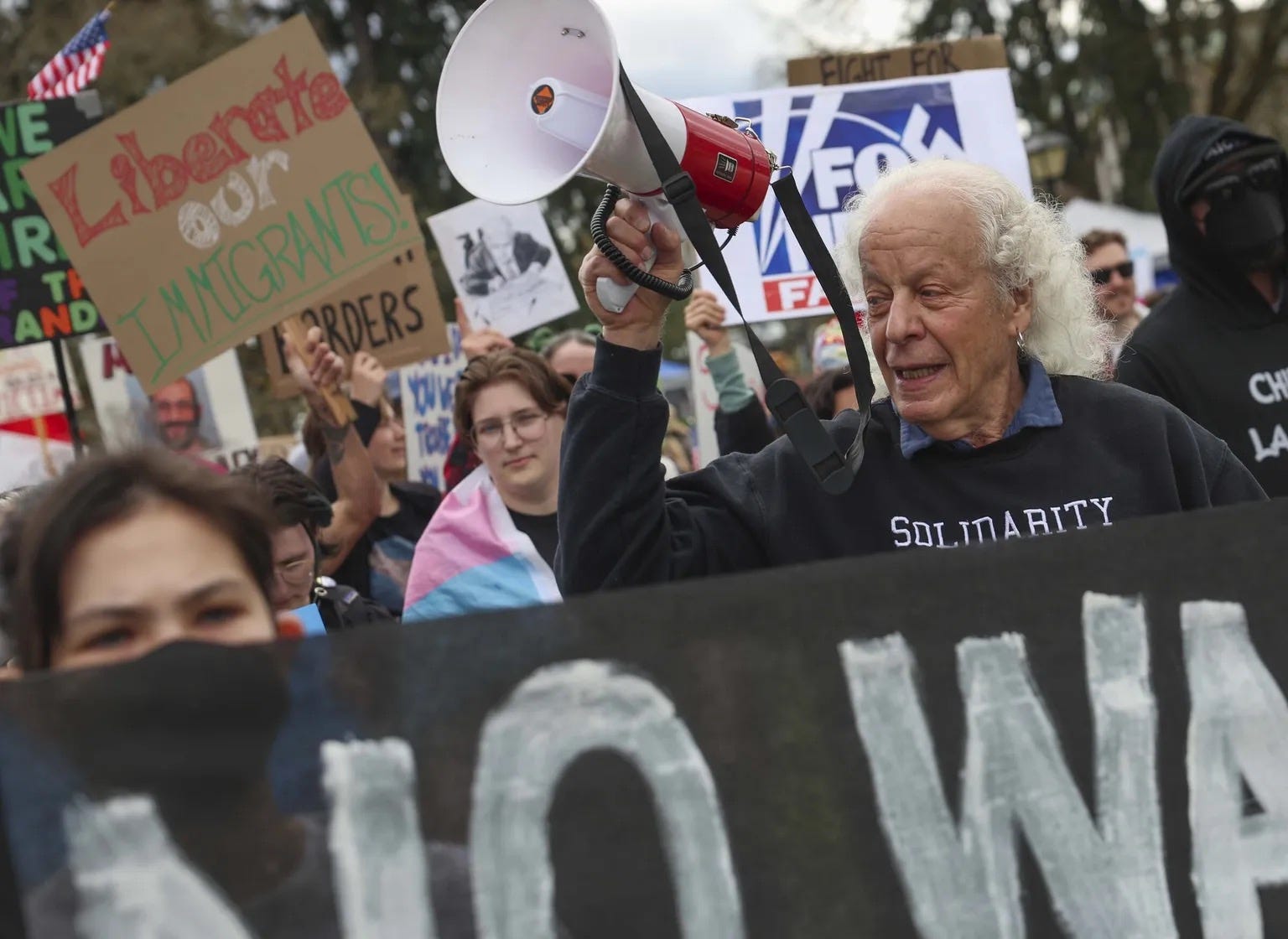
Trumpism is waging a war against the people of U.S. and the rest of the world. It is an authoritarian, bullying playbook that violently oppresses, exploits, and dehumanizes immigrants and poor people at home and abroad. The U.S. takes resources from the Global South through resource imperialism and demands total geopolitical dominance. The U.S. has no right or authority to intervene in other countries. Not surprisingly, this authority is seldom questioned by either of the two major political parties or the mainstream media. The following four cases demonstrate a bipartisan project of U.S. intervention that is both immoral and illegal. With blatant and murderous U.S. imperialism on the rise, we need a popular movement to build the power to stop it.
Palestine/Israel
The U.S. has given Israel $300 billion in aid since its founding in 1948, which Israel has used for its illegal occupation of the West Bank, the annexation of Jerusalem, and many wars against Gaza dating back to well before October 2023. This has led to the forced displacement of hundreds of thousands of Palestinians. The U.S. also supports Israel’s intense bombing of Lebanon which has killed more than 1100 people, displaced one million, and has led to Israel is occupying southern Lebanon again.
Israel has consistently violated the October 2025 ceasefire accords with Hamas by blocking food and medical aid from entering Gaza. The Israeli military has killed 700 residents since the ceasefire was announced in October, 2025. Our movements must oppose the illegal occupation and genocide by demanding the withdrawal of Israeli troops from Gaza and the West Bank as well as the opening of all the borders to Gaza. Palestinians deserve dignity and equality, which means ending the occupation of Palestine, establishing right of return for Palestinians, and equality for all people living in Palestine/Israel. Boycott Divestment Sanctions (BDS) campaigns such as the Boycott Chevron campaign and the successful campaign to get the City of Olympia to divest from companies involved with Israel show that we can have a material impact if we organize collectively. However, our most important demand remains unmet: the demand for the U.S. to end all aid to Israel.
Venezuela
On January 3, 2026, the U.S. blatantly violated both international law and its own laws when it invaded Venezuela, killing 130 people and kidnapping President Nicolas Maduro and his wife, Cilia Flores. Since then, the US has threatened to invade Venezuela again if it sends oil to Cuba or does not bend to the Trump administration by opening its economy to be exploited by U.S. corporations. We demand ending to U.S. terrorism, including the killing of more than 160 Venezuelans and others on small boats off the Venezuelan coast. In addition, we demand the withdrawal of the U.S. military from the Caribbean and the immediate release of Nicolas Maduro and Cilia Flores.
Cuba
The U.S. has conducted a covert war against Cuba since the revolution led by Fidel Castro overthrew the Batista dictatorship in 1959. In the eyes of the U.S., Cuba's crime has been its independence. The Cuban revolution brought many advances for the Cuban people: free, high quality health care and education, as well as cultural sovereignty and the dignity of its people. Economic problems such as a lack of consumer goods are partially caused by the US blockade, which severely cuts Cuba's ability to import goods. The Trump administration's position, led by Marco Rubio, is starving the Cuban people by stopping all oil shipments. This is murder and economic war. Trump claims Cuba is next on their hit list after Iran. We demand no to war on Cuba, the end of the U.S. blockade, and reparations to Cuba for a 64 year old embargo.
Iran
In 1953, the CIA overthrew the democratic Iranian Government led by Mohammed Mossadegh and replaced him with the repressive, pro-Israeli Shah, Mohammad Reza Pahlavi. In 1979, a popular uprising overthrew him, bringing Ruhollah Khomeini and Ali Khamenei to power. However, recent popular opposition has responded to their conservative interpretation of Islam and repressive political leadership.
The United States and Israel are committed to overthrowing the Iranian government. They both want to dominate the Middle East militarily, economically, and politically. Iran is an impediment to this imperialist aim, which compelled the U.S. and Israel to launch this unprovoked war on February 28, 2026. 2,000 Iranian civilians and counting have been killed, including 168 school children and 14 teachers in a single U.S. missile attack. Iran is justifiably defending itself by raising the social cost to the U.S. and Israel by attacking U.S. military bases in the region, attacking Israel, bombing Gulf oil facilities, and blocking oil shipments through the Strait of Hormuz. Prices of oil, natural gas, and fertilizer are rising rapidly. At home, inflation is increasing and the standard of living of working-class Americans is declining further.
Building an Anti-War Movement
There has never been a war that has been as unpopular from the start as this U.S.-Israeli War on Iran. This tension creates an opportunity to convince the U.S. to withdraw and end its attacks on Iran. The No Kings rallies locally and nationally are important actions towards stopping these wars and the Trump agenda but they alone are not enough. Voting matters but it alone is not enough. Many levels of protest and resistance are needed: people in the streets, direct actions against institutions complicit with this war machine, non-compliant non-cooperation, and more.
Currently, there is no mass anti-war movement in the United States. Moving beyond one-off mobilizations and building an infrastructure for ongoing organization that actively involves people is necessary. So is a movement focused on all lives lost, not just the lives of U.S. citizens. It is important to reach out to those already involved, to do political education, and to make it easier to get plugged in. Building this infrastructure will create the conditions that help form a mass anti-war movement, expand its effectiveness, and increase its longevity. Why this hasn’t happened yet is not entirely clear.
One reason might be that there wasn’t a buildup of U.S. propaganda to influence public opinion before the U.S. attacks on Iran. This is a partial explanation of the low support for the war. On the other hand, there wasn’t time to build an anti-war movement either. There was a broad Palestine solidarity movement in 2023 and 2024 against the U.S. backed Israeli genocide against Palestine, but this movement has weakened despite the U.S. continuing to fund Israel’s murderous attacks on Lebanon, Gaza, the West Bank, and Iran. Repression and fear are a cause for the weakening of the Palestine solidarity movement. Fear should not stop us. There is a lack of anti-war organizations that can effectively mobilize or involve large numbers to oppose U.S. aggression abroad in the way that various organizations existed in the 1960s, for example.
Sending soldiers into Iran causing mass U.S. casualties shouldn’t be necessary for bringing people into the streets, but it would likely have this effect. That is why it is important to focus on all casualties, not just the ones from the United States. It is also important to connect the war to the increasing hardship for working class people in the U.S., as inflation increases faster than wages as the war continues.
In the anti-war movement against the war in Vietnam, the anti-apartheid movement, and in the Palestine solidarity movement, especially the encampments in Spring 2024, students have played a major role. Spring is the season when student movements are usually the most active. There is a good possibility a student movement will rise up this spring in support of anti-war, immigrant solidarity, and climate justice. Additionally students can help resist the increased control of university curricula, admissions, and hiring of faculty and staff by the Trump administration, which is part of their racist agenda. Student movements are the strongest when issues of national and global importance are connected to campus complicity such as college portfolios supporting the war in Iran, involvement with Israel, or collaborating with ICE.
In the Olympia and Thurston County area, there is a need for a strong anti-war organization that continues to include Palestine solidarity as a focus while making room for other causes. As mentioned, stopping U.S. wars against Iran and Cuba should be integral to local organizing as well. Including anti-nuclear weapons and building an ongoing structure against the next war would be a powerful stance and draw in more participants.
Another option would be to form an organization that explicitly connects economic and social justice at home and U.S. aggression abroad. An example was the Olympia Movement for Justice and Peace (OMJP), a group that was active in the 1990s and early 2000s. Its focus was anti-imperialism and also support of the homeless, solidarity with farmworkers, universal healthcare, and organized many events including forums, conferences, and demonstrations. Domestic oppression and exploitation of the working class are intrinsically linked. Immigration is a clear example of this.
Let us take initiative to organize ourselves and form groups that go beyond single issues, and that respect and cooperate with existing progressive organizations in the area. We need to go beyond only organizing and mobilizing to return to the pre-Trump status quo unless we want another Trump in 2032.
Speaking out and organizing against attacks on democracy and defending social programs while simultaneously winning non-reformist reforms are a necessary and desirable strategy. Non-reformist reforms are ones that build our power, our political consciousness, and our capacity so that we can fight harder with more resources. Reforms are important stepping stones for our movements, but in the long run capitalism cannot be reformed, it must be overthrown. Examples of non-reformist reforms include reigning in U.S. imperialism, quality health care and housing for all, a universal basic income, free child care, free higher education and cancelling student debt, climate justice, and an end to deportations. These reforms will allow us to fight more ardently for reproductive, trans, and racial justice, as well as labor issues such as meaningful work and a shorter work week.
The need to connect this program of meaningful reforms to an anti-capitalist perspective that develops participatory socialist alternatives is necessary in expanding the imagination of the public in seeing a world beyond the current order. “Our alternatives,” as Rosa Luxemburg said more than 100 years ago, “are barbarism or socialism.”