

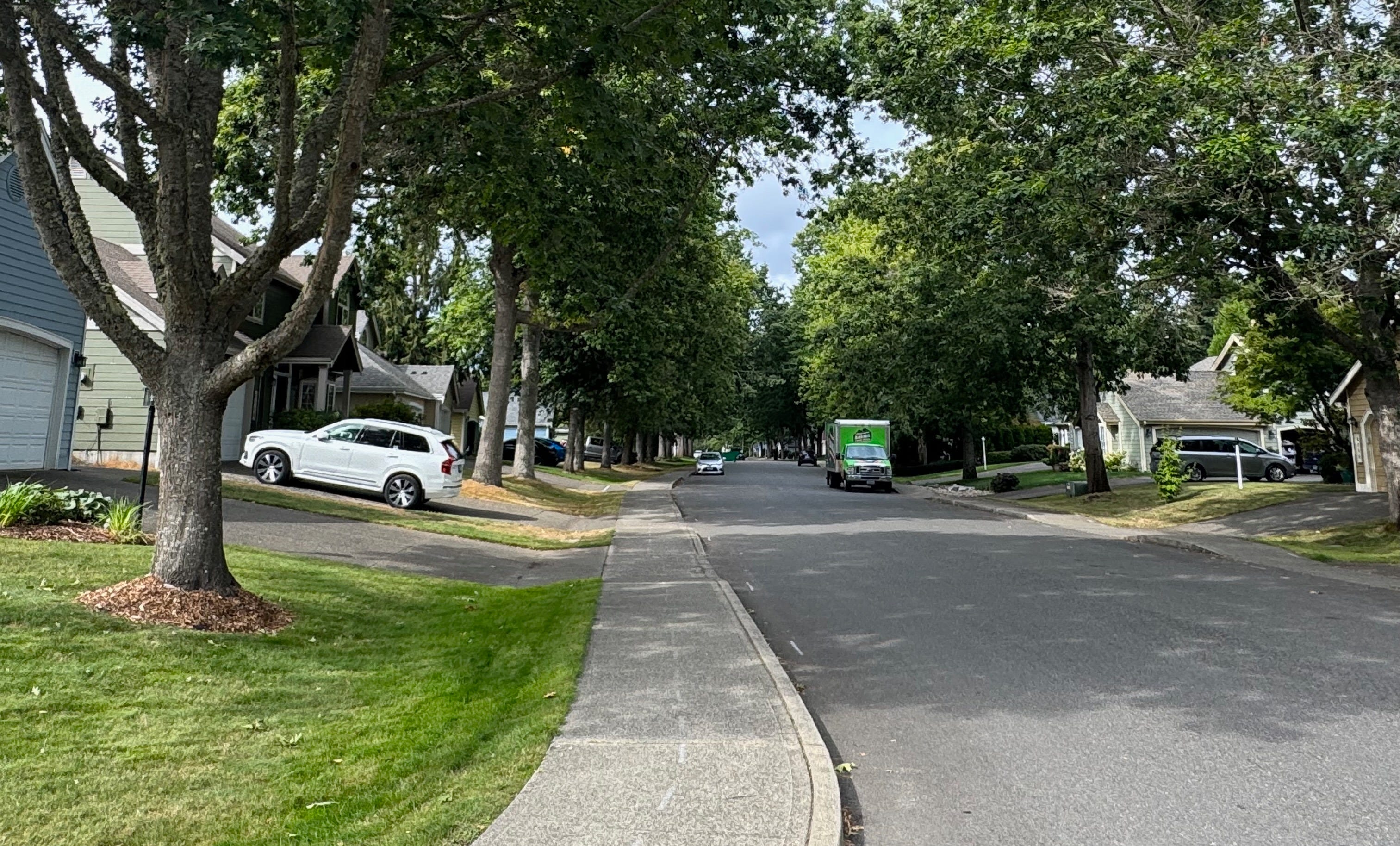
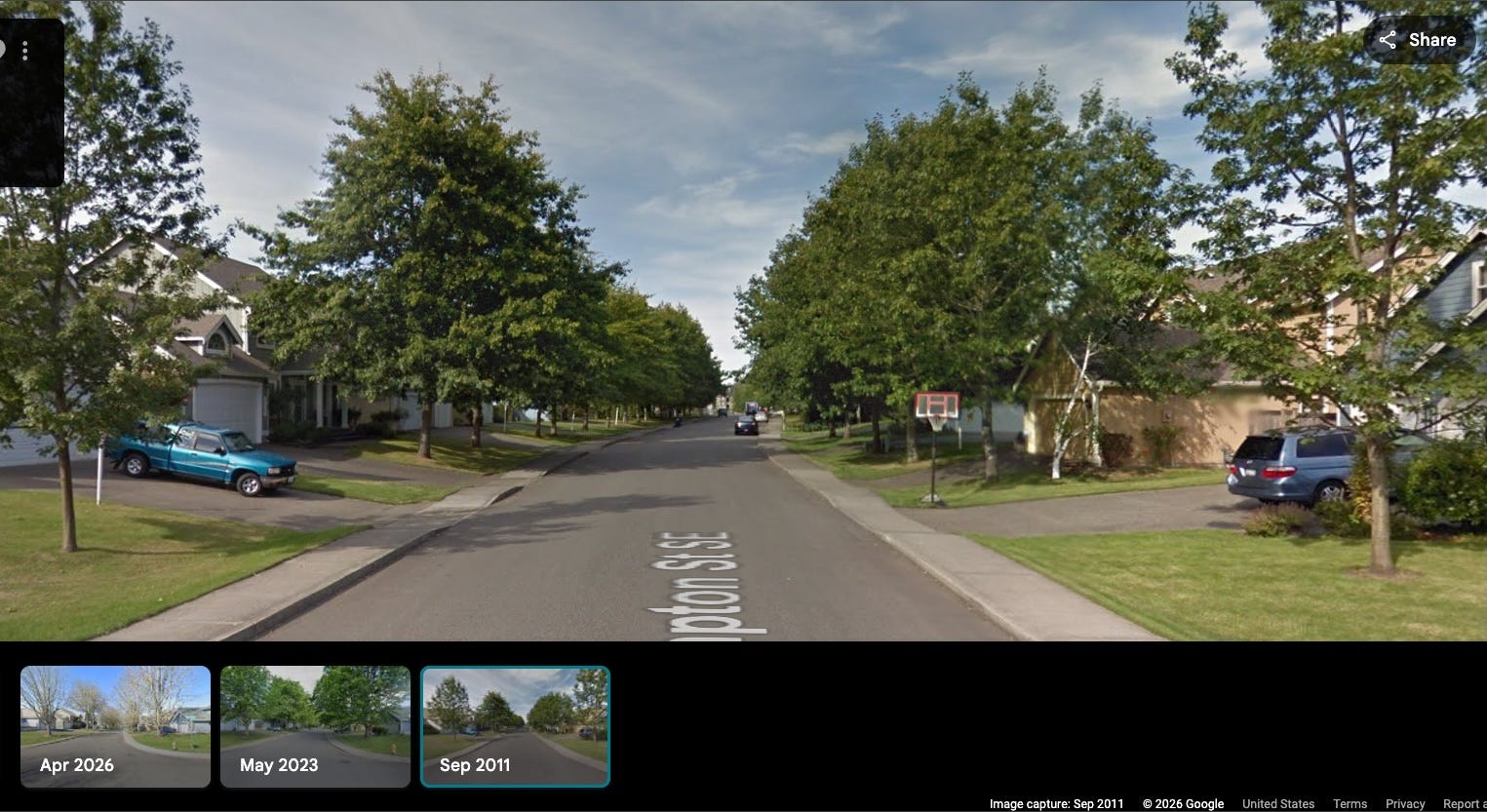
As the warming climate makes street-tree shade increasingly important for cooling urban neighborhoods, a long-running conflict is coming to a head along Thurston County streets, pitting the need for mature tree canopy against sidewalks buckling from the roots. In Lacey alone, two recent sidewalk projects have called for the removal of 455 trees.
Many of the trees now coming down are mature trees that provide the very canopy cities are trying to increase, but their roots have outgrown the spaces provided for them, lifting sidewalks and creating accessibility and maintenance problems.
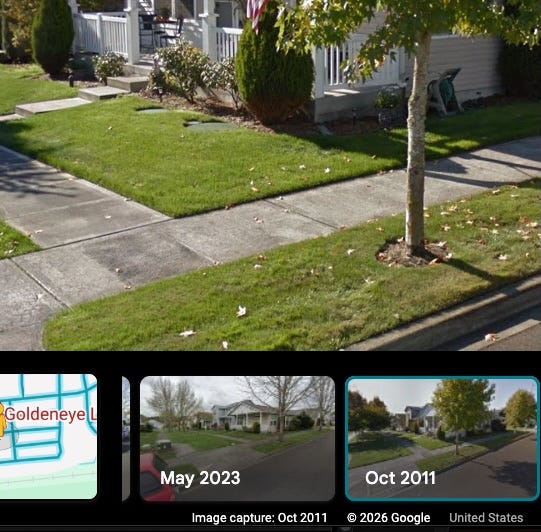
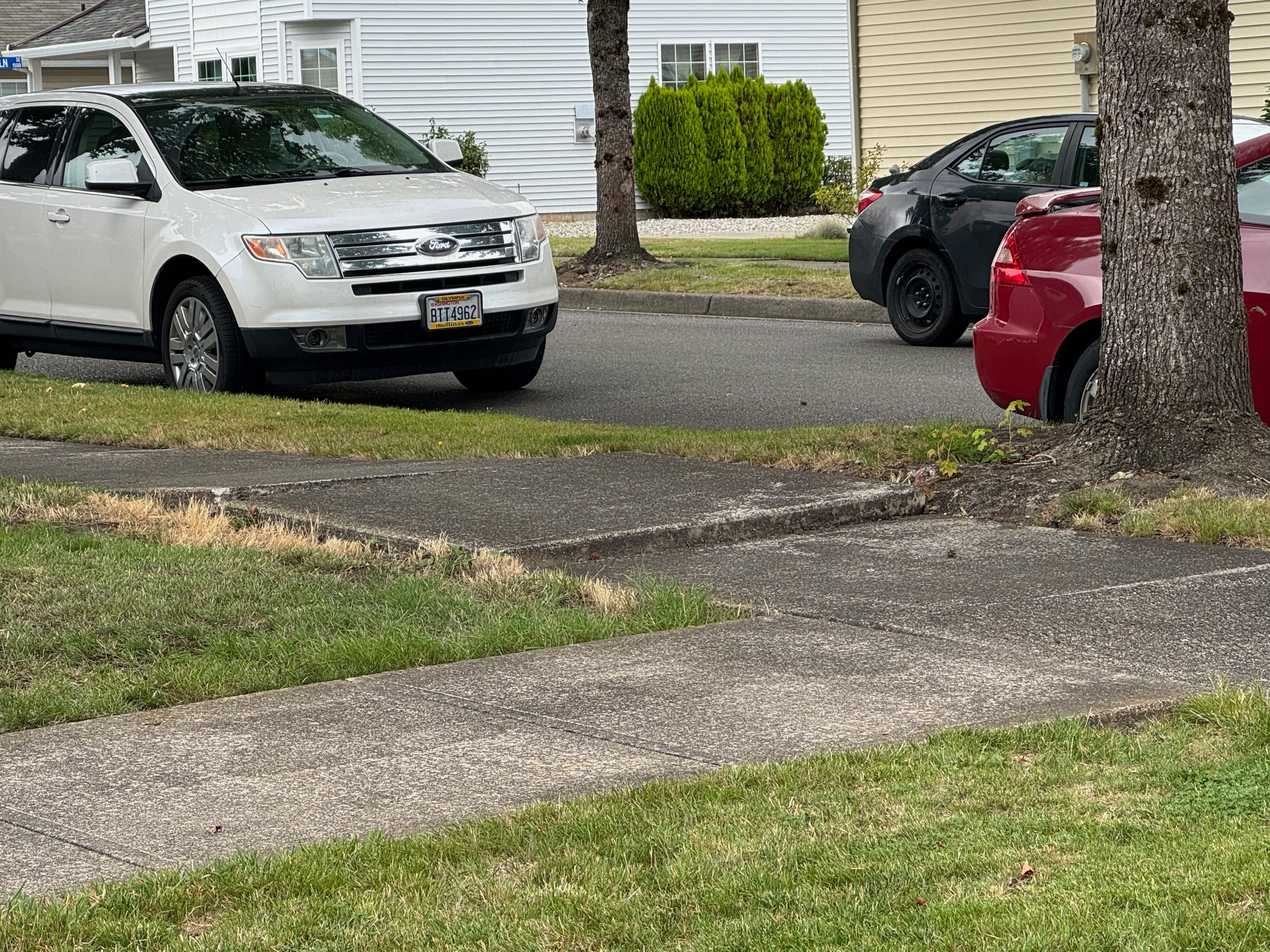
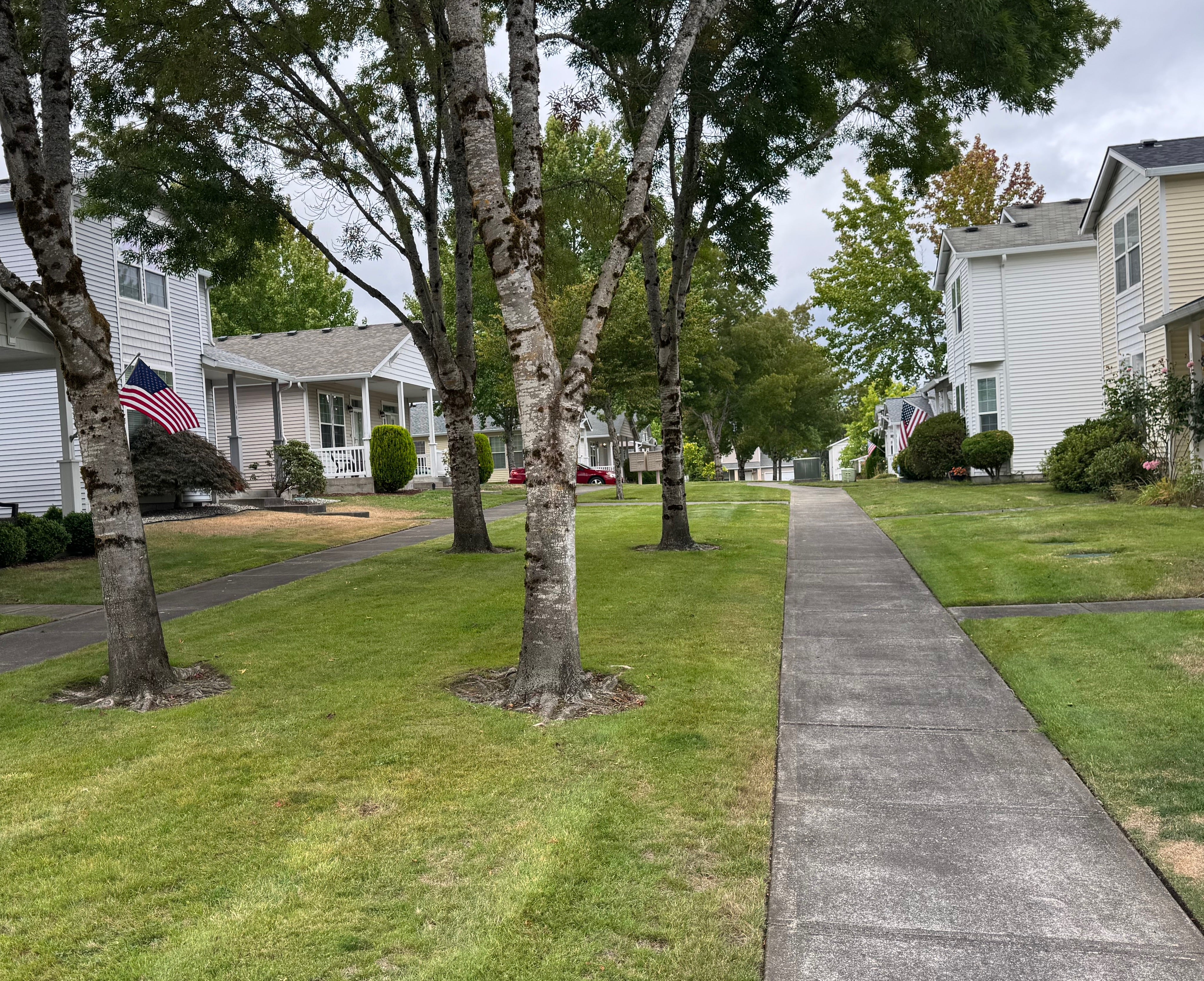
At issue is whether trees and sidewalks really have to be in conflict. Urban forestry standards in cities such as Kitchener, Ontario are based on the premise that growing large, long-lived trees means designing streets to provide not just a place to plant them, but enough functional soil for their roots to grow and pathways to reach it.
Street trees in Thurston County are typically planted in strips of soil between the curb and sidewalk, their size and species selected to fit the space provided. Local standards allow those strips to be quite narrow. Tumwater, for example, tells developers to select species according to planting-strip width; in alternate street designs, those strips may be as narrow as four feet. Similarly, Lacey publishes a street-tree list organized by minimum planter width, with some species approved for strips as narrow as four feet. The City of Kitchener in Ontario reverses that equation: the mature size of the tree determines how much functional soil must be provided.
Jesse Brighten, a Board Certified Master Arborist in Island County, says treating trees as an afterthought in street design can dramatically shorten their lives. “Urban street trees have a severely limited life, because urban planning and infrastructure design treats them as disposable ornaments,” Brighten said. “Proper design and planting is more costly in the short term, but the tradeoff is drastically reduced long term costs.”
Those long-term costs are already showing up in Lacey. In 2025, the city awarded a $1.3 million contract to repair sidewalks and driveways damaged by tree roots and replace street trees at six locations around the city. The project involved about 45,000 square feet of pavement and the removal and replacement of 270 trees. Another Lacey sidewalk project followed this year, calling for removal of 185 trees in the Jubilee neighborhood.
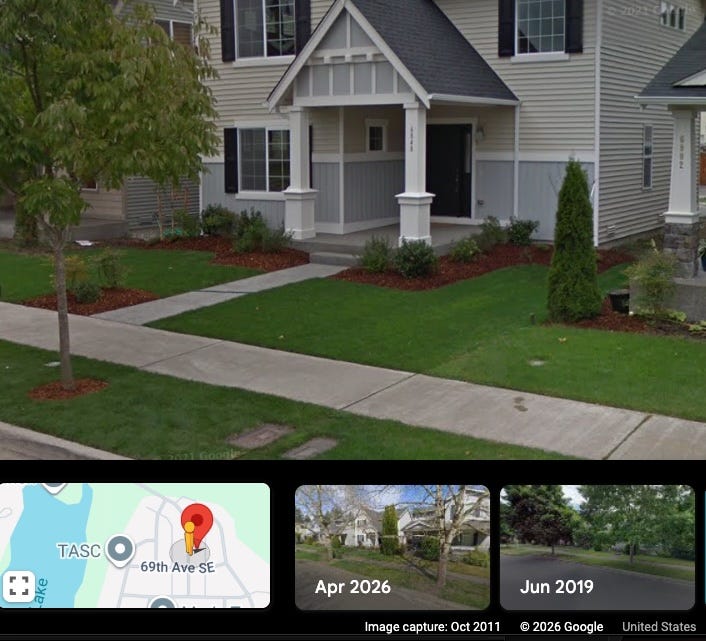
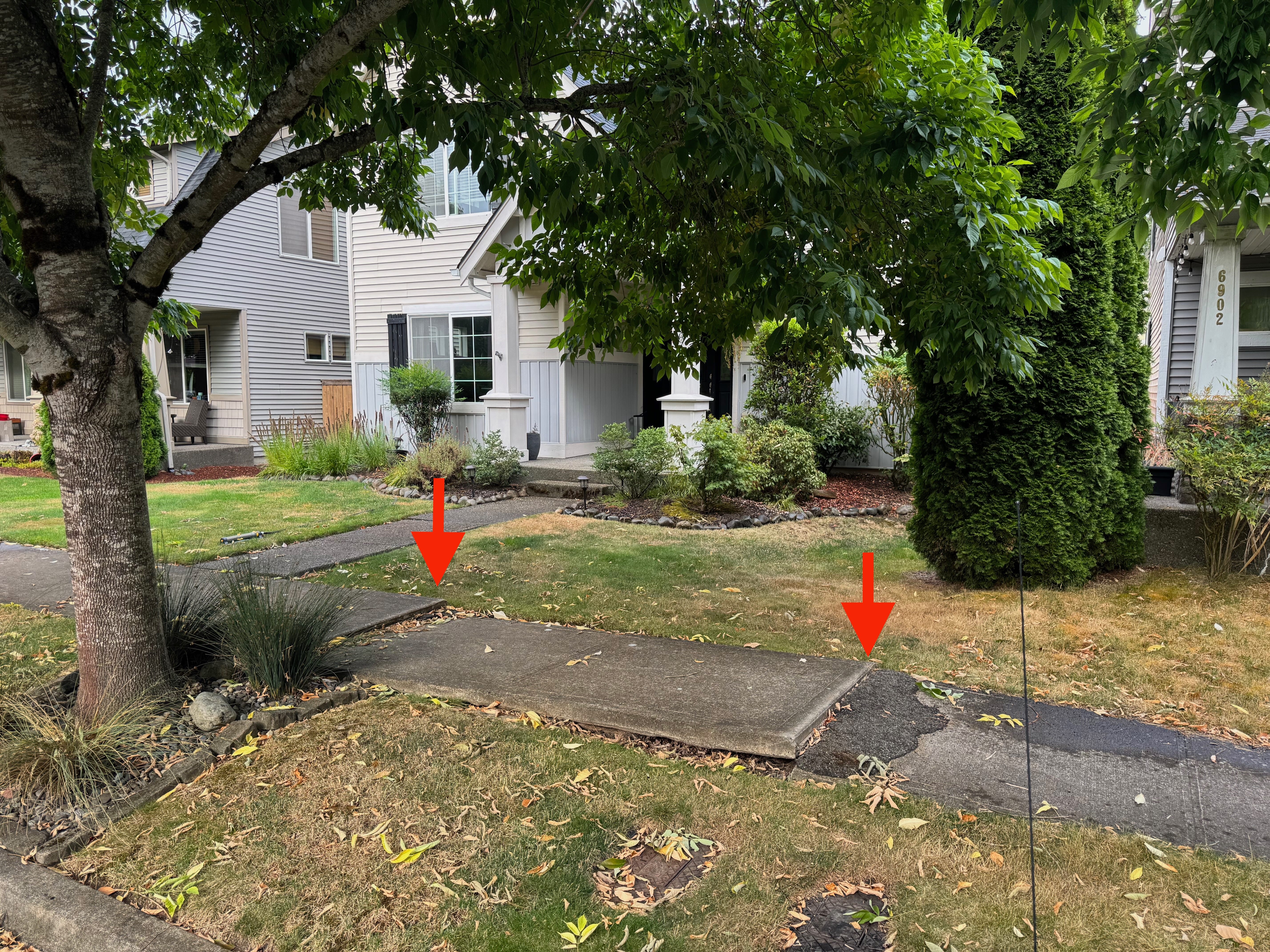
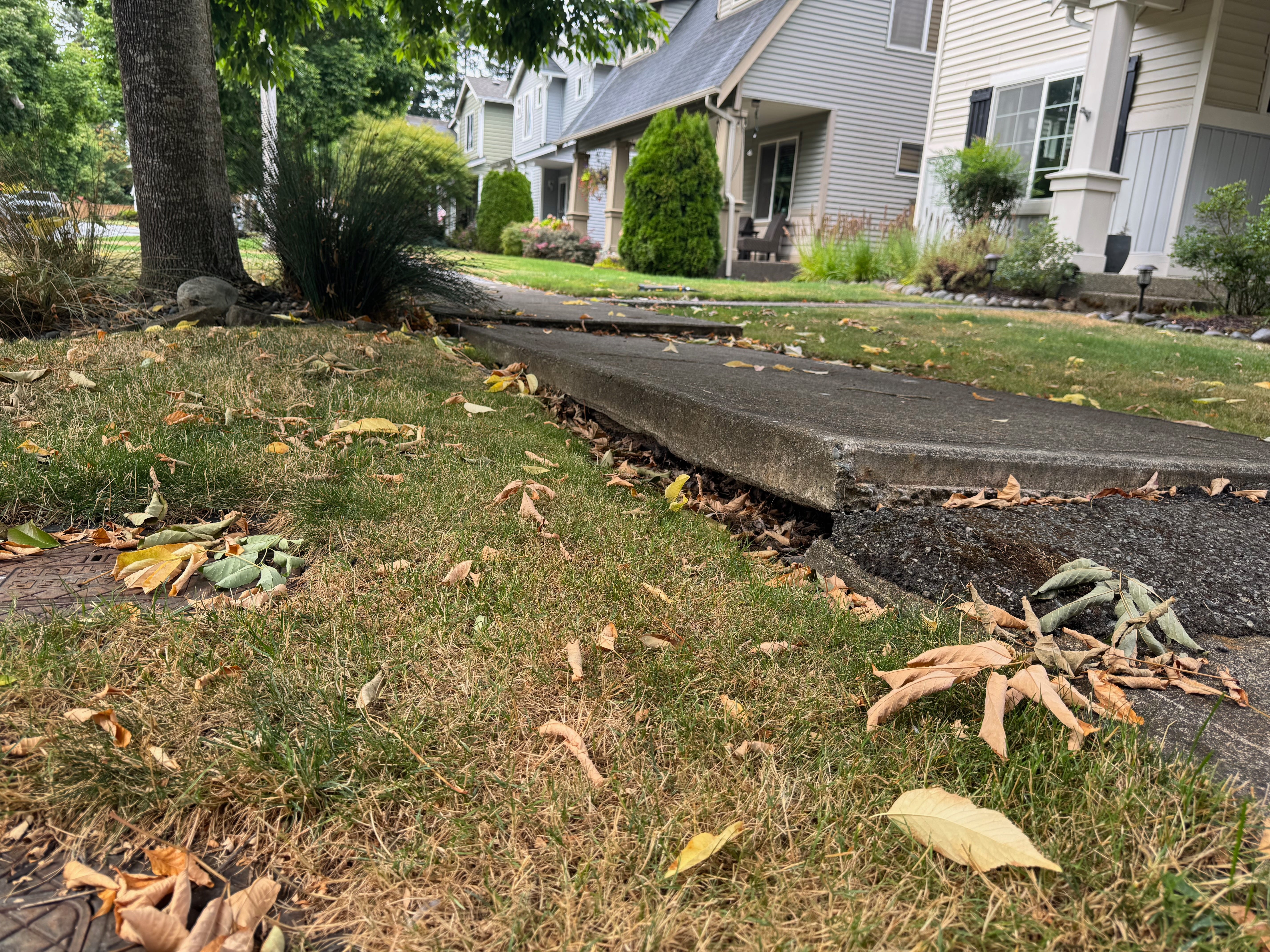
Tanya Nozawa, a member of the Tumwater Tree Board, sees the problem in her own neighborhood, where mature trees are being removed as sidewalks buckle. “In Tumwater, street design comes first and then trees are selected based on the planting-strip width and constraints like overhead utilities,” Nozawa said. “We need to reverse the process — decide what mature canopy we want, determine how much soil those trees need, and design the street to accommodate them from the beginning.”
Some 2,500 miles away, the City of Kitchener, Ontario, has built much of that idea into its development standards. There, the size of the tree helps determine the design, rather than the other way around. A large-stature tree must be provided at least 45 cubic meters — nearly 1,600 cubic feet — of functional soil. A medium tree gets 28 cubic meters and a small tree 17. Kitchener also specifies minimum soil depths and maps what it calls “soil habitat zones” around street trees.
Notably, Kitchener does not prescribe a uniform width for the planter strip between the curb and sidewalk. The width can vary. What the city regulates instead is the volume of functional soil available to the tree. A planter strip can be relatively narrow if the tree’s roots have access to enough suitable soil elsewhere.
And Kitchener doesn’t leave the trees until the landscaping stage. During subdivision planning, the developer’s landscape architect works with planners, engineers and utilities to determine where large, medium, and small trees can grow and how their required soil volumes will be provided. Streets, sidewalks, driveways, utilities, and trees are planned together.
A Kitchener street tree may still stand in the familiar grassy planter strip, called a “boulevard” there. But its rooting environment need not end at the sidewalk. Engineered root pathways can connect the boulevard beneath the sidewalk to additional soil, including the front yard on the other side of the sidewalk.
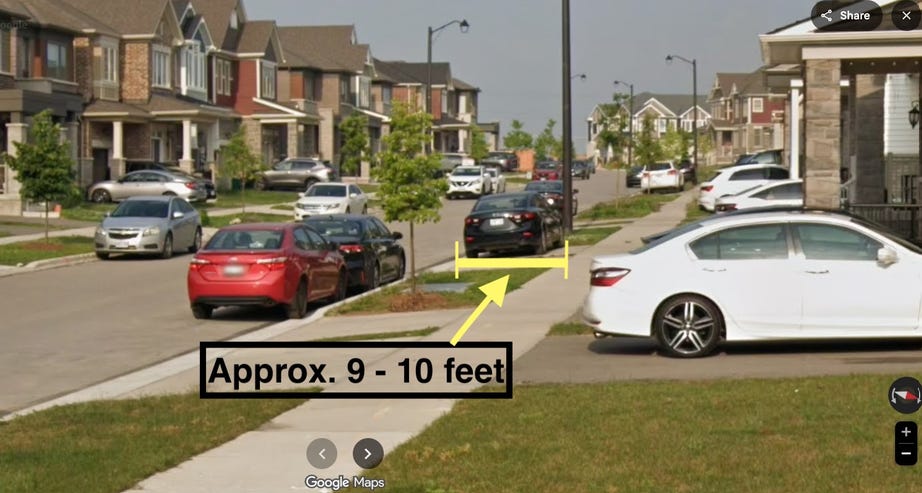
The system cannot guarantee that a tree root will never lift pavement. Trees growing with virtually unlimited soil can still send large roots beneath pavement. But Kitchener’s approach changes the question designers ask. Instead of “What tree will fit in the planting strip we have left?” it asks, in effect, “how much soil does the tree we want to grow require, and how will we provide it?”
Kitchener’s rules also don’t simply count trees; they regulate how large those trees are expected to become. That matters because ten small ornamental trees with mature crowns 15 feet across provide nowhere near the canopy of ten shade trees with crowns 40 or 50 feet across. Yet a regulation that simply counts trunks can treat both as ten trees. Kitchener does not.
For new residential development, at least 30 percent of required street trees must be large-stature species and at least 50 percent must be medium-stature. This means at least 80 percent must be medium or large. No more than 20 percent may be small-stature trees. And because Kitchener also requires functional soil volume based on mature tree size, the rules provide not just for planting those larger trees, but for giving them the underground space needed to grow.
Brighten, the arborist in Island County, said the benefits of designing for long-lived trees extend well beyond avoiding sidewalk repairs. Mature trees, he said, “pay us back in dividends,” providing compounding benefits from stormwater management...to reduced traffic speeds. Among the most important as the climate warms is their ability to reduce the urban heat-island effect by shading heat-absorbing pavement.
Eight thousand miles away, Canberra, Australia, is confronting the same problem while planning for a hotter climate and a growing population. Rather than sacrificing trees to accommodate greater housing density, the Australian capital is requiring development to make room for both.
The result is somewhat counterintuitive. Multi-unit development in Canberra’s lower-density RZ1 and RZ2 residential zones must provide at least 15 percent tree-canopy coverage at maturity. In the denser RZ3 through RZ5 zones, the requirement rises to 25 percent. In other words, Canberra requires more canopy — not less — as residential density increases.
But requiring canopy on paper does not make large trees grow. Like Kitchener, Canberra’s standards address what happens below ground.
Canberra requires adequate soil volume and depth for trees and warns designers against surrounding roots with barriers that create what its municipal landscape standard calls a “pot in the ground.” If a root barrier is used, suitable soil must be available beyond it for the roots to grow into.
In the densest parts of a city, however, there may be no front lawn on the other side of the sidewalk for roots to reach. Canberra uses another tool: putting growing space underneath pavement.
Structural soil cells are load-bearing underground structures that support sidewalks, plazas, and other paved surfaces while preserving uncompacted soil beneath them for tree roots. Canberra’s standards also provide for structural soils, in which a stone framework carries loads while soil within the mixture provides rooting space.
At Canberra’s Jamison Group Centre, the Australian Capital Territory (ACT) Government installed a structural tree pit beneath two rows of parking bays. The underground structure allows parking and pedestrian paths above while providing trees with uncompacted soil, more root space, and greater access to water below. The government says the system improves tree health and canopy coverage while helping prevent pavement uplift by tree roots.
Neither Kitchener nor Canberra has eliminated the competition for space beneath city streets. Water lines, sewers, utilities, sidewalks, roads, and building foundations still have to go somewhere. What their standards demonstrate is that the mature tree can be part of that engineering problem from the beginning, rather than something fitted into whatever space remains afterward.
That distinction could matter as Thurston County’s cities accommodate thousands of additional residents while also trying to increase urban tree canopy. The choice isn’t necessarily between housing, sidewalks, and trees. It can be a choice about how streets are designed to accommodate all three.