

Happy Pride!
Today we begin our yearly commemoration and celebration of the queer and trans struggle for liberation that has existed for decades and continues to persist in the face of mounting systemic pressure.
We remember the working-class queer revolutionaries that threw the first bricks at Stonewall and dared to fight back against a state that criminalized their existence. Pride was a riot, a collective act of solidarity by the most marginalized: trans women of color, sex workers, the homeless, and the poor.
As we gather this June, let us honor their legacy by recognizing that true queer liberation cannot be achieved through market inclusion or legal reform alone, but only through the dismantling of the class structures that produce homophobia, transphobia, and material deprivation simultaneously.
Pride means solidarity across every axis of struggle: with striking workers, with tenants fighting eviction, with the undocumented, and the incarcerated. Because the liberation of queer people is inextricably linked to the liberation of all working people.
In love and solidarity,
Works in Progress
The First Pride Was A (Prison) Riot
by Felix Chrome
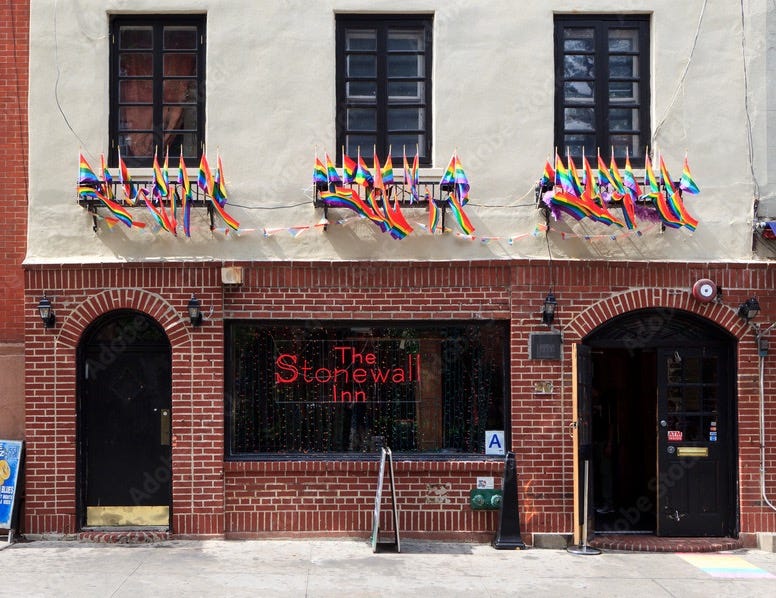
In recent years activists and scholars have done much important work to uplift the street queens who “threw the first brick at Stonewall,” and to reinsert the radical history of the Stonewall Riot into pride, far beyond rainbow jockstraps and vodka shots or the pride line from Gap. However, in this new popular retelling, many of us are still missing a huge facet of this story. In addition to being a multi-night series of riots, during which police were attacked in response to their violent provocations, in which gay revelers, drag queens, homeless youth, trans women, dykes, and many queers of all sorts, mostly unknown to us to this day, formed a beautiful mass to fight the cops who had long been agents of their degradation and destitution. Stonewall was also a riot inside the walls of a prison.
A block down Christopher Street from the historic Stonewall Inn, a mafia run gay bar that served as a gathering point for many gays in the Greenwich Village, stood the Women’s House of Detention. Until its demolition in 1973, the Women’s House of Detention was a women’s jail that operated much like Rikers does for men today, both as pretrial detention and where women would serve prison sentences. “The House of D” as it was familiarly called, also served as a point of queer gathering. At the heart of the gayborhood, women could often be seen calling up to their lovers through the barred windows, gathering outside waiting for their sisters to be released, or protesting in solidarity. The historical record shows that many of the women incarcerated inside the women’s house of detention were queer. Even as official documentation tries to elide this fact, the evidence is everywhere both in government surveys and first hand accounts.
In 1969 it was still common practice for the New York Police Department (NYPD) to arrest queer people for the crime of “impersonation” if they were not wearing three articles of clothing associated with their gender assigned at birth. While “crossdressing” was not technically illegal, this vague statute served as a loophole to criminalize trans expression, drag, butch presentation, and other facets of queerness. This meant that many people in the House of D were butches, bulldykes, or people we may today understand as transmasculine. Another common crime women were incarcerated for was prostitution, and many gay women turned to hustling, often working on the street where arrest risk was high as a means to support themselves after being disowned by family or barred from employment due to their lesbianism or gender non-conformity.
These factors meant that lesbians were already over represented in jail, there was also a queer culture in the House of D where life centered around familial structures women created with each other. Angela Davis, who was incarcerated there in 1970, writes, “homosexuality emerged as one of the centers around which life in the House of Detention revolved.” She goes on to state, “In an elemental way, this culture is one of resistance, but a resistance of desperation.” The families did not always include a sexual relationship but many women and girls who may not have identified as lesbian on the outside prior to being incarcerated forged romantic and sexual relationships behind bars — whether out of necessity or a paradoxical freedom found away from the compulsory heterosexuality of the outside. Davis describes being “bewildered and awed by the way in which the vast majority of the jail population had neatly organized itself into generations of families: mothers/wives, fathers/husbands, sons and daughters.” In addition to solving immediate problems and providing certain perks, Davis asserts, “the family system served as a defense against the fact of being no more than a number.” In this way the House of D stood as a central site of lesbian resistance in the village.
On the night that gays took to the streets — lighting a literal match in the movement for queer liberation as they tried to burn down Stonewall while cops cowered inside — the incarcerated queer women of the Women’s House of Detention responded in kind, in a remarkable act of solidarity behind bars, one that has gone largely untold.
Rita Mea Brown, author of the seminal lesbian novel Ruby Fruit Jungle, describes being out to dinner with a friend the night she encountered the riot, “I was in my early 20s, it was a very hot night, and Martha Shelley and I were walking through Sheridan Square in New York City. The cops, in a matter of seconds, pulled in front of this little bar — we all knew it was a men’s bar — and we heard this noise. The next thing we saw was cops flying out of the bar, then patrons came flying out of the bar. They were running out in their high heels. And we realized ‘Oh my god! It’s faggots in revolt! It’s heaven!’” She then goes on to say that night “at the Women’s House of Detention, the women heard the noises and started rioting inside the prison. All the windows were [open] because it was summer. The women burned mattresses and shoved them through the bars. This never got written up because all the accounts of that period were given by men.”
Another lesbian who was on the street that night shares a similar story, as described by historian Ryan Hugh, “Arcus Flynn was driving home late that night from her job as a nurse, wending through the streets around Washington Square when she noticed something strange: small points of light, flying through the sky. When she pulled over, she realized they were fires—little burning things being thrown from the windows of the House of D. As she got out of her car, she could hear them inside: dozens, maybe hundreds, of voices screaming, ‘Gay rights, gay rights, gay rights!’ That, she would later tell interviewers, was how she first realized Stonewall was happening.”
Rita Mea Brown is right that this fact was completely absent from news articles at the time and left out or unnoticed by many first hand accounts, mostly given by men, that have been committed to the record. The only indication of the women’s actions during the three days of rioting at Stonewall in an official report, is a story from the following weekend in the New York Amsterdam News, headlined “Women Held In Assault on Guard.” It describes a prison guard being attacked by eight girls who “threw her to the floor and tried to choke her” then “tried to take the officer’s keys which they had hoped to open the doors and gain their freedom.”
We can’t know for sure what instigated these actions or all the events inside of the House of D during the Stonewall riots but we know that above the riotous mass in the streets, there towered a building full of dykes and queers also fighting for their liberation. Scholar Polly Thistlethwaite writes of these women, “Lesbians may not have been roaming the Village streets in the numbers their gay and trans comrades were. But there were hundreds of dykes in the House of Detention for Women during the Stonewall Riots. The lesbians of Stonewall were arrested. They were in jail. They were not silenced or hidden or still. They were the nerve center of the Riots, the critical mass, the motor spiriting the resistance. They were shouting from the windows. They were raining fire onto the streets. They were floating sparks up into the sky.”
***
Much of this information and research shared in this article is owed to historian Ryan Hugh who wrote “Women’s House of Detention: Queer History of A Forgotten Prison.” Interviews and oral history work conducted by the Lesbian Herstory Archive has also provided crucial historical insight. If you are interested in learning more about the era, “The Stonewall Reader” edited by the New York Public Library contains many great essays and excerpts about Stonewall as well as the context leading to this moment and its lasting impact.
Organization Spotlight
This Pride, please consider giving a donation to the following organizations: