

by Carl Eugene Stroud
In France, a popular movement that started in the high schools has gone on to attract the support of unions and professional organizations. You may have seen viral clips of student protestors facing police brutality or public addresses from politicians. It’s already been more than a month of marches, blockades, and occupations. The continual organizing and mobilizing led to a general strike in early November, with a lot of support concentrated in the education sector where the conditions of the facilities, lack of supplies, and teacher shortages are national problems.
It’s clear that le 17 octobre was a marker of something important, but what exactly took place on that day is hotly debated. That debate is mostly fought through journalism, and political journalism in particular.
On that day, police started with a high level of violence and when their efforts failed to defeat the students, they got even more violent, losing control to protestors experienced in defending themselves against police tactics. Some students were severely wounded, and nearly 10,000 minors were detained, with many now facing large fines or probation, effectively preventing them from participating in ongoing actions.
Since then, what started with walkouts and blockades in the high schools has extended to the parents and teachers concerned with police brutality against teenagers. The unions and local politicians also joined the movement, as did people defending the right to protest without being violently suppressed.
If you try to follow the news about it, there’s a lot of propaganda to sift through. And that’s not necessarily a bad thing in itself. It’s through being told and retold that stories and experiences can survive across borders, oceans, and language barriers. By the time an article like this is written in English, anything that’s included has already been shaped and supported by multiple instances of political practice.
Popular movements and revolutionary organizations should go on the offensive and offer up their own narratives. Retelling is militancy, so this is an attempt to share some of what I know about what’s been happening in France and play an active role in what survives from their context to ours, from the current moment into the future.
As a French teacher, in the last few weeks, I’ve done several lessons with my students where we listened to speeches by the president, Emmanuel Macron, and by his party’s main opponents, as well as interviews with students, parents, and teachers. The introductory lessons focused on vocabulary and listening skills. The intermediate lessons were discussions about the arguments and rhetoric being used in French, reflecting on the choice of one word over another or the selection of one detail in particular. In the most advanced lessons, we compared and contrasted multiple speeches and interviews with the goal of teasing out the common threads and points of disagreement.
Macron’s lexicon included words like energy markets, high schools, universities, and young people. He talked about their futures and about the ordre républicain. He also mentioned the presidential election six months from now, even though he’s not running and the recent events aren’t directly related to who the current president is or which party is in power.
Only reactionaries consider this movement a political rejection of the current government rather than a social movement with its own independent demands. And in true reactionary fashion, the French president grouped together police and small businesses, suggesting they were the real victims in all of this, and proposing a division between the people breaking stuff and the peaceful, so-called “legitimate” protestors.
Grouping and dividing things in this way was strategic on his part. It allowed him to side with the armed forces, the ones in charge of violently maintaining his brand of order, and it let him kowtow to the capitalists least likely to be affected by a general strike: the petite bourgeoisie.
Since Macron so explicitly wants to obstruct any attempt to connect one struggle or set of demands to another, after a month and a half of regular actions across the country, more and more people find themselves on the other side of the debate from him.
Everyone claims to agree with the “legitimate demands,” but it’s not always clear what they mean by that, beyond the implication that some of the demands are illegitimate. For the high school students of Mayotte and French Guyana, who were the first to begin demonstrating, it’s about addressing the lack of public services, the dilapidated schools, and the rising cost of living.
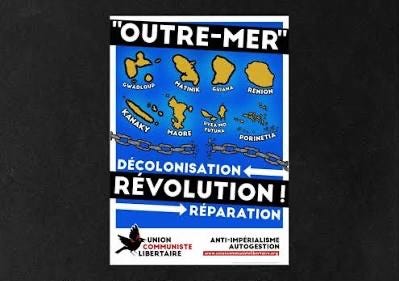
The Union Communiste Libertaire (UCL), an anarchist organization with chapters in cities across France, says the right to an education isn’t always guaranteed in the overseas territories and departments, where rural access to schools is limited, and that lack of clean water is a regular problem in Guadaloupe and Martinique. The unwillingness to compromise on these demands has kept the struggle alive, and in this regard, the outre-mer colonies have been a leading force for the mainland movement.
The term “outre-mer” means overseas, but not in a foreign way. It’s used to refer to departments and territories of France that aren’t part of the mainland “métropole.”
Macron said the destruction of public buildings was incomprehensible to the French people. But Jean-Luc Melenchon, the leader of the leftist party La France Insoumise (LFI), often translated as France Unbowed, agreed that damaged businesses should be reimbursed by the government but refused to dwell on the destruction of private property. The point being that the destruction of public buildings is more directly tied to the complaints and demands of the movement.
If, instead of the popular movement, we focus only on next year’s presidential election, we ignore the daily struggles of the students and workers facing the most desperate conditions. To his credit, Melenchon shares this critique, saying that you can’t boil it down to a question of who the people prefer from one election to another. Of course, he’s one of the leading candidates, so we should take that with a grain of salt.
Likewise, CBS could have done with a more skeptical approach for their recent 60 Minutes segment on the topic. They adopted the distinction, common in France, between what’s called the ultra-right, which is seen as palatable enough for elections, and the extreme-right, which is considered a violent and criminal political element. They spent most of the segment platforming Marine Le Pen, a xenophobic candidate for president, whose entire brand is based on packaging her politics in ways centrists find acceptable.
There are a lot of similarities between translation and journalism. In both practices, there’s no neutral point of view. Journalists, like translators, are constantly taking sides. The content of their work is full of bias. By feigning an innocent neutrality, 60 Minutes revealed their tendency to triangulate between different positions. That means they’re okay actively taking part in translating fascist ideology into the rhetoric of “legitimate demands.” So, when they asked Le Pen directly, she predictably responded that no, she’s not a fascist.
What stood out to me was how she was the only person in the segment that trusted CBS to translate their responses. I don’t know if she speaks English or not, but all the other people interviewed preferred to speak in their own words, even if that meant using a second language. You can imagine that speaking French to an English interviewer is some kind of nationalist dog whistle, but you can also see why someone might question the political intentions of CBS if they’re able to inspire that kind of confidence from a far-right figure head, when translating on her behalf.
I’m proud to say that my own translation would have been less favorable because, when making decisions in the translation process, political lines provide much needed orientation. Translators have to interpret two separate contexts: the source context and the target one. And in practice, there’s a literal choice to be made about whether to bring something into English by translating it or by taking a new step and creating a secondary source, maybe writing an article like this instead of a translation.
Either way, there’s no getting around bilingualism. If you want to learn about what’s happening in another place, you have to be able to listen to people in their own words. But what you find is that the more plugged in you are to information that’s only available in another language, the more you’re asked to translate, because it’s such an indispensable part of creating continuity. In order for political lines to advance from one context to another, someone always has to be doing that militant work.
When the US-based anarchist organization Black Rose/Rosa Negra (BRRN) recently hosted a panel with militants from Liza in Spain, Embat in Catalunya, and UCL in France, this kind of multilingual internationalism was on full display. All the participants responded in English, despite that not being their primary language, because that was the necessary mode for communicating in that context. That means they had each done the work to put what they’ve recently experienced and analyzed into words English speakers would understand. Militancy like that is fundamental to creating political continuity.
They said the students in France have been inspired and reassured by the support coming from other parts of the world. But they also said the energy of the movement is dwindling after so many weeks of constant organizing. That means our efforts to retell what’s happening are needed now more than ever. Then, it will be up to our militant comrades to translate our solidarity, in meaningful ways, back to the people on the ground. That’s the only way that the international struggle will continue and that local victories won’t stop at state lines.
Carl Eugene Stroud has a master's degree in French and regularly translates texts from French, Spanish, Portuguese, and Catalan. He's a member of the Center for Especifismo Studies.