

by Isaac Wagnitz
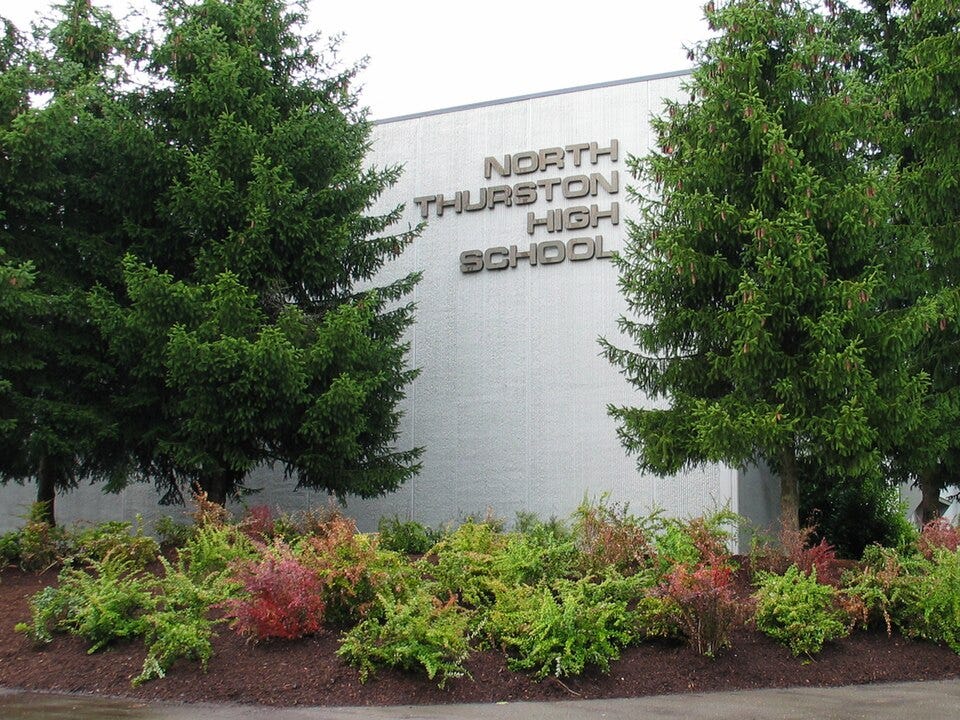
Staff at North Thurston Public Schools (NTPS) are looking at layoffs after the school board decided on a reduction in force (RIF), as part of their plan to address a significant budget shortfall in the district.
According to The Olympian, the district is currently facing a $10 million shortfall. The layoffs were first proposed at a school board meeting on April 28th, but were tabled due to substantial opposition from organized labor and present community members. At a subsequent meeting on May 7th, the board decided to follow through with the RIF. Initially the board had been at an impasse, but board member Michelle Gipson ultimately cast the tie-breaking vote in favor of the layoffs. Members Sarah Tracy and Gretchen Maliska also supported the RIF, while Esperanza Badillo-Diiorio and Jeff Line cast their votes in opposition.
Works In Progress spoke with two NTPS staff about the current situation: Jeff Berland, a special education teacher in the district, and another employee who declined to be named due to concerns about retaliation who will be referred to hereafter as E for Educator. Berland and E discussed the background and impacts of the RIF, as well as steps moving forward.
E stated that the origins of the crisis at North Thurston ultimately reflect larger historical trends. They mentioned that school districts in general are often not very transparent about finances, and that the public only scrutinizes them during shortfalls or levy requests. However, the main issue lies in how public schools in Washington are funded. E pointed out that in spite of the contention that sometimes surrounds local school levy elections, Washington schools are primarily supported by the state government, supplemented with some federal funding. According to this primer from USAFacts, North Thurston recieves less than 30% of its overall funding from local levies. This creates a situation where, even when local levies pass, shortfalls in state and federal budgets can still allow public schools to not meet their operating costs. With an ongoing state budget crisis, and a federal administration that is openly hostile to public education, NTPS was vulnerable despite having won a levy in the last local election. Works In Progress also reported on a similar situation which arose recently with Shelton Public Schools.
North Thurston Superintendent Troy Oliver was quick to place blame on the state Legislature, as well as falling enrollments (down 178 this year, and projected to fall another 117 next). Berland expressed basic agreement, emphasizing that the state has continually failed to meet the paramount duty in its own constitution to fully fund public education. At the same time, he added that the Legislature can only do so much as long as its hands are tied by Washington’s highly regressive revenue system, which is overly dependent on sales and property taxes. “The Millionaires Tax is a step in the right direction, but we’re not seeing that money yet,” Berland said. E attributed some of the drop in enrollment to administrators who are too eager to divert students with academic or attendance issues into GED programs outside their usual school. “This removes ‘problems’ from the building, but also they don’t have to count them as dropouts,” E said.
They went on to say that the district may also be neglecting to take advantage of some revenue sources that are actually available. They stated that some special-education activities are reimbursable under Medicaid, but that the district is not seeking those reimbursements. E cited documents on the current and forecasted NTPS budgets, which for unclear reasons show $0.00 under certain revenue sources. “Does that mean we were getting money from those sources, but now we aren’t? And if not, why is that?” they asked. E also pointed out that the district employs a full-time grant-writer, yet is nonetheless facing a serious budget shortfall.
The impacts of that shortfall will be felt immediately by students, their family and community, and currently employed staff. The most visible and reported impact will be the loss of 8 of the district’s 11 mental health social workers. E said these staff members assist students by doing crisis-intervention work. They connect students and their families with other support resources in the community. E said that the social workers had also done a great deal of work helping families whose children were afraid to come to school because of federal immigration enforcement activity. The loss of these staff and the stability that they provide will have severely negative effects on the students they serve, in some cases immediately. Berland added: “I’ve seen students who are already starting to check out because they know that support isn’t going to be there for them next year. Their learning is already suffering.”
The district is also using “attrition” to try to close the budget gap, that is, not hiring replacements for retired staff. Altogether, 21 provisional educators (those not yet on a permanent employment basis with the district) are not having their contracts renewed. Two physical therapists who serve students in the district are also being laid off. Additionally, a supervisor position was eliminated which provided direct support to custodial staff throughout the district. A custodial employee who was reached for comment said that position was crucial for their logistics, by managing supply orders and coordinating substitute coverage. “He [the supervisor who was cut] was also the only person actually working the same hours as us, so we could call someone if there was an emergency past 3pm when the rest of the district goes home. Basically we will be without dedicated support in the evenings from August on.”
While the district has not yet announced the intention to make any further cuts, E said staff are still nervous about the possibility of more to come. They pointed out that even laid-off staff still cost the district, since NTPS will have to contribute to their unemployment benefits until they find new work, so the RIF may do less to close the budget gap than advertised. When asked what supporters of students and educators could do to help, Berland and E said that regrettably there is not much the public can do at the moment now that the cuts have gone through, and emphasized the need for long-term changes to ensure that crises like this do not arise in the future.
E talked about the need for members of the public to educate themselves about how school districts operate and fund themselves. They emphasized the need for deeper, more consistent collaboration and communication between communities and school districts as the norm, not just at times of crisis. They also stated that communities must demand greater transparency from district leadership, and push for more opportunities for the public to voice their concerns directly to boards and administrators. They went on to say that, as long as schools are dependent on levies,[1] “yes” campaigns need to do a better job of making clear what communities gain from fully-funded schools.
Berland focused on the need for constant public pressure on the Legislature to reform the state’s revenue system, so that Washington can truly fulfill its paramount duty to fund education in the long term. He also spoke of the need for a wider shift in public perception, away from schools as just being a government expenditure, and toward them being a resource worth investing in for our collective future. He said that if people need to consider economic figures to get onboard with this, “even the most conservative studies find that every dollar invested in early learning brings at least four dollars in returns down the road; some go as high as 16.”
Berland also suggested that school districts need to stop spending so much money on expensive technologies that do not improve the quality of instruction. “Every student has a Chromebook now, which costs a lot of money, but their learning outcomes aren’t any better. We’re just giving them another screen to be addicted to.” A recent Jacobin article describes how, in a generation raised on screens at home and at school, even students at prestigious universities lack basic reading comprehension. Finally, Berland emphasized the need for school administrators who will seek out and listen to input from educators and students, and be fierce advocates on their behalf. “We need to see more of that ‘servant leadership’ people talk about.”
The crisis at NTPS calls attention on the one hand to the need for better collaboration between school leadership, the communities they serve, and the staff who carry out the work; and on the other hand, to the need to drastically reform education funding, and Washington’s revenue system as a whole. Neither goal will be possible without strong, coordinated efforts by a well-organized coalition of students and their families, educators and their labor allies, and all those invested in the future of their communities. Until Washington can implement a more equitable and sustainable model for funding public education, situations like the one in North Thurston are likely to become more common.