

by Jacqueline Garrison
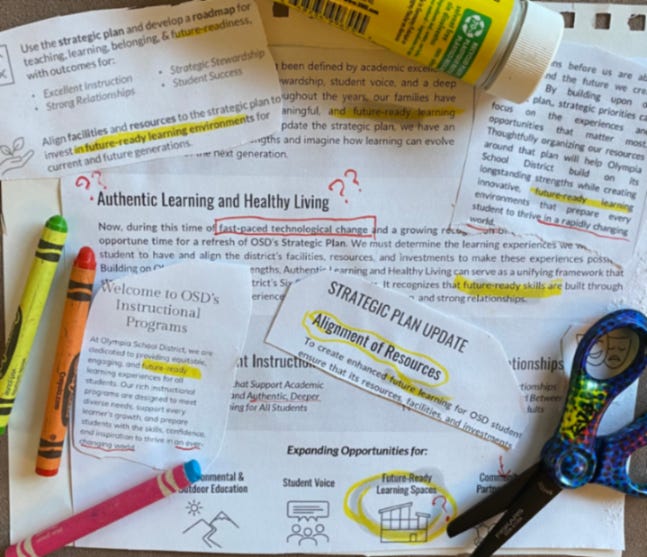
Last month, we covered the fight over school closures in the Olympia School District. This month, we are taking a step back to look at the nationwide, ongoing crisis in public education. In doing so, we uncover a pattern in which state and federal divestment from schools pushes officials toward financial solutions that consolidate school models and integrate unproven technology.
Whether these conditions result in a total tech takeover or a popped AI bubble, public education faces the same disaster as the private sector moves in offering the free market as a stand-in for public investment. Privatization guts structural supports and sets our institutions on the path to austerity and marketization.
In the localized fight to protect our neighborhood schools as they face imminent closure, it’s worth grappling with some of the larger economic forces that are folding public services into the private sector. The whole historical, political, and economic picture gives us a blueprint to fight back.
Dwindling Returns Leads to Divestment
The history of U.S. public education can be seen to reflect the evolving needs of capital, and that means not just money but the social relations that create value. Early twentieth century schools took design influence from assembly lines, which had been created in the century preceding to maximize industrial production. They incorporated strict hierarchies, standardized times, and tracking systems to separate mental from manual labor.
Currently, at the federal level, administrative policies continue to dismantle the Department of Education, reducing the workforce and rolling back hard-won civil rights protections. Federal strategies prioritize expanding private schools and “school-choice” through tax-credit scholarships and, at the same time, withholding federal grants tied to Diversity, Equity, and Inclusion (DEI) initiatives — grants that primarily serve districts with high rates of poverty.
While federal dollars only account for a small portion of Washington State’s total K-12 education budget, these funds provide vital support for low-income, rural, and English as a second language (ESL) students. Federal grant freezes, Title I shifts, and proposed Head Start program overhauls force local school boards into defensive budgeting cycles.
In districts like the the Olympia School District (OSD), these top-down federal strains compound existing local concerns over state levy caps, deferred facility maintenance, and chronically underfunded special education mandates. Together, these conditions contribute to the projected deficits and enrollment pressures that officials then use to justify school consolidation. But no amount of budgeting is going to stop a trajectory dictated by the market.
What Is a Future-Ready School?
One of the most defining features of a capitalist economy is volatility. There is enough chaos in an unplanned economy where “entrepreneurial” opportunists are able to oversell their products and under-deliver, creating an economic crisis from investment bubbles bursting as soon as the true value of these products and services is finally realized.
If a financially strained school district is treated like a vulnerable herd, EdTech startups act as scavengers lying in wait. As public districts cannibalize their own infrastructure to hit austerity targets, private tech vendors offer proprietary “services” that neither address nor solve underlying structural problems.
This dynamic is driven by what education advocates have labeled “Ed Reform 2.0” a push to replace traditional “brick-and-mortar” schools with decentralized “future-ready schools.” The vision for future-ready schools has been propagated by the likes of Tom Vander Ark, former Gates Foundation Executive Education Director, venture capitalist, co-founder of Learn Capital, and Senior Advisor at Getting Smart — a company OSD hired in 2025 to produce a preliminary report on small school sustainability. Ideas directly from Tom Vander Ark and Rebecca Midles of Getting Smart are included in the OSD Long Range Facilities Master Plan 2025-2035 (pg 13), as well as within the Strategic Plan Update.
Vander Ark’s technocratic framework replaces traditional seat-time and standardized tests with “competency-based education” (CBE). Learning is shifted onto automated platforms that track students via micro-assessments, digital portfolios, and continuous data feeds. Kids are able to enroll in “microschools” that focus on specific career-oriented training and education.
Under the guise of progressive, personalized learning, this model could effectively reduce human teacher hours, eliminate traditional school board oversight, and open up public education to venture capital extraction. This is something Vander Ark identified in his tenure at the Gates foundation as an untapped resource, especially in elementary grades.
When terms like “Future-Ready Schools” appear so frequently across our district planning, we must ask: Does this mean preparing facilities for tomorrows children, or is it just mirroring language used for a predatory corporate-tailored vision that sees every student as a data mine and uses AI-driven algorithms to guide their future?
Tracking Progress: Who Benefits from Educational Surveillance?
The technology underpinning an automated future is not rooted solely in consumer tech; its roots are long and deep within the national security state. Institutions like the U.S. Army Research Laboratory, alongside defense contractors such as Halliburton and Booz Allen Hamilton, have spent decades funding intelligent tutoring systems, digital instruction frameworks, and remote platforms.
AI platforms, such as Carnegie-derived math software, have worked to incorporate motion-sensing and affective computing to detect student engagement, measure tolerance and motivation, and apply automated interventions to manage emotional states for desired outcomes. Rather than working to supplement classroom instruction, AI programs are increasingly used during the school day to replace certified teachers in areas like math and reading. This is particularly concerning in underfunded and “turnaround” schools with low test performance, high poverty, and failing achievement metrics with outside interests in rapid change.
As school districts face financial strain, many will buy into Silicon Valley’s promises of high-quality, individually tailored education without the burden of salaried employees. AI is not only being rapidly introduced into classrooms across the country, but in some states it is being mandated. Amira, developed by Amira Learning, is an AI chatbot tool designed to assess, tutor, and screen K-8 students for reading fluency and dyslexia. The program works by listening to students read aloud, automatically detecting reading errors, and then providing immediate feedback or scoring. It is currently being implemented across school districts in California, Georgia, Massachusetts, Michigan, Oklahoma, and Texas, and is strictly mandated by state education authorities in New Mexico and Idaho for early elementary grades as a screening tool.
Primary concerns center on data privacy, transparency, and the collection of biometric data. Parents worry that their young children’s voice recordings are being collected and stored without explicit consent, highlighting that there is no guarantee the audio won’t be used at some point to train or develop something like a commercial AI model. These anxieties have led some districts to temporarily pause the program’s voice-recording features or substitute traditional teacher-administered tests while seeking clearer state guidance on student privacy rights.
The technology being implemented in classrooms is evolving faster than public officials can form a coherent policy for its use. We do not know if Amira will truly help with early literacy or long-term reading proficiency, or if the benefits it’s shown are primarily from one on one interactions. We do know that Amira was developed using technology from Carnegie Mellon University, specifically originating from CMU’s Project LISTEN. It was funded by EdTech venture capitalists at Owl Ventures, GSV Ventures, and Rethink Education. And current investors backing Amira include the Amazon Alexa Fund and the Google Assistant Investments program. These companies seem to have identified a value in developing voice AI specifically trained to understand the difficult nuances of children’s speech.
The Illusion of Choice
The biggest losers in the corporate takeover of public schools are kids who are already facing challenges in poor, rural, underfunded, underserved, and crumbling districts. Relying on subscriptions, technology, and AI tools to run school programs effectively reduces local control. In districts operating without an elected school board, community voices have no way to be heard. When a computer is in charge, there’s no one to hold accountable.
Automating teaching reduces costs at the expense of replacing flesh and blood with screens. These staff reductions go hand-in-hand with minimizing the need for brick-and-mortar schools, favoring blended learning. This all redirects instruction from something place-based to something that follows the individual. In many ways, it’s easy to see the appeal. We can save money and personalize learning; students can “choose” their own educational adventure. But what do we give up in this exchange?
The language of choice is wielded by today’s snake oil salesmen. School choice means nothing if the only options presented work together to dissolve the public services and infrastructure that are truly accessible to all. Any equitable improvements that have changed public schooling have historically been fought for by the people and conceded by those in charge of resources. From the point of view of working-class and poor communities, education has long been a site of struggle. “School choice” often leaves the most marginalized members of society trapped within a less-resourced, less-funded, and less-desirable public school system that offers them no additional support.
When Olympia families organize and fight to keep schools open, it’s about the people, not the buildings. We are rejecting austerity measures being forced on the smallest members of our community, and we refuse to allow our public institutions to collapse under the strain of private coercion.
In 2013, following a historic strike the previous year, Chicago Teachers’ Union president Karen Lewis spoke at the United Federation of Teachers headquarters in Manhattan, launching their massive protest against school closures into the larger labor movement:
“They say every child deserves a choice. We say every child deserves a guarantee.”
Jacqueline Garrison is a full-time parent, part-time volunteer, and a dedicated advocate for public education and transit.