

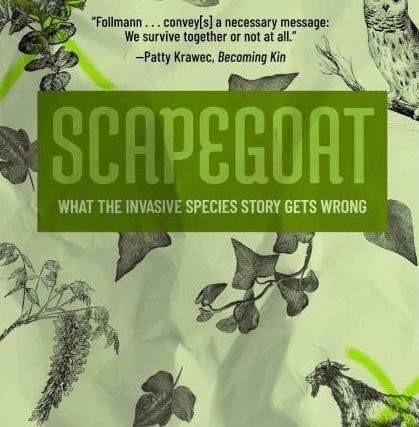
Excerpt from Clare Follmann’s Scapegoat: What the Invasive Species Story Gets Wrong
by Clare Follmann
A caste of plants and animals, labeled “invasive species,” are charged with being a key cause of habitat degradation that must be eradicated at any cost — an ethically questionable and often futile approach. While some invasive species cause great environmental damage, recent developments in the study of ecology have found that intervention efforts themselves have frequently proved more harmful than helpful to their local ecosystems. Yet the outdated narrative of “species management” persists in both public belief and conservation policy, distracting from and even justifying a far greater threat to biodiversity: the global capitalist system that is destroying our planet.
***
(Abridged excerpt, slightly edited)
Although this book isn’t a story, it’s certainly about a story. It is full of many different stories, and it also begins with a story. So, for the sake of tradition (which this book at times will at length disavow), let it begin this way.
Once upon a time, there was a group of fishermen. . .
Right to Work, Reconsidered
In order for organized labor to overcome the anti-union political right, it must shift focus from simply using collective power for meager pay raises, towards taking back power.
by Nicholas Hefling
As a union rep, I hear a lot of confusion about Right to Work (RTW) — a term that the left should reappropriate. RTW is the norm in most states (though not in the State of Washington) and the entire public sector since 2018. Where RTW exists, most workers in a union-represented workplace only pay dues voluntarily. RTW is an attack on a hard-won contractual provision called the union security clause, which requires that everyone a union represents pay their share of the cost of that representation.
At first glance, RTW can sound fairer to workers; why should anyone be forced to pay union dues? Here’s the catch. Even when a worker pays nothing, the union is still legally required to represent them: to bargain on their behalf, file their grievances, and defend their rights on the job. That costs significant resources. When the share of workers paying dues shrinks while the represented workforce doesn’t, the union is squeezed. This strain pushes unions to raise dues (which drives more people to drop out), cut staff, or scale back external organizing efforts. That, of course, was the dream anti-union activists pursued in Janus v. AFSCME.
Captive Consumers!
Within prisons, exclusive contracts with private vendors leave incarcerated people with no choice.
by Tomas S. Afeworki

The prison industrial complex has always been rooted in profit, and it’s a well-oiled, self-feeding operation. And it will continue to grow during this new AI era as the citizenry loses jobs and the middle class becomes more nonexistent with each passing year.
Olympia Joins International Kite Festival to Resist Israeli Occupation in the West Bank
by Nicholas Kohnen and Michelle Ryder
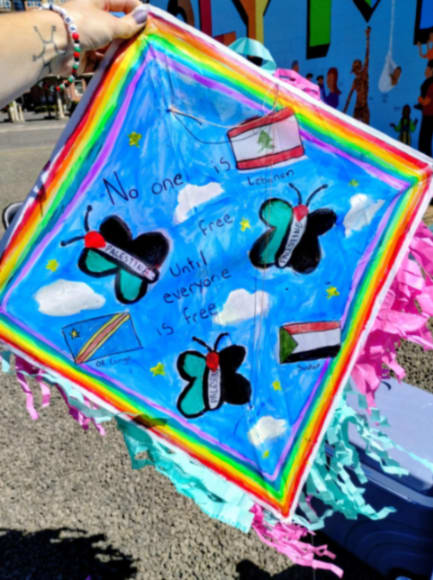
On a sunny summer Sunday afternoon, some 25 Olympia families gathered near the Heritage Park Fountain to build, decorate, and fly kites alongside organizers across the world to show solidarity with Palestinians facing settler violence in the West Bank.
Laughter mingled with the sounds of classic Arabic music as bubbles floated past smiling faces, and children ran freely, compelling their kites to take to the skies. It was an afternoon of deliberate celebration and unbridled joy, part of an act of global solidarity coinciding with the 13th annual Burin Kite Festival.
Thank you for your continued support! Works in Progress is fundraising to bring back a free print issue, accessible to all. If you’d like to be part of this effort, you can support us by becoming a paid subscriber to our newsletter or by making a one time, monthly or yearly donation here.