

by Jacqueline Garrison
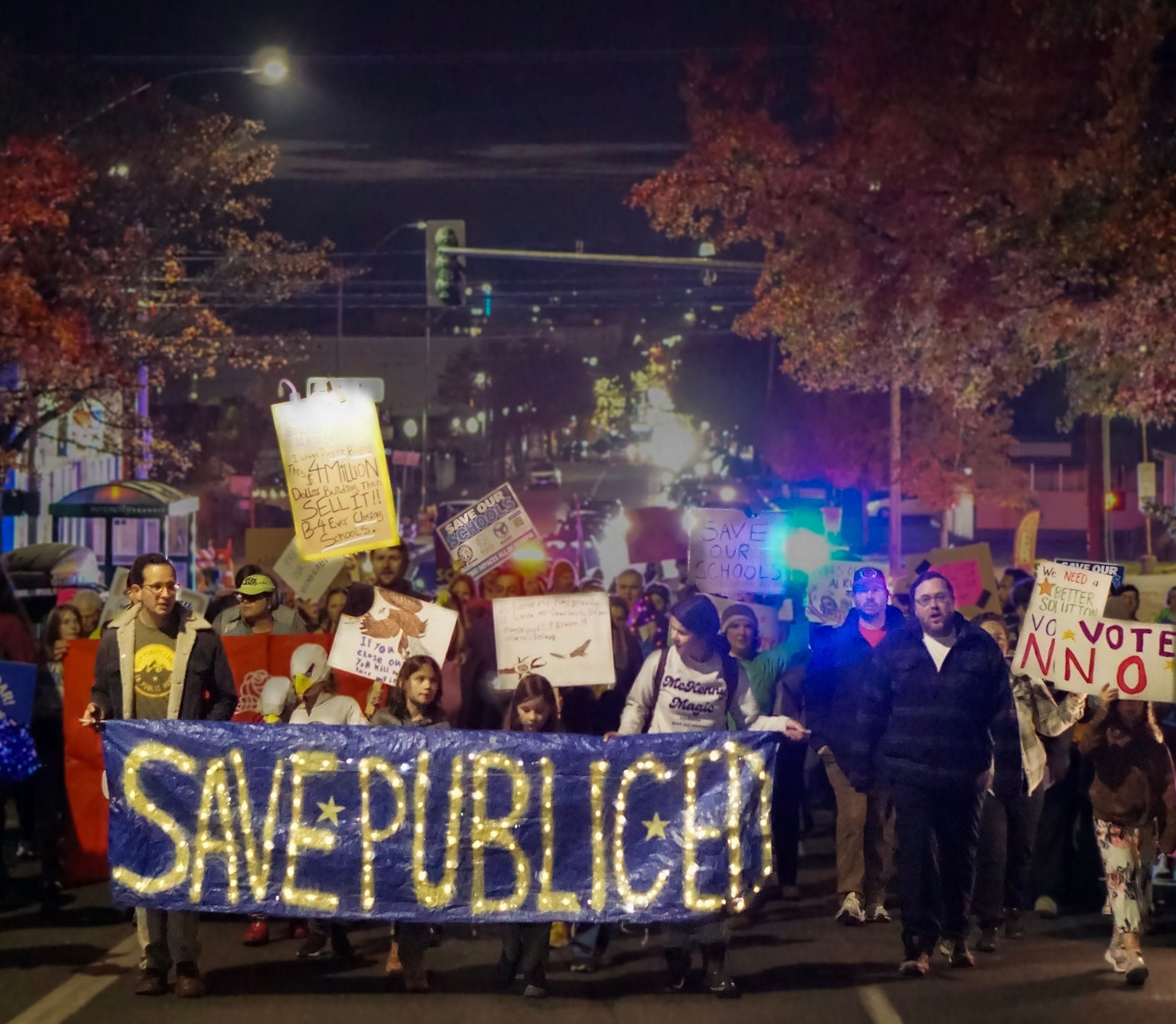
The first two parts of this series looked at the local fight over Olympia school closures and the broader systemic crisis of divestment and privatization of public education. In this final installment, we cover the lessons we have learned from current community organizing efforts in Olympia.
While there is no widely applicable and perfect playbook for community organizing, experience provides a rough how-to guide for building power, uniting diverse forces, and fighting back effectively. Against all cynicism, we are still fighting. And we are winning.
Why a Coalition?
Coalitions are a configuration of existing organizations and individuals who come together to accomplish a shared goal. The purpose of a coalition is to create a bridge from solitary defensive reactions to proactive, community-rooted power. For instance, the Patron Coalition for Local Libraries—a five-county group formed this year that pushed for removing top library administrators, saving frontline library jobs, and getting a levy lift on the ballot—started when community organizer Rachelle Martin noticed the same community voices expressing concern and anger at library board meetings. She was able to provide a template for turning community outrage into action, galvanizing the start of a campaign to recenter both public and frontline worker voices in the conversation about public library values. The historic levy lid lift passed, and it will allow libraries to remain open to serve communities across the region. None of this could have been possible without the work of a coalition.
Whether their purpose is as large as the Rainbow Coalition, creating multiracial solidarity on the basis of a shared struggle for social justice, or as small as bringing people together to defend their local public schools, coalitions work by championing the community as both the source of and the guide for power.
Power within a coalition should be diffuse: no single individual or group should be essential to the project. But doing the work to combine our collective forces is non-negotiable. It’s absolutely vital to create a high level of unity between diverse sections of society in order to leverage enough power to win.
Where Do We Start?
There is no better time to start organizing a coalition than the present. At the beginning, the focus is usually outreach. At this point, it’s extremely beneficial to have someone who has done this kind of work before to serve as a mentor, someone you can come to with questions or ask for contacts that you can reach out to. A mentor like this could be from your local labor council. It could be a long-time community organizer or it could just be a leader within your community that has done a lot to bring people together to accomplish something.
First contacts can include established organizations, already organized individuals or key community members that have some kind of stake in the game. Reach out and see what they're willing and able to bring to the table. What this organizing looks like day-to-day is long hours of tabling at events, phone calls, emails, meetings, follow-ups, and tons of one-on-one conversations with people in person. The importance of talking to people in real life, on equal grounds, cannot be stressed enough — it is the basis for creating a working coalition. This kind of work cannot be substituted by social media or digital platforms, despite their supposedly "wider" reach.
When pulling people into the fold, it’s important to create a strong sense of unity. Stay focused on a clear political vision and endpoint; anything that isn’t a direct step towards those goals must be put aside. Organizer burnout rarely happens from hard work alone: it is often the result of ambiguity and a lack of measurable progress.
Explicitly discussing and reinforcing a shared sense of purpose provides the solidarity and trust needed to move together even as difficulties emerge.
How Do We Keep Moving Forward?
To maintain momentum over time, an organization must foster democratic participation while navigating internal and external friction. Establishing clear channels for internal debate, open dialogue, and collective decision-making is vital, though often hindered by a lack of time and dedicated capacity.
Movements must actively embrace a diversity of thought and experience within their ranks while remaining fiercely united in action. Crucially, organizers must learn to distinguish between constructive internal critique (which strengthens the collective) and bad-faith disruption, all while effectively absorbing and countering external attacks from institutional opponents. Through it all, the coalition must keep its focus sharp: targeting the harmful policies, structures, and systems that oppress the community, rather than creating enemies among allies who share far more common ground than differences.
As coalitions gain momentum, they move from doing outreach, informational meetings, and petitions, to public gatherings and public actions, culminating in a higher level of organization and a call to action from the larger community.
Coalitions maintain leverage by ensuring that each escalation builds on previous steps taken and staying immersed in the larger waters of public opinion. It’s important to match the moment: we cannot take action that is severely above or below the public temperature.
None of this is easy. None of it is intuitive. We are likely to fail many more times than we are able to succeed. But there is tremendous value in fighting, even if it ends in a losing battle.
Learning Through Practice
The journey of organizing is not something that most of us willingly set out on. One way or another, we are pulled in through unfortunate circumstances, life events, and personal loss. Fighting for something against stacked odds is difficult, it’s not something we would want to choose. But the only other choice besides doing the work is not to do it, and that is unacceptable.
In an interview for The New Society, children’s book author Katherine Rundell laments what we lose when the difficulties of learning are bypassed. When problems are increasingly solved for us, our own work is left out of the equation, leaving an outcome unmarked by our mistakes and devoid of imagination. In order to learn, there must be a struggle. For Rundell, the friction of learning is necessary for a person "to have a sense of their own mind as belonging to them and as being a robust and extraordinary tool for their freedom."
Learning is painful before it’s joyous. The same goes for organizing. We must go through difficulty, because that process will build the strength we need to solve complex problems of tremendous social importance.
We are doing the hard work, reveling in the joy of learning as we go, and we hope to share it with you.
Jacqueline Garrison is a full-time parent, part-time volunteer, and a dedicated advocate for public education and transit.